
Your plumbing website is working 24/7 — but is it actually bringing in calls, or just sitting there like a digital business card collecting dust?
For most plumbing business owners, the website decision comes down to a simple question: how much does it cost? But that's the wrong question. The right question is: how much is a underperforming website costing me in lost leads every single month?
The choice between a plumbing website template and a custom design is one of the most consequential decisions you'll make for your online presence — and it's not as straightforward as "cheap vs. expensive." Both options have legitimate use cases. Both can look professional on the surface. But underneath, the differences in performance, SEO capability, and lead generation potential are significant enough to directly impact your bottom line.
This guide cuts through the noise. We'll break down the real costs at every budget tier, the SEO and conversion performance gap between templates and custom builds, and a clear decision framework based on where your plumbing business stands today — so you can invest confidently, not just spend.
What's the Real Difference Between a Template and a Custom Plumbing Website?
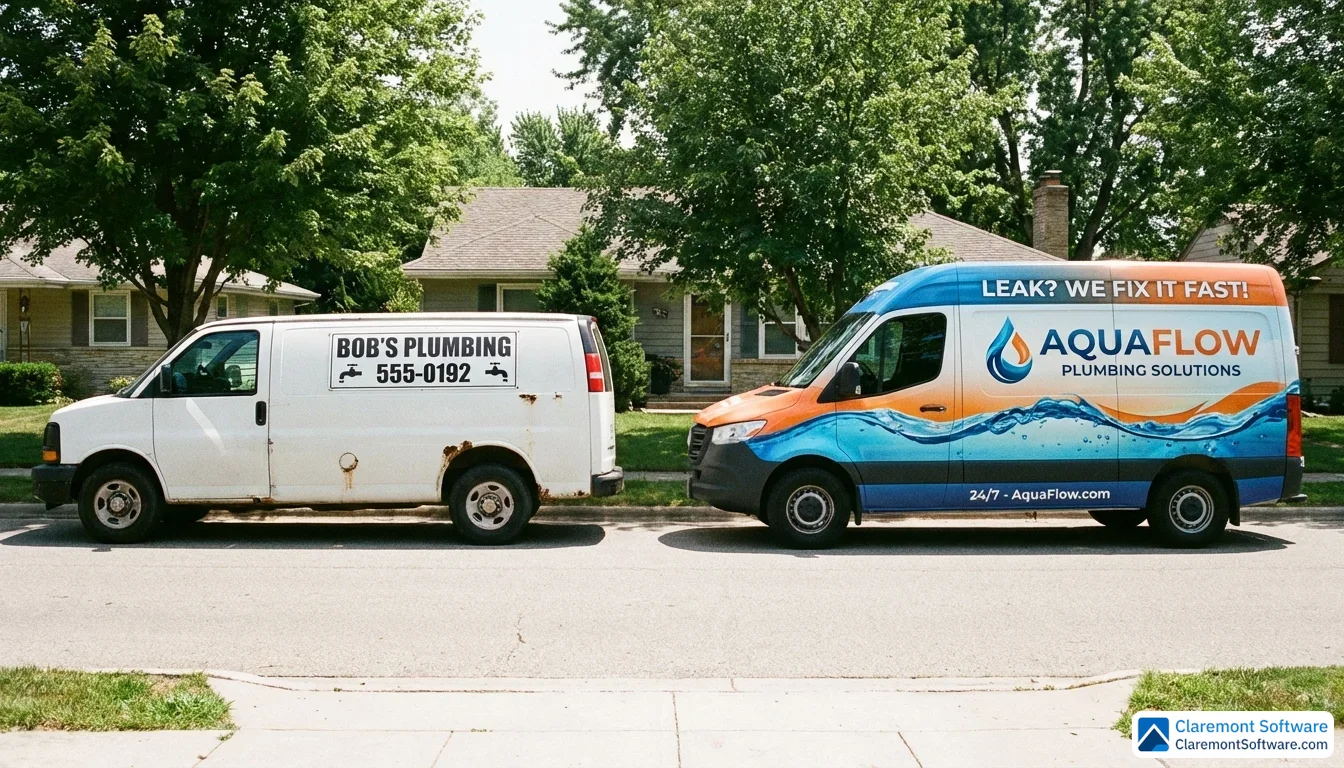
At first glance, a template website and a custom website can look nearly identical. Both can have clean layouts, professional photography, and a prominent phone number at the top of the page. But the similarities are mostly skin-deep — underneath the surface, these two approaches to building a plumbing website are fundamentally different in ways that directly affect your rankings, your lead volume, and your long-term growth.
Template websites are pre-designed frameworks built for general use across many industries. When you use one, you're essentially filling in the blanks — swapping in your logo, choosing your brand colors, uploading some photos, and dropping in your service descriptions. The structure, layout logic, and underlying code already exist. It's fast, it's affordable, and it gets you online quickly. But here's the catch: that template wasn't built for a plumbing business. It was built for everyone, which means it was built for no one in particular.
That distinction matters more than most business owners realize. Templates typically carry bloated code — unused scripts, redundant styling, and features designed for industries that have nothing to do with plumbing. All of that extra weight slows your site down, and in a world where 53% of mobile users abandon a site that takes longer than three seconds to load, page speed isn't a technical nicety. It's a lead generation issue.
Custom websites, by contrast, are built from the ground up with your specific business in mind. Every page, every button, every line of code exists for a reason — to serve your customers, reflect your brand, and move visitors toward picking up the phone or booking a job. The architecture is cleaner, the performance is stronger, and the flexibility to grow is built in from day one.
Think of it this way: a template is a prefabricated house — functional, livable, and ready fast. A custom website is a home built to your exact specifications, on your lot, for the way you actually live. Both put a roof over your head. Only one was designed with you in mind.
The True Cost Breakdown: Templates, Freelancers, and Custom Builds
Let's be direct: the price you see advertised for a website is rarely the full price you'll pay. Understanding what you're actually buying — and what it will cost you over time — requires breaking the market down into three distinct tiers.
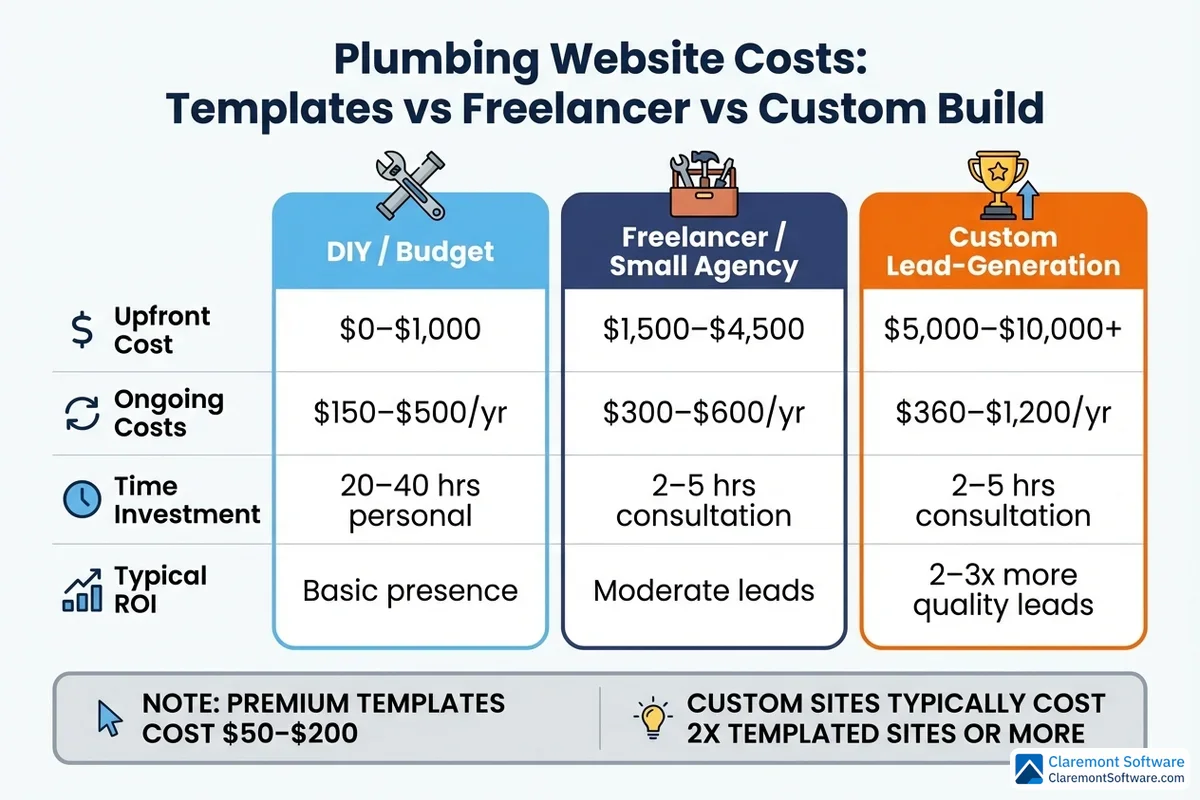
Tier 1: DIY/Budget ($0–$1,000)
This is the drag-and-drop route. You sign up for a website builder, choose a free or premium plumbing template (typically $50–$200 for a one-time purchase), and build it yourself. The platform handles hosting, and you handle everything else.
The upfront cost is low. The time cost is not. Most plumbing business owners spend 20–40 hours setting up a DIY website — time that could be spent on jobs, estimates, or managing your crew. And that's before you factor in the learning curve of writing your own copy, sourcing photos, and figuring out why your contact form isn't working.
Annual platform fees typically run $150–$500 per year, and that's before any premium add-ons for booking tools, SEO plugins, or additional storage.
Tier 2: Freelancer or Small Agency ($1,500–$4,500)
At this level, you're hiring a professional to do the heavy lifting. A freelancer or boutique agency will typically use a premium template or semi-custom design, write basic copy, set up your service pages, and handle foundational SEO. You get a polished result without the DIY headache.
This is a solid middle ground for plumbing businesses that need a credible online presence but aren't yet ready to invest in a fully custom build. The quality gap between Tier 1 and Tier 2 is significant — both in how the site looks and how it performs.
Tier 3: Custom Lead-Generation Website ($5,000–$10,000+)
This is a purpose-built growth asset. A fully custom plumbing website at this tier includes original design, professional copywriting, advanced on-page SEO, structured data markup, and integrations with scheduling or dispatch software. Every element is engineered to convert visitors into booked jobs.
Yes, a custom site typically costs 2x the price of a templated build upfront. But that comparison only holds if you ignore what happens next. A template site that generates 50% fewer leads than a custom site isn't saving you money — it's costing you revenue every single month it's live.
The hidden cost most plumbing business owners never calculate is the opportunity cost of an underperforming website: the calls that went to a competitor because your site loaded too slowly, the leads lost because your contact form was buried, the jobs never booked because a homeowner couldn't find your service area page. Those losses don't show up on an invoice — but they're very real.
Total Cost of Ownership: The 1-Year, 3-Year, and 5-Year View
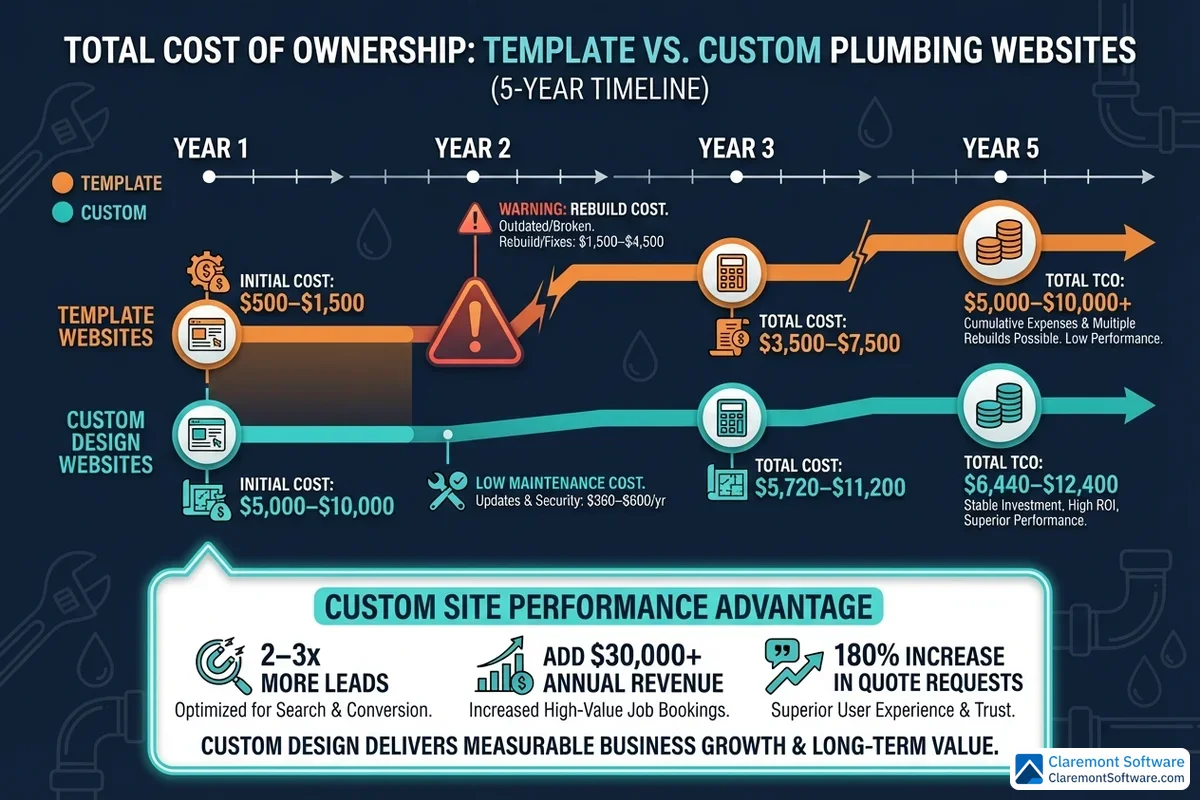
Most plumbing business owners make their website decision based on one number: the upfront cost. That's understandable — it's the most visible number. But it's also the least important one. The figure that actually determines whether your website was a smart investment or an expensive mistake is the total cost of ownership over three to five years.
And that calculation looks very different depending on which path you choose.
The Template Trap: Paying Twice
Here's a pattern that plays out constantly in the trades: a plumbing business launches with a budget template, gets online quickly, and moves on. A year or two later, the business has grown — more service areas, more technicians, more need for scheduling integrations and dedicated landing pages — and the template simply can't keep up. The site gets rebuilt from scratch.
That means paying for a website twice. The "affordable" option ends up costing more in total than a custom build would have from the start.
Many trades businesses outgrow their template websites within one to two years. When you factor in the cost of a second build, the savings from going the template route largely disappear.
The Revenue Side of the Equation
The more important number isn't what your website costs — it's what a poorly performing website loses you.
Consider this: if your average plumbing job is worth $500, and a custom website brings in just five additional leads per month compared to your current template site, that's $30,000 or more in additional annual revenue. Measured against a $5,000–$10,000 custom build investment, the ROI becomes obvious within the first year.
A template site that costs $500 upfront but generates significantly fewer leads than a well-built custom site isn't a bargain. It's a slow, invisible drain on your revenue — one that never shows up on an invoice but compounds every single month.
The Right Tool for the Right Stage
Templates help you start. Custom websites help you scale. Neither statement is a criticism — they're just accurate descriptions of what each option is built to do. The critical question is whether your current website matches where your business actually is right now, and where you need it to be in three years.
Local SEO and Google Rankings: Where Templates Fall Short
When homeowners search "emergency plumber near me" at 11pm on a Sunday, Google decides in milliseconds which websites deserve to appear at the top of the results. That decision is based on hundreds of technical and content signals — and the platform your website is built on has a direct impact on how many of those signals you can actually control.
This is where the gap between template websites and custom builds becomes most consequential.
The Technical SEO Problem with Templates
DIY website builders are notoriously difficult to rank on Google for competitive local plumbing keywords. The core reason is architectural: templates are built to serve every type of business, which means they carry a significant amount of code, features, and structural elements your plumbing business will never use. That bloat slows your site down, and page speed is a confirmed Google ranking factor.
Beyond speed, most template platforms restrict your access to the technical elements that matter most for local SEO: custom schema markup, canonical tags, structured heading hierarchies, and granular control over meta descriptions. You're working within guardrails that were designed for convenience, not search performance.
Custom websites are built clean from the start — every line of code serves a purpose, and every technical SEO element is implemented correctly rather than approximated through a plugin or workaround.
Service Pages Are Your Local SEO Engine
One of the most important — and most overlooked — drivers of local plumbing rankings is the number of dedicated, well-optimized service pages on your website. A page specifically targeting "water heater repair in [city]" will consistently outperform a generic services page that mentions water heaters in passing.
Drain cleaning, emergency plumbing, sewer line repair, fixture installation, gas line services — each of these deserves its own page, optimized for the specific keywords homeowners use when they need that service. Template platforms often make creating and managing large numbers of service pages cumbersome, limiting the depth of your local keyword coverage.
Schema Markup and the Map Pack
Appearing in Google's local map pack — the three business listings that appear above organic results for local searches — is arguably the highest-value real estate in local plumbing SEO. Getting there requires a well-optimized Google Business Profile, consistent local citations, and a website that reinforces your local authority through proper structured data.
Schema markup for local businesses, service types, and customer reviews signals to Google exactly what your business does and where you do it. On a custom-built site, implementing this markup is straightforward. On many template platforms, it ranges from limited to impossible without technical workarounds that often create more problems than they solve.
For plumbing businesses investing in local SEO, the platform you build on isn't a minor detail — it's the foundation everything else is built on.
Lead Generation and Conversion: The Performance Gap That Matters Most
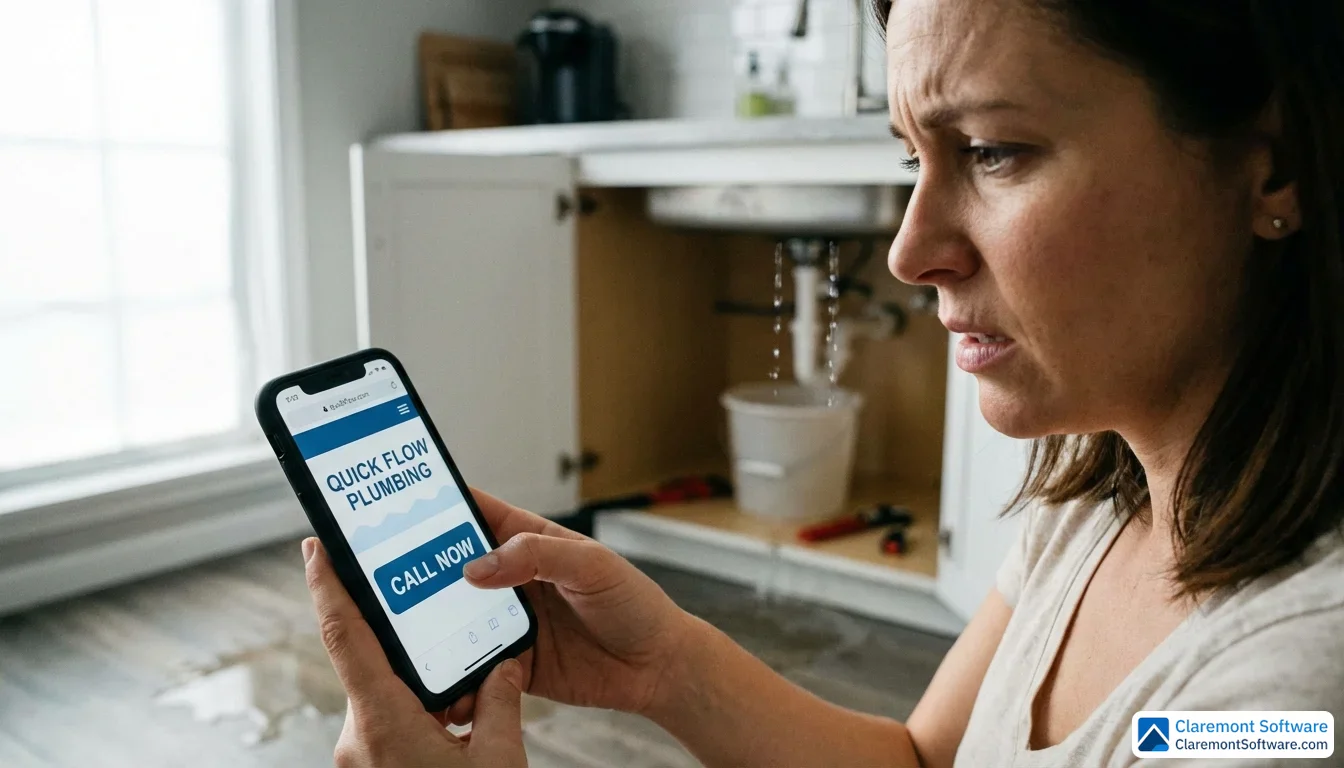
Here's the hard truth about plumbing website performance: a beautifully designed site that doesn't convert visitors into phone calls is just an expensive brochure. And when it comes to conversion, the gap between template websites and custom builds isn't marginal — it's the difference between a site that generates consistent, qualified leads and one that technically exists on the internet.
The Conversion Advantage of Custom Design
Custom websites generate two to three times more quality leads than template websites for trades businesses. That's not a small edge — it's a fundamental performance difference rooted in how each type of site is built. With a custom site, every element on every page exists for a reason: to move a stressed homeowner from "I found this website" to "I'm calling right now." Templates, by contrast, are designed to look acceptable for any business, which means they're optimized for no business in particular.
The conversion features that matter most for plumbing websites include:
- Prominent click-to-call buttons visible above the fold on every page, especially on mobile
- Service area maps that immediately confirm you serve the visitor's neighborhood
- Review and testimonial widgets pulling live ratings from Google to build instant credibility
- Before/after project galleries that demonstrate real results from real jobs
- Emergency service CTAs that stand out visually and create urgency for high-intent visitors
These aren't decorative features. Each one directly addresses a question a homeowner is asking in the moment they land on your site.
Mobile Speed Is Non-Negotiable
When a pipe bursts at midnight, nobody is sitting at a desktop computer. Homeowners in plumbing emergencies are searching on their phones, and they're not patient. Fifty-three percent of mobile users will abandon a site that takes longer than three seconds to load — and that decision happens before they've read a single word about your business.
Template platforms, with their bloated code and generalized architecture, frequently struggle to meet this threshold. A custom-built site, optimized specifically for mobile performance and Core Web Vitals, keeps those visitors on the page long enough to become leads.
Advanced Lead Capture Requires Flexibility
Beyond basic contact forms, high-performing plumbing websites use layered lead capture systems that templates simply can't accommodate without significant workarounds. Multi-step forms that qualify leads before submission, AI-powered chatbots that handle after-hours inquiries, callback request systems, and direct integrations with field service management software — these tools require the kind of technical flexibility that only a custom build provides.
Trust Signals Convert — When They're Designed to
In plumbing, trust is everything. Homeowners are letting a stranger into their home, often during a stressful situation. License numbers, insurance badges, years in business, real photos of your actual team, and video testimonials from satisfied customers all move the needle on conversion — but only when they're presented in a layout designed to showcase them prominently. Template designs bury these elements or treat them as afterthoughts. Custom layouts are built around them.
Platform Comparison: Popular Website Builders vs Custom Development for Plumbers
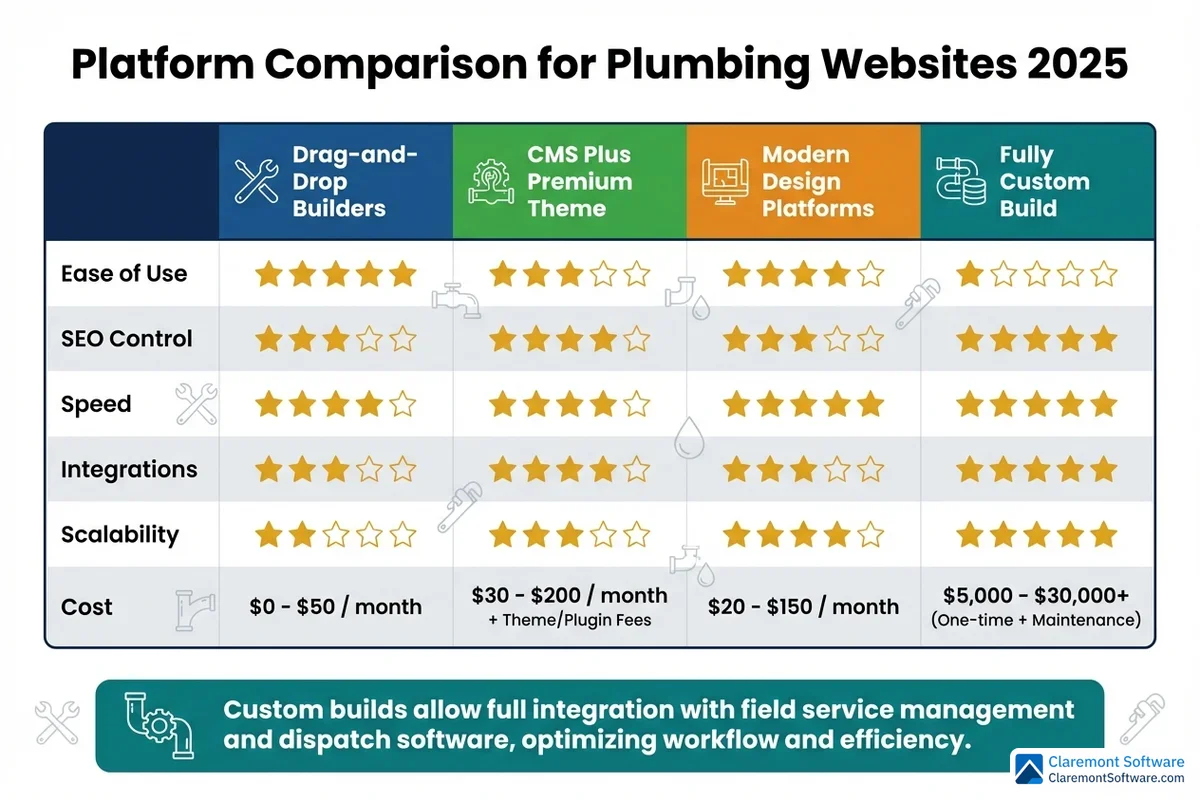
Not all website platforms are created equal — and for plumbing businesses, the platform decision goes far beyond personal preference or what's easiest to set up on a Saturday afternoon. The platform you build on determines your SEO ceiling, your integration options, your page speed potential, and ultimately how much control you have over your own digital growth.
Here's how the main categories stack up against each other.
Drag-and-Drop Website Builders
These platforms are designed for speed and simplicity. You can have a plumbing website live within days, no developer required. The tradeoff is significant, though. The code these platforms generate tends to be bloated and difficult for search engines to parse efficiently. Technical SEO controls — the kind that matter for competitive local plumbing keywords — are limited or locked behind the platform's own guardrails. You're also tied to their ecosystem, which means if you outgrow the platform, migrating your site is a painful, often expensive process.
For a brand-new plumbing business that simply needs an online presence while building its reputation, this category can serve as a reasonable starting point. But if you're investing in SEO or paid advertising, the platform's limitations will cap your returns.
Open-Source CMS Platforms with Premium Themes
This category offers a meaningful step up in flexibility. You gain access to thousands of plumbing-specific and trades-focused themes, a robust plugin ecosystem for adding functionality, and far greater control over technical SEO elements. The code quality is generally cleaner than pure drag-and-drop builders, and the platform scales reasonably well as your business grows.
The catch is that "more flexible" also means "more to manage." Security updates, plugin compatibility, and performance optimization require ongoing attention — either your own time or a developer's. A premium theme is also still a template at its core, meaning you're working within someone else's structural decisions rather than building around your specific conversion goals.
Modern Visual Design Platforms
Newer design-focused platforms produce significantly cleaner code output than traditional builders and offer more genuine design freedom. They're a legitimate middle ground for plumbing businesses that want a more distinctive look without the full investment of custom development. Page speed scores tend to be stronger, and SEO flexibility is meaningfully better.
That said, integration capabilities with field service management tools — the scheduling, dispatch, and invoicing software that growing plumbing businesses depend on — remain limited compared to a fully custom build.
The Criteria That Actually Matter
When evaluating any platform, measure it against these five factors:
- SEO flexibility — Can you control schema markup, meta data, and site architecture fully?
- Core Web Vitals performance — Does the platform produce fast, mobile-optimized pages by default?
- Software integrations — Can it connect with your dispatch, scheduling, and CRM tools?
- Multi-location scalability — Can it support separate service area pages and location-specific content as you grow?
- Maintenance requirements — What does ongoing upkeep actually cost in time and money?
The platform you choose today will either support or constrain your business three years from now. Make that decision with your growth trajectory in mind, not just this week's budget.
The Hybrid Approach: Starting Smart and Scaling Up
The template-versus-custom debate doesn't have to be an all-or-nothing decision — and for many plumbing businesses, it shouldn't be. A hybrid approach, where you launch on a well-chosen premium template and progressively layer in custom functionality as your revenue grows, is often the smartest path forward for businesses in their first one to three years.
Think of it as building your website the same way you'd build your business: start lean, prove the model, then invest in the infrastructure that supports real scale.
Start with the Right Foundation
Not all templates are created equal. A well-coded premium template — one built on a clean, lightweight framework with solid mobile performance — gives you a legitimate starting point without the bloat that drags down cheaper, generic options. Pair that foundation with professional copywriting and high-quality photography, and you've already closed most of the gap between a template site and a custom one. The design might be borrowed, but the words and images that actually convert visitors into callers are entirely yours.
This is where many plumbing businesses underinvest. They spend their entire budget on the website build and leave nothing for the content that makes it work.
Know When It's Time to Upgrade
The hybrid approach works until it doesn't — and there are clear signals that tell you when you've outgrown it:
- You're running paid ads but your cost-per-lead is climbing and your site isn't converting the traffic
- You need integrations with scheduling, dispatch, or payment software that your template platform can't support
- You're expanding into multiple service areas and need location-specific pages that your current setup makes cumbersome
- Your page speed scores are hurting your Google rankings despite your best optimization efforts
When any of these triggers appear, the cost of staying on a template starts to exceed the cost of upgrading.
Allocate Your Budget Where It Counts
Regardless of whether you're working with a template or a custom build, the same budget allocation principle applies: put roughly 60% of your website investment into content and copywriting, 25% into design customization, and 15% into technical SEO setup. This ratio reflects where the actual conversion value lives.
Professional copywriters who understand the home services space know how to speak directly to a homeowner who's panicking about a burst pipe at 11pm — with empathy, authority, and a clear path to action. That skill, combined with strategic keyword integration, often moves the needle more than any design decision. For many plumbing businesses, investing in great content on a solid template will outperform a beautifully designed custom site with generic, forgettable copy.
The hybrid approach isn't a compromise. Done right, it's a deliberate growth strategy.
Essential Features Every Plumbing Website Needs (Template or Custom)
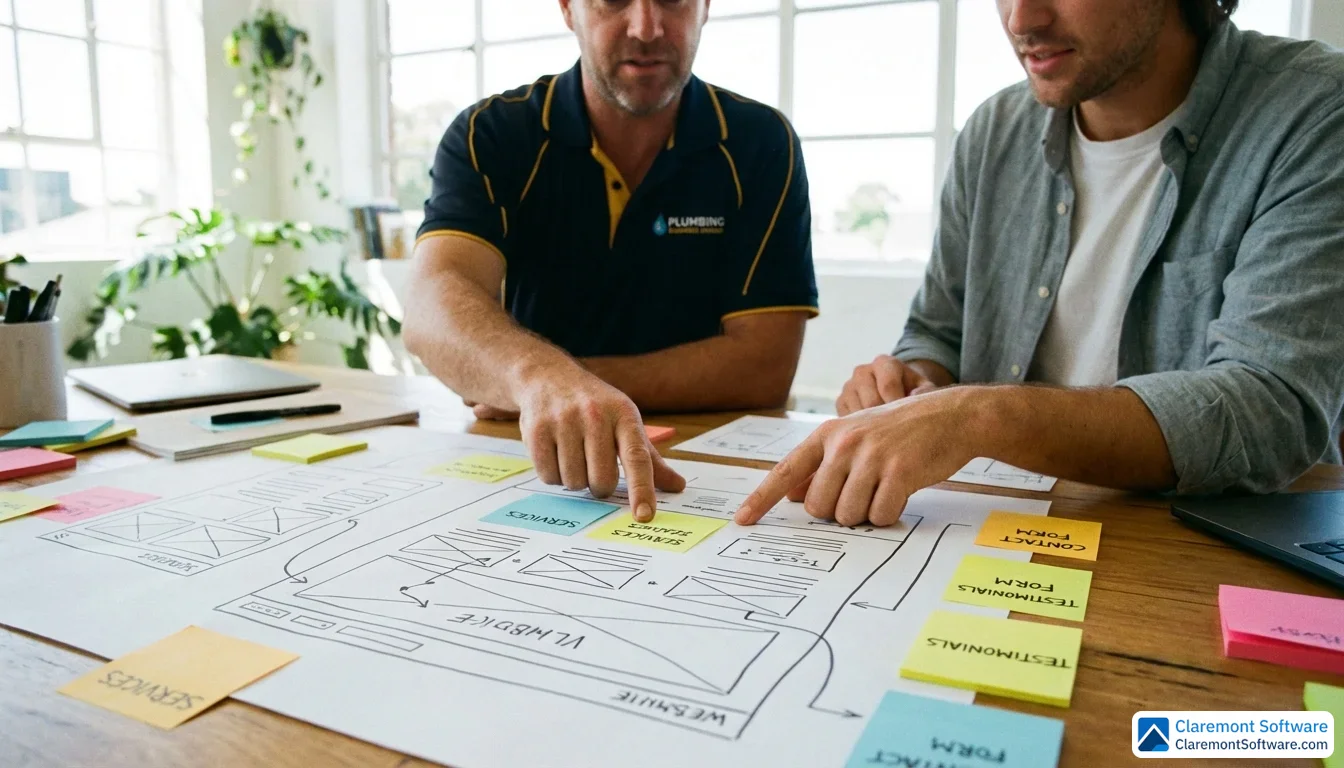
Whether you're launching on a premium template or investing in a fully custom build, certain website features aren't optional — they're the baseline expectation for any plumbing business that wants to turn website visitors into paying customers. The platform debate matters, but it matters a lot less if the fundamentals aren't in place.
The Non-Negotiables
Every plumbing website, regardless of how it was built, needs these core elements working properly:
- Mobile-responsive design — The majority of emergency plumbing searches happen on smartphones. If your site doesn't display and function flawlessly on a small screen, you're losing calls before they start.
- Click-to-call functionality — A phone number that's tappable on mobile, prominently placed above the fold, and visible on every page. Friction kills conversions, especially when someone's dealing with a flooded basement.
- Online booking or scheduling — Homeowners increasingly expect to request service without picking up the phone. Even a basic contact form with clear response time expectations is better than nothing.
- Service area pages with embedded maps — These pages tell both Google and your potential customers exactly where you work, which is foundational for local search visibility.
- Fast page load times — With 53% of mobile users abandoning sites that take longer than three seconds to load, speed isn't a nice-to-have. It's a direct factor in how many leads you capture.
Trust and Credibility Elements
Plumbing is a high-trust service category. Homeowners are letting a stranger into their house to work on critical infrastructure. Your website needs to earn that trust quickly and visibly:
- License and insurance verification badges displayed prominently
- Real photos of your team — not stock images of generic workers in hard hats
- Customer review widgets pulling live ratings from Google
- Before-and-after project galleries that demonstrate real work quality
- Video testimonials, which consistently outperform written reviews for building confidence
Advanced Features That Drive Growth
Some functionality is difficult or impossible to implement well on standard templates. If your business is at the stage where these matter, they're a strong signal that a custom build is worth the investment:
- Integration with field service management software like dispatch and scheduling platforms
- Real-time availability calendars that reduce back-and-forth communication
- Customer portals for viewing invoices and service history
- AI-powered chatbots that capture after-hours leads when your phones aren't staffed
Accessibility and Security
Two areas that plumbing businesses consistently overlook: ADA and WCAG accessibility compliance ensures your site is usable by visitors with disabilities — and it also signals quality to search engines. Custom builds make it significantly easier to implement accessibility standards correctly from the start.
On the security side, SSL certificates, properly secured contact forms, and PCI compliance for any online payment processing are non-negotiable. These aren't technical luxuries — they're the minimum standard for any business handling customer data responsibly.
How to Choose a Web Design Partner for Your Plumbing Business
Choosing the right web design partner is just as important as choosing between a template and a custom build. The wrong agency can take your money, deliver a mediocre site, and leave you locked into a platform you can't control — while the right partner becomes a genuine growth asset for your business.
Prioritize Trades-Specific Experience
Not all web designers understand the plumbing industry, and that gap shows up in the results. Look for agencies or freelancers who have built websites specifically for trades or home services businesses. They'll already understand how emergency search behavior differs from standard e-commerce, what local SEO signals matter most for service area businesses, and which conversion elements actually move the needle for homeowners who need a plumber fast. A designer who's built beautiful websites for restaurants and retail brands isn't automatically equipped to build one that generates plumbing leads.
Questions Worth Asking Before You Sign Anything
Go into any discovery call prepared with these:
- Can you show me plumbing or home services websites you've built, along with results they've achieved?
- Do you handle copywriting and SEO as part of the project, or is that separate?
- How do you approach mobile optimization and Core Web Vitals performance?
- Will I own the website and domain outright when the project is complete?
That last question matters more than most business owners realize. Some agencies build your site on proprietary platforms that you can't take with you if you leave — effectively holding your online presence hostage.
Red Flags to Walk Away From
- No portfolio of trades or service-based businesses
- No mention of SEO, lead generation, or conversion strategy during the sales conversation
- Pricing that seems dramatically lower than the market without a clear explanation
- Vague ownership terms or pressure to stay on their hosting platform indefinitely
What to Expect from a Legitimate Partner
Claremont Software specializes in high-performance websites for service businesses, combining custom design with conversion optimization and local SEO expertise built specifically for companies that depend on their website to generate calls and bookings.
Whoever you work with, insist on a clear written scope of work, a realistic timeline — custom sites typically take four to eight weeks, while template-based builds run one to two weeks — and transparent terms for ongoing support and maintenance before any agreement is signed.
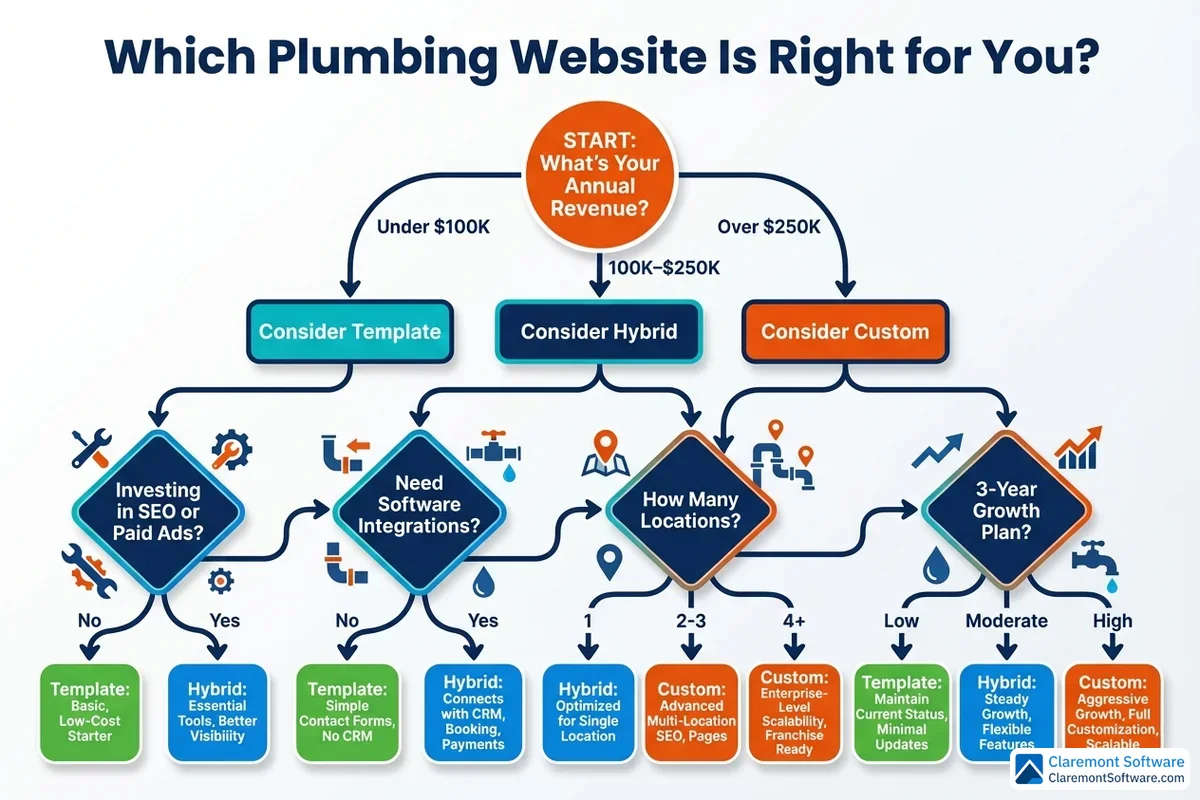
Decision Framework: Which Option Is Right for Your Plumbing Business Right Now?
All the information in this guide points toward one conclusion: there's no single right answer for every plumbing business. The right choice depends entirely on where your business stands today and where you're committed to taking it. Here's a straightforward framework to cut through the noise.
Choose a Template If:
You're a new plumbing business that needs to establish an online presence quickly and affordably. If you're a solo operator or running a small crew, haven't yet invested in SEO or paid advertising, and your primary goal is simply to be findable online, a well-built template gets you there without overextending your budget. At this stage, the money you save is better spent on tools, equipment, or your first marketing campaigns.
Choose Custom If:
Your plumbing company is generating $250,000 or more in annual revenue and your website is a meaningful part of how you win new business. If you're running paid ads and your site isn't converting that traffic into calls, you're burning money. If you need integrations with dispatch or scheduling software, serve multiple service areas, or your current template site simply isn't pulling its weight — these are clear signals that a custom build will pay for itself. Custom websites generate two to three times more quality leads than template sites for trades businesses, and at an established revenue level, that difference compounds quickly.
Choose the Hybrid Approach If:
You're in a growth phase — past the startup stage but not yet ready to commit to a full custom investment. Start with a quality template, pair it with professional copywriting and real photography, and build toward custom functionality as revenue grows.
Whatever path you choose, hold onto this principle: a website that works beats a website that just looks nice. Fast, clear, and easy to use on a phone will always outperform beautiful and slow.
Most importantly, make this decision based on where you want your business to be in three years — not just where it is today. Your website isn't an expense. It's infrastructure.
Conclusion
The template-versus-custom debate ultimately comes down to one question: what does your website need to do for your business right now, and what will it need to do three years from now?
Templates are a legitimate, smart starting point for new and smaller plumbing businesses. Custom websites deliver measurably better results — more leads, stronger local rankings, and the integrations that growing operations depend on — for established companies ready to treat their website as a revenue-generating asset rather than a line-item expense. The hybrid approach bridges the gap intelligently for businesses moving between those two stages.
Whichever path fits your situation, the fundamentals never change: prioritize mobile speed, make it effortless for homeowners to call or book, build trust visibly, and get your local SEO foundations right. Those factors will always matter more than any design trend.
Your website is your hardest-working employee — available at midnight, never calls in sick, and either winning jobs or losing them while you sleep. Make sure it's built to perform.
If you're ready to build a plumbing website that actually generates leads, Claremont Software can help you get there.
Related Reading
- Best Plumber Websites 2026: Examples That Generate Calls
- How Much Does a Plumber Website Cost in 2026?
- Why Most Plumber Websites Don't Generate Calls
Frequently Asked Questions
How much does a custom plumbing website cost compared to a template?
A custom plumbing website typically costs 2x more upfront than a template-based site. Template websites range from $0–$1,000 for DIY setups (plus 20–40 hours of your time) or $1,500–$4,500 through a freelancer using premium templates. Fully custom, lead-generation-focused plumbing websites run $5,000–$10,000+. Templates also carry ongoing platform fees of $150–$500 per year, while custom sites average $30–$100/month in maintenance. However, when you factor in that custom sites can generate 2–3x more leads, the long-term ROI often makes the higher upfront investment the smarter financial decision.
Can I rank on Google with a template plumbing website?
Yes, but it's significantly harder. DIY website builders are notoriously difficult to rank on Google for competitive local plumbing keywords. Template sites often suffer from bloated code, limited schema markup options, and restricted technical SEO controls — all of which hurt your rankings. Custom websites are built with clean code, proper heading hierarchies, optimized meta descriptions, and structured data markup, giving them a clear SEO advantage. That said, a well-configured premium template with strong content and local SEO fundamentals can still rank — it just requires more effort to overcome the platform's built-in limitations.
How long does it take to build a custom plumbing website vs using a template?
Template websites can be launched in as little as a few days to two weeks, depending on how much customization and content work is involved. Custom plumbing websites typically take 4–8 weeks from kickoff to launch, accounting for design, development, copywriting, SEO setup, and revisions. While the longer timeline can feel like a drawback, the result is a purpose-built site designed specifically to generate leads for your business. If speed to market is critical — for example, you're a brand-new business — a template can get you online fast while you plan a future custom build.
What features should every plumbing website have?
Every plumbing website — template or custom — should include: mobile-responsive design, prominent click-to-call buttons, online booking or scheduling, service area pages with embedded maps, and fast page load times (under 3 seconds, since 53% of mobile users abandon slower sites). Trust-building elements are equally critical: license and insurance badges, real team photos, Google review widgets, and before/after project galleries. Advanced features like integration with field service management software, real-time availability calendars, AI chatbots for after-hours lead capture, and customer portals typically require custom development but can significantly boost conversions for established plumbing businesses.
Is it worth paying for a custom website if I'm a small plumbing business?
It depends on your stage and goals. If you're a solo operator or brand-new plumbing business with a tight budget, a well-set-up template site is a perfectly legitimate starting point. However, if you're already investing in SEO or paid advertising, a custom site pays for itself quickly. Consider this: if your average job is worth $500 and a custom site brings in just 5 extra leads per month, that's $30,000 in additional annual revenue against a $5,000–$10,000 investment. For small businesses planning to grow, a custom site is less of an expense and more of a revenue-generating asset.
Can I start with a template and switch to a custom plumbing website later?
Absolutely — and for many plumbing businesses, this is the smartest path. Starting with a quality premium template lets you get online quickly and affordably, establish your brand, and start generating early leads. As your revenue grows, you can invest in a fully custom site built around your specific conversion goals, service areas, and software integrations. The key is to treat the template phase as a foundation, not a permanent solution. Invest in professional copywriting and photography from day one — that content will carry over and continue to serve you when you make the upgrade.
How do I know when it's time to upgrade from a template to a custom plumbing website?
There are several clear signals it's time to upgrade. You're running paid ads but your site isn't converting visitors into calls. You need integrations with scheduling, dispatch, or invoicing software that your template platform can't support. You're expanding into multiple service areas and need scalable, location-specific pages. Your site is loading slowly and hurting your Google rankings. Or your business has crossed the $250,000+ annual revenue mark and your website simply isn't keeping pace with your growth. If any of these apply, the cost of staying on a template is likely higher than the cost of upgrading.
What's the best website platform for a plumbing business?
The best platform depends on your budget, technical comfort level, and growth plans. Open-source CMS platforms with premium themes offer the best balance of flexibility, SEO control, and scalability for most plumbing businesses — and they support thousands of plumbing-specific templates. Drag-and-drop builders are the fastest to launch but come with SEO and customization limitations that can hold back growth. Modern visual design platforms offer cleaner code and more design freedom but still fall short of a fully custom build for performance and software integrations. Whatever platform you choose, prioritize SEO flexibility, Core Web Vitals performance, and compatibility with plumbing field service tools — and always think about your 3-year plan, not just today's budget.