
Plumbing is one of the few trades where demand never dries up — every home, office, and commercial building needs reliable water and drainage systems, making it one of the most recession-resistant businesses you can start.
While other industries rise and fall with economic cycles, plumbers get called whether the market is booming or contracting. Pipes burst in recessions. Water heaters fail during downturns. Drains clog regardless of what the stock market is doing. That built-in, year-round demand is exactly why so many skilled tradespeople — and sharp entrepreneurs — are turning to plumbing as their path to financial independence.
But knowing how to fix pipes and knowing how to run a profitable business are two very different skill sets. That gap is where most new plumbing businesses struggle.
This guide closes that gap. Whether you're a licensed plumber ready to go solo or an entrepreneur looking to enter the trade, you'll find everything here — from licensing requirements and realistic startup costs to landing your first 50 customers and scaling beyond a one-person operation. Let's build something that lasts.
Licensing, Certifications, and Legal Requirements
Before you book your first job or wrap your first truck, you need to make sure your business is legally authorized to operate. Skipping this step isn't just risky — in most states, performing plumbing work without the proper licensing is illegal and can result in fines, voided insurance claims, and serious liability exposure.
What Licenses Do You Actually Need?
Licensing requirements for plumbing businesses vary significantly by state, county, and sometimes even municipality, so there's no single universal answer. That said, most jurisdictions require the person performing plumbing work — or the qualifying agent of the business — to hold either a journeyman plumber's license or a master plumber's license before legally offering services to the public.
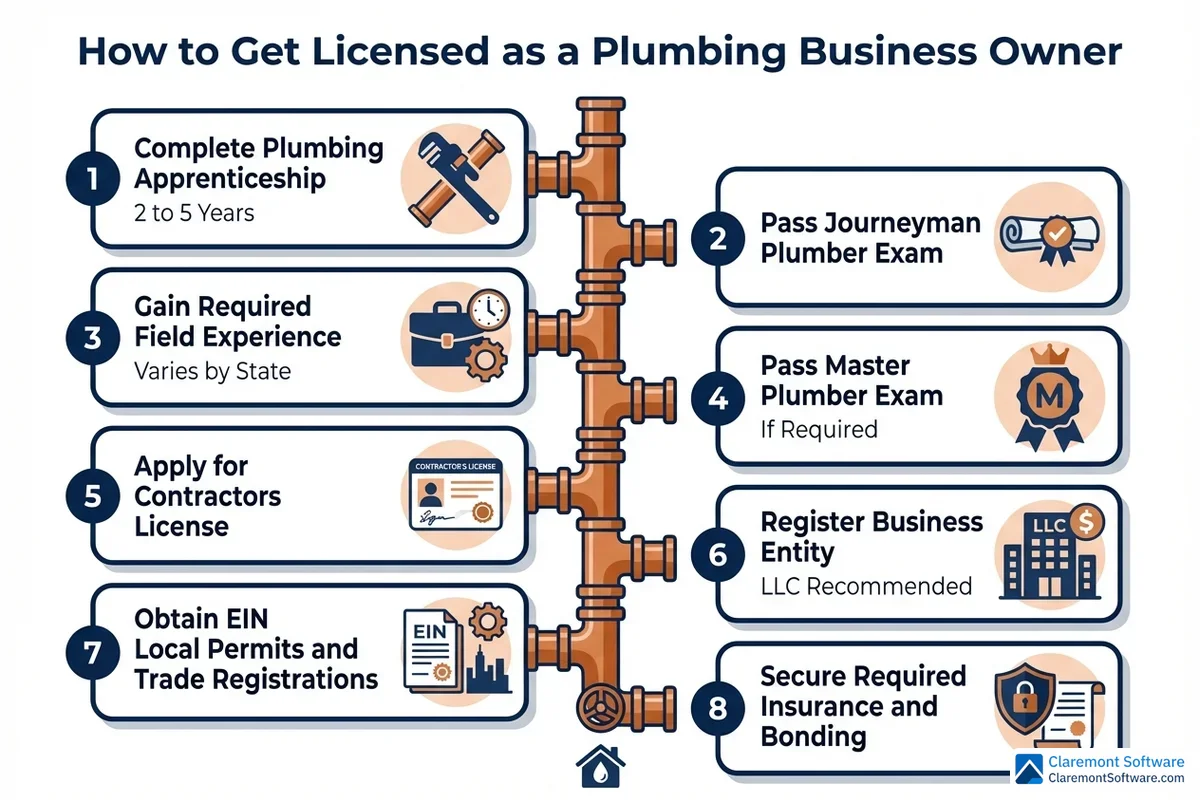
Here's how the typical licensing pathway works:
- Apprenticeship: Most states require aspiring plumbers to complete a formal apprenticeship program lasting two to five years, combining on-the-job training with classroom instruction. These programs are often administered through trade unions or vocational schools.
- Journeyman License: After completing your apprenticeship and accumulating the required hours, you can sit for the journeyman exam. A journeyman license allows you to perform plumbing work under supervision or independently, depending on your state.
- Master Plumber License: This is the highest credential level and is typically required to pull permits, run a plumbing business, or serve as the responsible licensee for a company. Most states require several years of journeyman experience before you're eligible to test for your master's license.
License fees and exam registrations are relatively affordable — ranging from under $100 to several hundred dollars depending on your location. However, some states have more complex requirements. California, for example, requires plumbing contractors to obtain a separate contractor's license through the state licensing board, which involves additional testing, experience verification, and bonding requirements.
Registering Your Business Entity
Once your licensing pathway is clear, you need to establish your business as a legal entity. An LLC (Limited Liability Company) is the recommended structure for most plumbing businesses because it separates your personal assets from your business liabilities — critical protection in a trade where property damage and injury claims are a real risk.
To get your business properly set up, you'll need to:
- Register your LLC with your state's Secretary of State office
- Obtain an Employer Identification Number (EIN) from the IRS — this is free and required for opening a business bank account, hiring employees, and filing taxes
- Apply for a local business license or operating permit from your city or county
- Pull any required trade permits for the specific types of plumbing work you plan to offer
One Important Exception Worth Knowing
Not every state requires the business owner to be a licensed plumber. Some states allow entrepreneurs without a plumbing background to legally own and operate a plumbing company, provided they hire licensed journeyman or master plumbers to perform the actual work. This opens the door for business-minded individuals to enter the trade without going through the full apprenticeship pathway — a topic we'll explore in more detail later in this guide.
The bottom line: Research your specific state and county requirements before you spend a dollar on equipment or marketing. Regulations vary dramatically, and getting this foundation right protects everything you build on top of it.
Choose Your Plumbing Niche and Business Model

Once your legal foundation is in place, the next strategic decision shapes everything from your equipment list to your marketing message: what kind of plumbing business do you actually want to run?
Residential vs. Commercial: Choosing Your Primary Market
Most plumbing businesses fall into one of two broad categories, and understanding the difference early saves you from costly missteps.
Residential plumbing serves homeowners and tenants — fixing leaks, replacing water heaters, clearing drains, and handling everything from bathroom remodels to whole-house repiping. It's the natural starting point for most new operators because the jobs are smaller, the sales cycle is short, and customers are easy to reach through local marketing.
Commercial plumbing serves businesses, property managers, and construction contractors. Projects are larger in scope and value, but they also demand specialized knowledge, heavy-duty equipment, and the ability to navigate complex building codes and multi-trade coordination. The upfront investment is higher, and landing commercial contracts typically requires an established reputation. Most successful commercial plumbing businesses started in residential work first.
Profitable Niches Worth Considering
Rather than positioning yourself as a generalist from day one, consider specializing in a high-demand niche. Specialization lets you command premium pricing, build a recognizable reputation faster, and reduce competition. Some of the most profitable plumbing niches in 2026 include:
- Drain cleaning — high-frequency, recurring service with strong upsell potential
- Slab leak detection and repair — specialized skill set that justifies premium rates
- Water heater installation and replacement — consistent demand driven by aging equipment
- Backflow testing and certification — often required annually by municipalities, creating predictable recurring revenue
- Water filtration and treatment systems — growing consumer interest in water quality drives strong margins
- Trenchless sewer repair — advanced technology that commands significantly higher job values than traditional excavation
- Green and eco-friendly plumbing — low-flow fixtures, greywater systems, and water-conservation upgrades
That last niche deserves special attention. Demand for sustainable plumbing solutions is accelerating, and some state and local governments offer incentives, rebates, or tax breaks for eco-friendly installations. Positioning your business around water conservation can differentiate you meaningfully in markets where every competitor is offering the same standard services.
Start from Scratch or Buy an Existing Business?
There's a third strategic decision that many guides overlook: should you build your plumbing business from the ground up, or acquire one that's already operating?
Starting from scratch keeps your initial investment low — as little as $13,000 for a solo operator — but requires time to build a customer base and reputation. Buying an established business gives you immediate cash flow, existing customers, trained staff, and a known brand. The tradeoff is capital: the median asking price for an established plumbing business is $732,500, with listings ranging from under $340,000 to well over $1.5 million depending on revenue, equipment, and market position.
For most first-time owners, starting from scratch is the more accessible path. But if you have access to financing and want to skip the slow early-growth phase, acquisition is worth exploring through business-for-sale marketplaces and local business brokers.
Write a Plumbing Business Plan That Attracts Funding
A business plan isn't just a document you create to impress a bank — it's the strategic blueprint that forces you to think through every dimension of your business before reality does it for you. For a new plumbing business, a well-constructed plan is the difference between reacting to problems and anticipating them.
The Eight Sections Every Plumbing Business Plan Needs
A complete plumbing business plan typically includes these eight components:
- Cover page — your business name, logo, contact information, and date
- Executive summary — a concise overview of your business concept, target market, and financial highlights
- Team bio — your background, licensing credentials, and relevant experience that establishes credibility
- Business overview — your services, service area, business model, and what sets you apart from competitors
- Market analysis — a data-driven look at your local opportunity
- Risk analysis — honest identification of potential challenges and your mitigation strategies
- Marketing strategy — how you'll acquire customers and what channels you'll invest in
- Financial projections — revenue forecasts, startup costs, and break-even timeline
Each section builds on the last. Lenders and investors read them in sequence, and a weak market analysis will undermine even the most polished financial projections.
What Your Market Analysis Should Actually Include
Your market analysis needs to go beyond "plumbing is always in demand." Dig into specifics: the demographics of your service area, the density of competing plumbing businesses, average household income levels, and — critically — the age of the local housing stock. Older homes generate significantly more plumbing work than new construction, from corroded pipes and failing water heaters to outdated fixtures and chronic drain issues. If your target area has a high concentration of homes built before 1980, that's a meaningful competitive advantage worth quantifying.
Realistic Financial Projections
Be honest about your revenue ramp-up timeline. Most new plumbing businesses take six to twelve months to reach consistent monthly revenue, and projections that show immediate profitability will raise red flags with experienced lenders.
Build your numbers around realistic pricing benchmarks: plumbers typically charge $45 to $150 per hour, with average jobs running $125 to $450 in total. Many operators also set a minimum service fee of $50 to $200 to ensure every call is worth dispatching. Model your projections conservatively in months one through three, then show gradual growth as your marketing gains traction and word-of-mouth builds.
A well-crafted business plan serves two purposes simultaneously: it's your personal roadmap for the first year, and it's the document that unlocks SBA loans, bank financing, and other funding sources. Treat it as both.
Startup Costs: How Much Does It Really Cost?
Before you commit to launching full-time, you need a clear-eyed picture of what it actually costs to get off the ground — and what it costs to stay running once you do.
What You'll Spend to Launch
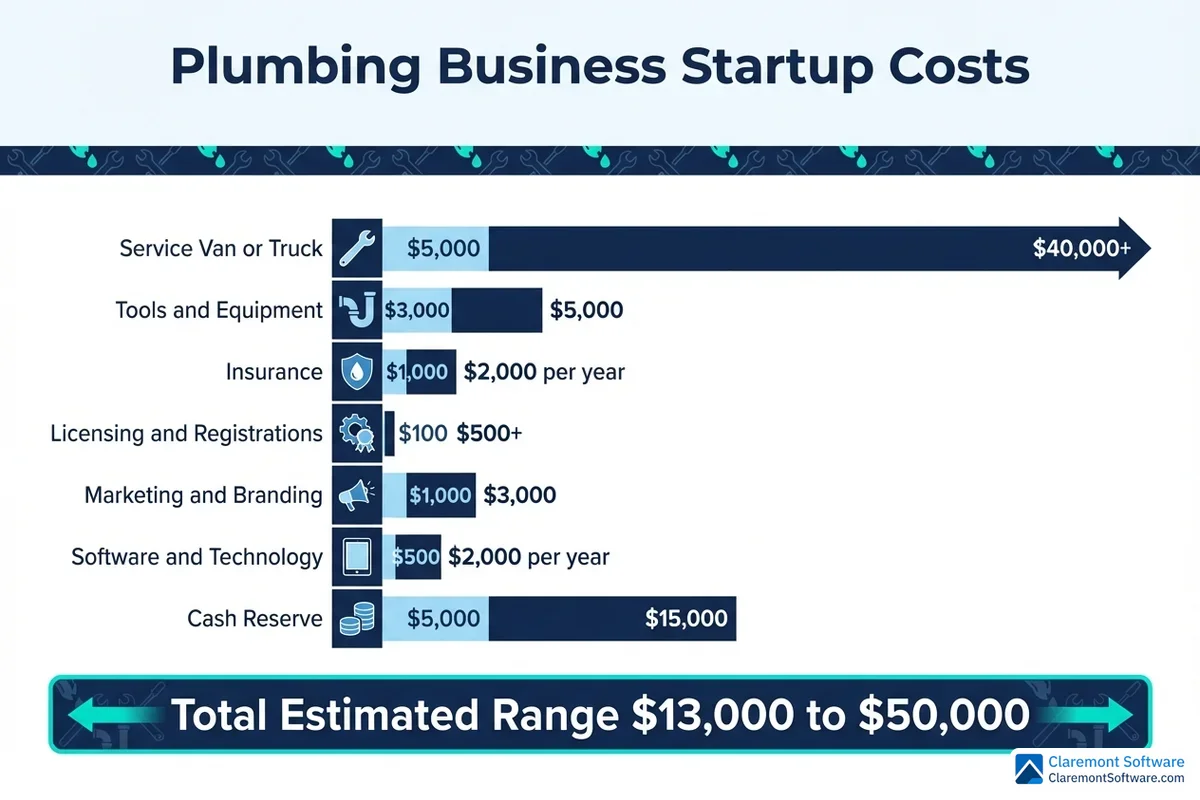
Total startup costs for a new plumbing business typically fall between $13,000 and $50,000, depending on whether you're buying used or new, working solo or hiring immediately, and operating from home or leasing a space. Here's where that money goes:
- Vehicle: Your service van or truck is your single largest expense. A reliable used vehicle runs $5,000 to $15,000, while a new work truck can easily exceed $40,000. Most solo operators starting lean buy used and upgrade once revenue supports it.
- Tools and equipment: Budget $3,000 to $5,000 for a solid starter kit — hand tools, power tools, and basic diagnostic equipment. More on the specifics in the tools section below.
- Insurance: Expect to pay at least $1,000 to $2,000 annually for general liability coverage at minimum. This is non-negotiable.
- Licensing and registration: Fees vary widely by state but typically range from under $100 to a few hundred dollars for your license, business registration, and any required permits.
- Website, branding, and initial marketing: A professional website and basic brand identity (logo, vehicle wrap) can run $500 to $2,500 depending on whether you DIY or hire out.
The Cash Flow Runway Most New Owners Underestimate
Startup costs are only half the equation. Before you leave your current job, you should have three to six months of both living expenses and operating costs saved or secured. Plumbing work can be seasonal, customers take time to find you, and invoices don't always get paid on the day the job is done. That runway is what keeps you from making desperate decisions in month two.
Ongoing monthly costs add up quickly: fuel, vehicle maintenance, marketing spend, software subscriptions, phone and internet, accounting services, and material restocking. Build these into your monthly budget from day one rather than treating them as surprises.
Why a CPA Is Worth the Investment Early
Bring a qualified CPA into your business before you start taking jobs, not after. A good accountant will help you structure your finances correctly from the start, set up job costing so you know exactly what each service type earns, and ensure you're tracking gross margins by category. Knowing that your drain cleaning jobs run at 60% margin while your water heater installs run at 40% changes how you price, market, and prioritize — and that clarity is only possible if your books are set up to capture it.
Financing Options: Loans, Grants, and Starting with No Money
Now that you have a clear picture of what it costs to launch, the next question is where that money comes from. The good news: you have more options than you might think — and starting lean is more viable than most people assume.
Federal and SBA Loan Programs
The U.S. Small Business Administration offers some of the most accessible financing available to new trade businesses. SBA microloans — designed specifically for startups and small operators — provide up to $50,000 with favorable interest rates and longer repayment terms than conventional bank loans. Standard SBA 7(a) loans can cover larger amounts if your business plan and personal credit support the application. Because plumbing is an essential trade with proven demand, lenders tend to view new plumbing businesses favorably compared to more speculative ventures.
Local Grants and Enterprise Zone Incentives
Don't overlook what's available at the city and county level. Many local governments offer small business grants, low-interest loans, or tax breaks specifically for businesses opening in designated enterprise zones or economically targeted areas. Your local Small Business Development Center (SBDC) — a free resource available in most regions — can point you toward programs you'd never find through a basic internet search. Some areas also offer incentives for businesses offering eco-friendly or water-conservation services, which aligns well if you're planning to specialize in green plumbing.
Equipment Financing and Leasing
Rather than draining your cash reserves on a single large purchase, consider financing or leasing your vehicle and major equipment. Spreading those costs over 24 to 48 months preserves working capital for the expenses that can't be financed — fuel, materials, insurance premiums, and marketing spend. Many equipment lenders work specifically with trade contractors and offer straightforward approval processes.
The Bootstrap Path: Starting While Still Employed
If outside financing isn't accessible yet, bootstrapping is a legitimate and often smarter route. Start by taking side jobs on evenings and weekends while still employed, keeping overhead near zero — a used van, free or low-cost software, and a focus on local word-of-mouth jobs. Build your customer base and savings simultaneously until the revenue justifies going full-time. Many successful plumbing business owners followed exactly this path, using their existing employer's steady paycheck as a runway while quietly building something of their own.
Protect Your Business with the Right Insurance
One plumbing job gone wrong — a burst pipe that floods a customer's finished basement, or a technician injured on a job site — can generate a liability claim large enough to wipe out a new business before it finds its footing. The right insurance coverage isn't an optional expense; it's the foundation that makes everything else you're building worth protecting.
The Coverage Every Plumbing Business Needs
General liability insurance is your first and most critical policy. It covers third-party property damage and bodily injury claims — the scenarios that turn a routine service call into a five-figure legal problem. For a new solo operator, this is non-negotiable from day one, and most commercial customers and property managers will require proof of it before they'll let you on site.
Commercial auto insurance covers your service vehicle for business use — your personal auto policy won't apply once you're driving to jobs. Pair this with inland marine insurance, which protects your tools and equipment while they're in transit or stored on a job site. A stolen tool bag or damaged camera inspection system can set you back thousands; inland marine coverage keeps that from becoming an out-of-pocket loss.
Workers' compensation insurance becomes legally required in most states the moment you hire your first employee. One costly mistake new owners make is misclassifying employees as independent contractors to avoid this obligation — a shortcut that can result in significant fines, back payments, and legal exposure if a worker is injured.
Bundling for Better Value
A Business Owner's Policy (BOP) bundles general liability with commercial property insurance into a single package, typically at a lower combined premium than purchasing each policy separately. It's worth getting quotes on a BOP early, as it simplifies your coverage and your billing.
Annual premiums start at $1,000 to $2,000 for a basic solo operation but scale upward as you add employees, vehicles, and higher coverage limits. Budget for that growth from the start.
Essential Tools, Equipment, and Truck Setup
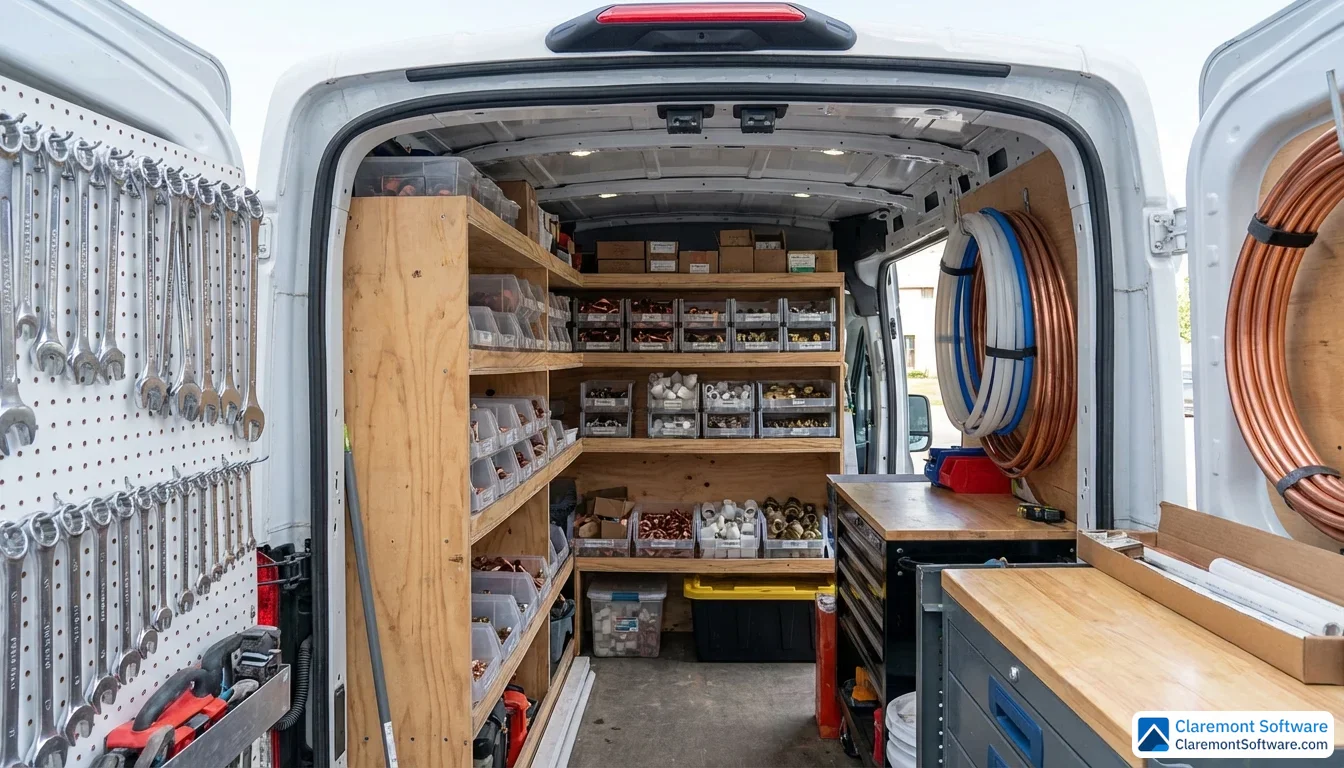
Your tools are your livelihood — and how you organize them says a lot about how you run your business. A well-equipped, thoughtfully arranged service vehicle doesn't just make your workday more efficient; it signals professionalism to every customer who watches you pull up to their home.
Building Your Core Tool Kit
Start with the essentials before spending on anything else. Your foundational inventory should include:
- Hand tools: Pipe wrenches (multiple sizes), tube cutters, channel-lock pliers, basin wrenches, soldering equipment, and a quality hacksaw
- Power tools: A reliable cordless drill, reciprocating saw, and angle grinder cover the majority of installation and repair scenarios
- Diagnostic equipment: A camera inspection system and electronic leak detector are worth the investment early — they help you diagnose faster, justify your pricing, and avoid costly guesswork
Budget $3,000 to $5,000 for your initial tool setup. Prioritize quality on the items you'll reach for every single day — pipe wrenches, your drill, and your inspection camera. For specialty tools you'll use occasionally, mid-range options are perfectly adequate until volume justifies upgrading.
Organizing Your Service Vehicle
A disorganized truck costs you more than you realize — time spent hunting for a fitting or a specific wrench adds up across dozens of jobs per week. Invest in shelving units, labeled bins, and a logical layout that puts your most-used tools within arm's reach. Keep a restocking checklist so you're never caught short on common materials mid-job.
Scaling Your Equipment Over Time
As your revenue grows, reinvest in equipment that expands what you can offer. Hydro-jetting machines, trenchless repair systems, and pipe-lining equipment open up higher-value jobs that less-equipped competitors have to turn away — turning your tool investment directly into increased revenue per call.
Technology Stack: Software for Scheduling, Invoicing, and Operations
Running a plumbing business on paper and invoices alone is a fast track to chaos. As soon as you're juggling multiple jobs, customer callbacks, and supplier orders simultaneously, the administrative side of the business will consume hours you should be spending on billable work. The right software stack solves that problem before it starts.
Field Service Management: Your Operational Backbone
Field service management (FSM) software is the single most important technology investment you'll make. A quality platform handles scheduling, dispatching, job tracking, invoicing, and customer communication in one place — eliminating the spreadsheets, sticky notes, and missed callbacks that plague disorganized operations. When a customer calls to book, you can confirm availability, assign the job, send a confirmation, and generate an invoice all within the same system.
For solo operators just getting started, affordable entry-level FSM tools keep costs manageable while still delivering the core functionality you need. As you scale to multiple trucks and technicians, enterprise-level platforms offer GPS tracking, real-time dispatching, and performance dashboards that give you visibility across your entire operation.
Accounting Integration and Job Costing
Your FSM software should connect directly to your accounting platform so that every completed job flows automatically into your financial records. This integration is what makes job costing possible — tracking exactly what each service type costs you in labor and materials versus what it earns. Without that data, you're pricing on instinct rather than margin, which is one of the most common reasons new plumbing businesses underperform in their first year.
CRM Features That Drive Repeat Business
Look for platforms with built-in CRM capabilities: lead tracking, estimate follow-up reminders, customer history logs, and automated review requests after job completion. Reviews are currency in the plumbing industry, and automating the ask means you collect them consistently rather than only when you remember.
Building SOPs Into Your Systems
As you hire, your software becomes the vehicle for your standard operating procedures. Checklists, job templates, and communication scripts built into your platform ensure every technician delivers a consistent experience — protecting the reputation you've worked to build.
Marketing Strategy: How to Get Your First 50 Customers
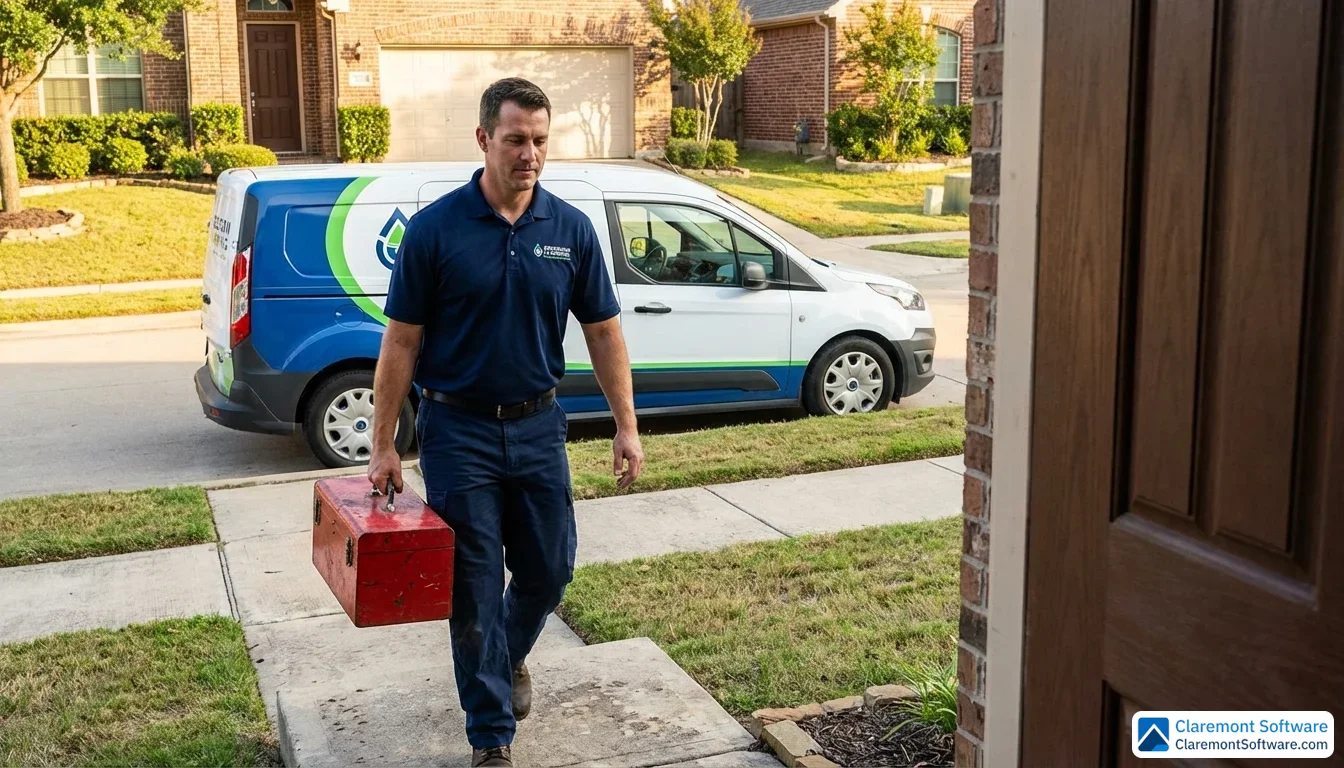
Getting your first customers is the hardest part of launching any service business — and plumbing is no exception. You can have the best tools, a perfectly organized truck, and competitive pricing, but none of that matters if the phone isn't ringing. The good news: plumbing has one of the clearest customer acquisition playbooks of any trade business. Follow it consistently, and reaching your first 50 customers is entirely achievable within your first few months.
Start with Local SEO — It's Your Highest-ROI Channel
Before you spend a dollar on advertising, claim and fully optimize your business profile on every major search and map platform. When someone's pipe bursts at 9 p.m. and they search "plumber near me," the businesses that appear in the local map results win that call. Getting there requires a complete, accurate, and actively managed profile — including your service area, hours, photos, service descriptions, and a steady stream of customer reviews.
Local SEO is the number one customer acquisition channel for plumbing businesses, and it compounds over time. The effort you put in during your first 30 days continues paying dividends months later, unlike paid ads that stop the moment your budget runs out.
Build a Website That Works While You Sleep
Your website is your 24/7 salesperson. A professional site with dedicated service pages, transparent pricing information, real customer reviews, and an easy online booking option converts visitors into booked jobs — even at midnight when you're not available to answer the phone. Keep it fast, mobile-friendly, and locally optimized with your city and service area throughout the content.
This doesn't need to be expensive. A clean, well-structured site that clearly communicates what you do, where you serve, and why customers should trust you will outperform a flashy but confusing one every time.
Make Your Truck a Moving Billboard
Every time you drive to a job, park in a neighborhood, or pull into a hardware store, your vehicle is either marketing your business or missing an opportunity. A professional vehicle wrap with your business name, phone number, and website turns every service call into a local impression. Pair that with a memorable business name and a clean logo, and you're building brand recognition in your service area with zero additional spend.
Set a Marketing Budget and Track Every Dollar
New plumbing businesses should expect to spend $500 to $2,000 per month on marketing during their first year, spread across local SEO, pay-per-click advertising, and directory listings. The exact mix matters less than tracking what each channel produces. Know your cost per lead, your lead-to-booking conversion rate, and your average job value — those three numbers tell you exactly where to invest more and where to cut back.
List on Home Service Platforms and Review Sites
Customers actively searching for plumbers use home service platforms and review directories as a first stop. Listing your business on these platforms puts you in front of high-intent buyers who are ready to book. Prioritize platforms with strong local presence in your market, and respond promptly to every inquiry — speed of response is one of the biggest factors in winning jobs through these channels.
Build Word-of-Mouth Through Referrals and Partnerships
Word-of-mouth is the most cost-effective marketing channel in the trades, but it doesn't happen by accident. Create a simple referral program that rewards existing customers for sending new ones your way. More importantly, build relationships with real estate agents, property managers, and home inspectors — these professionals need a reliable plumber to refer to their clients regularly, and a single strong partnership can generate dozens of jobs per year. Community involvement, local sponsorships, and neighborhood social media groups round out a word-of-mouth strategy that compounds quietly in the background while your paid channels do the heavy lifting upfront.
Hiring, Managing, and Scaling Your Team
At some point, demand will outpace what you can handle alone. That's a good problem to have — but how you respond to it determines whether your business scales smoothly or stumbles under the weight of its own growth. Hiring your first employee is one of the most consequential decisions you'll make, and getting it right requires preparation well before you post a job listing.
Know the Law Before You Hire Anyone
Labor law compliance isn't optional, and the consequences of getting it wrong are expensive. Before bringing on your first worker, understand the distinction between an employee and an independent contractor — misclassifying an employee as a contractor to avoid payroll taxes and workers' compensation is one of the most common and costly mistakes new plumbing business owners make. The IRS and most state labor boards apply strict tests to determine classification, and the burden of proof falls on you.
Beyond classification, familiarize yourself with your state's wage requirements, overtime rules, and workers' compensation obligations. In most states, workers' comp coverage becomes mandatory the moment you hire your first employee — not your fifth.
Hire for Independence First
When you're ready to bring someone on, prioritize experienced journeyman plumbers who can run jobs without constant supervision. Your goal at this stage isn't to manage someone's every move — it's to multiply your capacity. A journeyman who can handle a full service call independently doubles your revenue potential from day one.
As your volume grows and your systems mature, add apprentices to build a training pipeline beneath your journeymen. This structure keeps your labor costs balanced while developing the next tier of your workforce from within.
SOPs Are What Make Scaling Possible
Every service type, customer interaction, and administrative process in your business should be documented in a standard operating procedure. SOPs are what allow a new hire to deliver the same quality experience your first customers received — without you being present for every job. They're also what protect your reputation when you're managing three trucks instead of one.
Build your SOPs early, refine them based on real job experience, and embed them into your scheduling and field service software so they're accessible to every technician in the field.
Review Your Pricing Every Quarter
As your team grows, your cost structure changes. Labor rates shift, material costs fluctuate, and fuel expenses climb. Conduct a quarterly pricing review to ensure your rates still reflect your actual costs and target margins. Many plumbing businesses that struggle financially aren't underperforming on volume — they're underpricing work that's become more expensive to deliver.
Plan Your Scaling Milestones
Growth without a roadmap leads to reactive decisions. Map out your scaling stages in advance:
- Solo operator — you handle everything
- First hire — a journeyman who expands your capacity
- Office support or dispatcher — someone managing scheduling and customer calls so you stay in the field
- Multiple trucks — a full crew operating simultaneously
- Operations manager — someone running day-to-day so you can focus on strategy
- Owner working on the business, not in it — the ultimate goal
Each milestone requires different systems, different hires, and different financial thresholds. Knowing where you're headed makes each transition deliberate rather than chaotic.
Starting a Plumbing Business Without Being a Plumber
You don't need a pipe wrench to own a plumbing business. In a number of states, the law allows non-licensed individuals to operate a plumbing company — provided that licensed journeyman or master plumbers are the ones actually performing the work. If you have strong business instincts but no trade background, this model is worth serious consideration.
The key is understanding your state's specific rules before you invest a dollar. Regulations vary significantly across jurisdictions. Some states permit non-plumber ownership with minimal restrictions, while others require at least one licensed plumber to serve as a qualifying agent or responsible managing employee — a designated individual who holds the license that legally covers the company's work. A few states are more restrictive still. Research your local requirements thoroughly, and consult a business attorney before structuring your ownership arrangement.
If this model is available to you, your role becomes entirely focused on the business side: sales, marketing, customer service, financial management, hiring, and strategic growth. These are precisely the skills that many technically excellent plumbers lack — and the reason so many talented tradespeople stay employees rather than becoming owners. If you can build systems, manage people, control costs, and consistently bring in new customers, you can build a highly profitable plumbing operation without ever touching a pipe.
That said, credibility matters. Your technicians and customers will both notice quickly if you have zero understanding of the work being done. Invest time in learning plumbing fundamentals — not enough to replace your licensed staff, but enough to speak intelligently about services, evaluate job quality, and earn the respect of your team. That foundational knowledge is what separates a business owner who leads effectively from one who simply signs the checks.
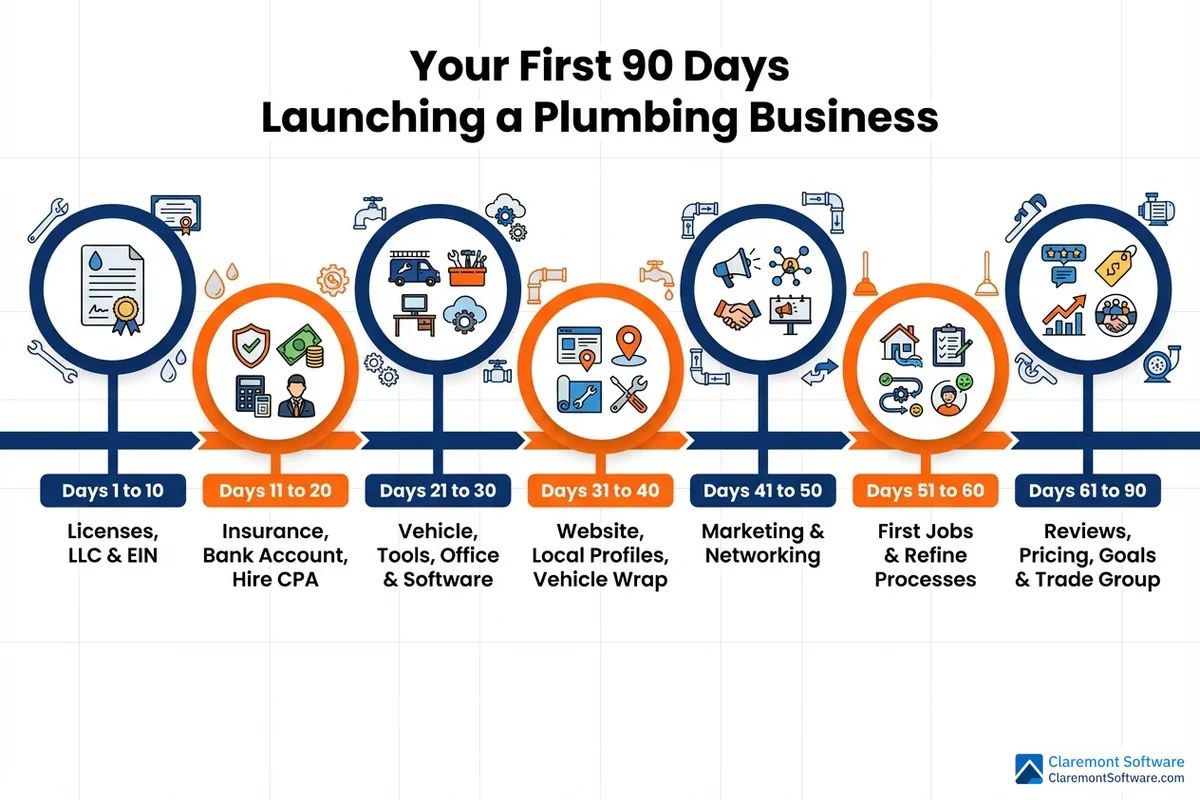
Your First 90 Days: Action Plan and Milestones
The foundation is built. Your licenses are secured, your LLC is registered, your truck is stocked, and your website is live. Now the clock starts. Your first 90 days will set the trajectory for everything that follows — and having a clear, phase-by-phase action plan is what separates new businesses that gain momentum from those that stall before they ever find their footing.
Days 1–30: Build the Infrastructure
Before you take a single paying job, make sure your business is legally and operationally ready to run. This means completing all licensing requirements, registering your LLC, and securing your insurance policies — general liability at minimum, commercial auto if your vehicle is in service. Set up your accounting system with the help of a CPA, establish a dedicated business bank account, and configure your field service software for scheduling and invoicing. Purchase your vehicle and core tools, and get your website live with your service area, contact information, and a clear way for customers to request a quote. These aren't glamorous tasks, but skipping them creates expensive problems later.
Days 31–60: Go to Market
With your infrastructure in place, shift your full energy toward customer acquisition. Claim and fully optimize your profiles on every major local search and directory platform. Order your vehicle wrap — your truck is a moving billboard, and every neighborhood you drive through is a marketing opportunity. Start actively networking with property managers, real estate agents, and home inspectors who can become consistent referral sources. Take every job that comes your way, deliver exceptional service, and treat each customer as a potential source of five future referrals.
Days 61–90: Refine and Stabilize
By now, you have real data to work with. Review your pricing against actual job costs — what looked profitable on paper may look different after fuel, materials, and time are accounted for. After every completed job, request a review. A steady stream of five-star reviews in your first 90 days builds the social proof that accelerates every other marketing channel. Evaluate which lead sources are converting and which aren't, establish a consistent weekly schedule, and start identifying patterns in your most profitable service types.
Track These Numbers From Day One
- Number of leads per week
- Estimate-to-job conversion rate
- Average job value
- Customer acquisition cost
- Weekly revenue
These metrics tell you exactly where to focus. If leads are high but conversions are low, your pricing or follow-up process needs work. If leads are low, your marketing needs more investment.
Once you're operational, join a trade association or plumbing business peer group. Learning from owners who've already navigated your current challenges is one of the highest-return investments you can make in year one.
How AI and Smart Home Technology Are Changing Plumbing in 2026
The plumbing industry is being reshaped by technology — and the businesses that adapt earliest will have a measurable competitive advantage over those still running on clipboards and phone calls.
Smart home plumbing is creating an entirely new service category. Wi-Fi-connected water heaters, automated shut-off valves, and intelligent leak detection systems are moving from luxury add-ons to mainstream homeowner expectations. These devices need to be sold, installed, configured, and maintained — and most homeowners have no idea where to turn when something goes wrong. A plumbing business that positions itself as the local expert in smart home water systems can command premium pricing and build a recurring service relationship with every customer who buys in.
On the operations side, AI-powered scheduling and dispatching tools are changing what's possible for solo operators. Route optimization software reduces windshield time between jobs, which directly translates to more billable hours per day without adding a single employee. For a one-truck operation trying to compete with larger companies, that efficiency edge matters enormously.
Customer expectations have also shifted permanently. Digital-first service is no longer a differentiator — it's a baseline requirement. Customers expect to book online, receive text updates when a technician is en route, review a digital estimate before work begins, and pay contactlessly when the job is done. Businesses that still rely entirely on phone calls and paper invoices are losing jobs to competitors who make the experience frictionless.
The opportunity here is straightforward: lead with technology as part of your brand identity from day one. Offer smart home plumbing consultations alongside traditional services, invest in field service software that delivers a modern customer experience, and let your digital fluency signal to customers that they're hiring a forward-thinking professional — not just the cheapest option in the directory.
Conclusion
Starting a plumbing business in 2026 is one of the most accessible paths to genuine financial independence available in the trades. With startup costs as low as $13,000, recession-resistant demand, and a clear roadmap from solo operator to multi-truck operation, the opportunity is real — but only for those willing to treat it like a business from day one.
The difference between plumbing businesses that thrive and those that stall comes down to a handful of fundamentals: proper licensing, a realistic business plan, smart financial management, and relentless focus on customer acquisition in the early months. Whether you're a licensed plumber ready to go solo or an entrepreneur building a team of licensed technicians, the 90-day action plan in this guide gives you the structure to build momentum quickly rather than learning expensive lessons slowly.
Invest in the right technology, track your numbers obsessively, review your pricing every quarter, and build SOPs that let your business run without you in every job. The plumbing industry rewards those who combine technical excellence with business discipline — and there's no better time to start than right now.
Related Reading
- How Much Does a Plumber Website Cost in 2026?
- Plumber Digital Marketing: The Complete Guide
- Best Plumber Websites 2026: Examples That Generate Calls
Frequently Asked Questions
How much does it cost to start a plumbing business in 2026?
Starting a plumbing business in 2026 typically costs between $13,000 and $50,000 for a modest solo setup. Your biggest expenses will be a service vehicle ($5,000 used to $40,000+ new), tools and equipment ($3,000–$5,000), and insurance ($1,000–$2,000 annually). Licensing and registration fees are relatively minor, ranging from under $100 to a few hundred dollars depending on your state. To keep startup costs low, buy a used van, work from home instead of renting an office, and focus on local jobs first. Before launching full-time, make sure you have 3–6 months of both living and operating expenses saved as a financial runway.
Can I start a plumbing business without being a licensed plumber?
Yes — in many states, you can legally own and operate a plumbing business without holding a plumber's license yourself, as long as you hire licensed journeyman or master plumbers to perform the actual work. Your role becomes focused on business management: sales, marketing, customer service, hiring, and financial oversight. However, regulations vary significantly by state, and some require at least one licensed plumber on staff as a qualifying agent or responsible managing employee. Research your specific state's rules carefully before pursuing this model. While it's a viable path, you'll also benefit from learning plumbing fundamentals to earn credibility with your team and customers.
How long does it take to get a plumbing license?
Getting a plumbing license is a multi-year process. Most states require you to complete a formal apprenticeship lasting two to five years before you're eligible to sit for a journeyman plumber's license exam. After gaining additional experience as a journeyman — typically another few years — you can qualify for a master plumber's license, which is required to run your own plumbing business in many jurisdictions. The exact timeline depends heavily on your state's requirements, so research your local licensing board early. Some states also require contractor-specific licensing through a separate state board, adding another step to the process.
How much do plumbing business owners make in their first year?
First-year income varies widely depending on your market, niche, and how aggressively you pursue customers. Plumbers charge $45 to $150 per hour, with average jobs running $125 to $450, and many businesses set minimum service fees of $50 to $200. As a solo operator, your take-home pay in year one will be modest after covering vehicle costs, insurance, marketing, materials, and other overhead. Most new plumbing businesses take 6–12 months to reach consistent monthly revenue. Realistic first-year net income for a solo operator typically falls in the range of $40,000–$70,000, with significant upside as your customer base and reputation grow.
What insurance do I need for a plumbing business?
At minimum, every plumbing business needs general liability insurance, which protects you against property damage and injury claims that could otherwise bankrupt a new operation. If you have employees, workers' compensation insurance is required in most states — misclassifying workers as independent contractors to avoid this is a costly legal mistake. You'll also need commercial auto insurance for your service vehicle and inland marine insurance to cover tools and equipment in transit or on job sites. A Business Owner's Policy (BOP) bundles general liability with commercial property coverage at a discounted rate and is worth considering. Annual premiums start at $1,000–$2,000 and increase as you add staff and vehicles.
Should I buy an existing plumbing business or start from scratch?
Both paths have real merit, and the right choice depends on your capital and goals. Buying an existing plumbing business gives you instant customers, trained staff, established revenue, and an existing reputation — but it comes at a significant cost. The median asking price for an established plumbing business is $732,500, with prices ranging from under $340,925 to over $1,512,500. Starting from scratch costs far less ($13,000–$50,000) and gives you full control over your brand, culture, and systems, but requires more time to build momentum. If you have access to capital and want faster revenue, buying can be smart. If you're bootstrapping, starting from scratch is the more accessible route.
What is the best business structure (LLC, sole proprietorship, corporation) for a plumbing company?
An LLC (Limited Liability Company) is the recommended business structure for most plumbing businesses. It separates your personal assets from your business liabilities, meaning a lawsuit or debt claim against your business generally can't touch your personal savings, home, or vehicle — critical protection in a trade where accidents and property damage claims can happen. An LLC is also simpler and less expensive to set up and maintain than a corporation. Sole proprietorships offer no liability protection and are risky for a trade business. As your business grows significantly, a CPA or business attorney may recommend transitioning to an S-Corp for tax advantages, but an LLC is the right starting point for most new plumbing businesses.
How do I get my first customers as a new plumbing business?
Getting your first customers requires a multi-channel approach focused on local visibility. Start by claiming and fully optimizing your profile on major search and directory platforms — local SEO is the top customer acquisition channel for plumbing businesses. Build a professional website with clear service pages, pricing transparency, and easy online booking. Wrap your service vehicle so every job site becomes a mobile advertisement. List your business on home service platforms and review sites where customers actively search for plumbers. Network with real estate agents, property managers, and contractors who can send you steady referrals. Ask every early customer for a review — social proof is essential for building trust quickly. A monthly marketing budget of $500–$2,000 covering local SEO and pay-per-click ads will accelerate your first 50 customers significantly.