A plumber website in 2026 costs $0–$1,000 DIY, $1,500–$4,500 from a freelancer or small agency, or $5,000–$15,000+ for a custom lead-generation build — plus ongoing hosting and care. Subscription plans that bundle the website with local SEO and call tracking run about $297–$497/month. One water heater job typically covers months of any of these options.

One emergency water heater replacement job — worth $1,500 to $2,500 — can pay for half your entire website, yet 85% of homeowners won't even call a plumber who doesn't have a professional online presence. Let that sink in.
In 2026, your website isn't a luxury — it's the first impression that determines whether a homeowner picks up the phone or scrolls straight to your competitor. But with plumber website costs ranging from $50/month for a DIY builder to $15,000+ for a full-service agency build, knowing where to invest your money is anything but straightforward.
The upfront build cost is only part of the story. Hidden ongoing expenses — hosting, SEO tools, CRM software, content creation, and maintenance — can quietly add $20,000 or more per year if you're not paying attention.
This guide cuts through the noise. You'll get a complete, line-by-line breakdown of every cost involved in building a plumber website in 2026, an honest look at what each pricing tier actually delivers, and a clear ROI framework to help you invest wisely — not just cheaply.
Why Every Plumber Needs a Website in 2026
Think about the last time a pipe burst at midnight or a water heater gave out on a Sunday morning. Homeowners in that moment don't flip through a phone book — they grab their phone and search. And here's the uncomfortable truth for plumbers without a website: 73% of homeowners in blind tests chose plumbers with professional websites over those without, even when the pricing was identical. Your craftsmanship, your years of experience, your fair rates — none of it matters if a potential customer can't find you or trust you before they pick up the phone.
Your website is your 24/7 digital storefront, and that matters more in plumbing than almost any other trade. Between 35–40% of emergency plumbing searches happen during off-hours — late nights, early mornings, weekends — when your office is closed and no one is answering calls. A professional website captures those leads automatically, presenting your services, credentials, and contact information exactly when a stressed homeowner needs them most.
Plumbing is also a deeply trust-based service. You're inviting someone into a customer's home to work on systems that, if handled incorrectly, can cause thousands of dollars in damage. Customers know this. Research shows they spend 5–10 minutes reviewing a plumber's website before ever making contact — scanning for licenses, reviews, service guarantees, and signs of professionalism.
Beyond trust, a well-optimized website is your most cost-efficient marketing tool. Organic search delivers 3–5x better ROI than pay-per-click advertising over the long term, reducing your dependence on expensive ad campaigns that stop working the moment you stop paying.
Without a website in 2026, you're not just missing out — you're actively handing leads to competitors who have one.
The Three Tiers of Plumber Website Pricing
Not all plumber websites are created equal — and neither are their price tags. Before you commit to any investment, it helps to understand that the market breaks down into three distinct tiers, each designed for a different stage of business growth.
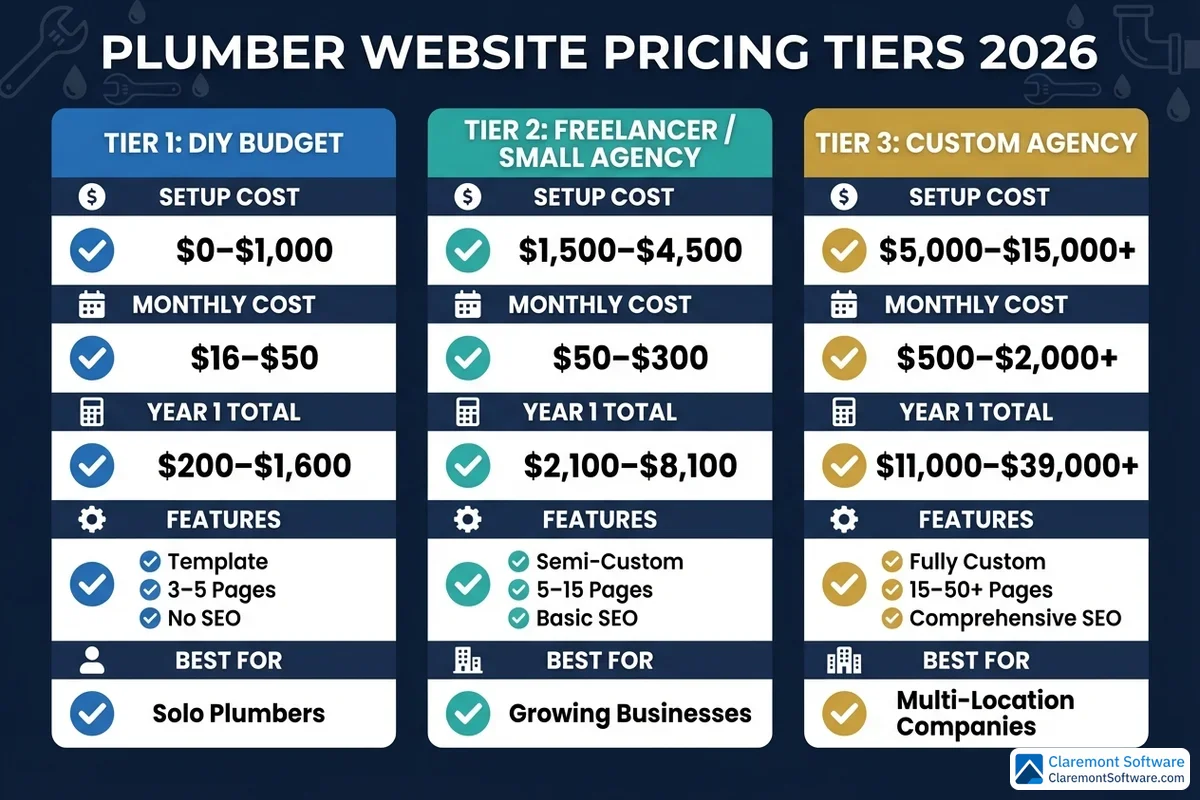
Tier 1: DIY or Budget ($0–$1,000) This is the entry-level option, built on drag-and-drop website builders starting at around $16/month. It's the right starting point for a solo plumber who needs an online presence fast and is working with limited capital. The tradeoff is time — expect to invest 20–40 hours of your own labor — and results that reflect the budget.
Tier 2: Freelancer or Small Agency ($1,500–$4,500) A step up in both quality and professionalism, this tier gets you a semi-custom design with dedicated service pages, mobile responsiveness, and basic local SEO. It's the sweet spot for a growing 2–5 truck operation that needs to compete seriously in local search without committing to a full agency retainer.
Tier 3: Custom Lead-Generation Website ($5,000–$15,000+) This is a fully custom, conversion-optimized website built by a specialist agency. You get comprehensive service and location pages, technical SEO foundations, CRM integration, and professional copywriting — everything an established multi-location plumbing company needs to dominate its market.
Here's a quick comparison of what each tier delivers:
| Feature | Tier 1 (DIY) | Tier 2 (Freelancer) | Tier 3 (Agency) |
|---|---|---|---|
| Design type | Template | Semi-custom | Fully custom |
| Number of pages | 3–5 | 5–15 | 20–50+ |
| SEO foundation | Minimal | Basic on-page | Comprehensive technical |
| Conversion features | Generic | Click-to-call, forms | Booking, CRM, automation |
| Monthly ongoing cost | $16–$50 | $100–$500 | $2,000–$10,000 |
One important note on affordability: if the Tier 3 price tag feels out of reach, many agencies offer payment plans that spread a $10,000 investment across 12 months — roughly $833/month — making a professional build far more accessible than the sticker price suggests.
Tier 1: DIY or Budget Route ($0–$1,000)
If you're a brand-new plumber trying to get something online without draining your startup capital, the DIY route is where most people begin — and for good reason. Popular website builders offer plumber-friendly templates with drag-and-drop editors starting at around $16/month, meaning you can have a live website for under $200 in your first year. No coding knowledge required, no agency fees, no long-term contracts.
The catch? You're trading money for time. Setting up even a basic plumber website on a DIY platform realistically takes 20–40 hours — time spent wrestling with templates, writing your own copy, uploading photos, and figuring out settings that a professional would handle in an afternoon. For a working plumber, those are hours that could be spent on billable jobs at $75–$150 per hour. The "free" website isn't really free when you do that math.
What you get at this tier is a basic online presence — your name, services, phone number, and a contact form. The design will be a template shared by thousands of other businesses, the SEO foundation will be minimal at best, and the conversion features that turn visitors into booked customers simply won't be there. You won't have dedicated service pages, location-specific content, or the trust signals that make homeowners choose you over the competitor who shows up above you in search results.
This tier is genuinely appropriate for one specific situation: a solo plumber who needs something online quickly while building early revenue, with a clear plan to upgrade within 12–18 months.
The real hidden cost here isn't the monthly subscription — it's the leads you never see. A site that doesn't rank in local search and doesn't convert visitors into callers is quietly costing you far more than any agency ever would.
Tier 2: Freelancer or Small Agency ($1,500–$4,500)
Stepping up from the DIY tier, hiring a freelancer or small agency is where your website starts working as a genuine business tool rather than just a digital placeholder. For a total investment of $1,500–$4,500, you get a semi-custom design built around your specific business — your branding, your service area, your competitive advantages — rather than a generic template that looks identical to every other plumber in your city.
At this tier, you can expect 5–15 dedicated service pages covering your core offerings (drain cleaning, water heater repair, repiping, emergency plumbing, and so on), along with basic on-page SEO to give each page a fighting chance in local search. The practical essentials are all included: mobile-responsive design, prominent click-to-call buttons, contact forms, and typically a Google Business Profile setup to anchor your local presence. These aren't luxury features — they're the baseline requirements for converting a visitor into a phone call in 2026.
You'll also have real input on the outcome. Unlike a DIY template where you're constrained by what the builder allows, a freelancer will work with your logo, color scheme, and service priorities to produce something that actually reflects your business. Turnaround time typically runs 4–8 weeks from kickoff to launch.
The main risk at this tier is scope creep. Most freelancers and small agencies quote a flat project fee, but revisions beyond the agreed scope are billed separately — typically at $75–$150 per hour. A few rounds of back-and-forth on design changes or additional pages can quietly push a $2,500 project past $4,000. Before signing anything, get explicit clarity on how many revision rounds are included, what triggers hourly billing, and what happens if you need an extra service page added mid-project. A clear contract upfront saves expensive surprises later.
Tier 3: Custom Lead-Generation Website ($5,000–$15,000+)
At the top tier, you're no longer buying a website — you're buying a lead-generation system built specifically to rank, convert, and scale with your plumbing business. A full-service agency investment of $5,000–$15,000 delivers something fundamentally different from the previous two tiers: a custom-engineered digital asset designed from the ground up to bring in paying customers month after month.
The content alone sets this tier apart. Rather than a handful of generic pages, you get comprehensive service pages of 800–1,500 words each — professionally written, keyword-targeted copy covering every service you offer, from drain cleaning and water heater replacement to repiping and emergency callouts. Add to that a network of location-specific pages targeting every city, suburb, and neighborhood in your service area, and you have the kind of geographic coverage that dominates local search results across an entire region, not just your home city.
The technical foundation is equally serious. Expect full schema markup so Google understands exactly what your business does and where, site speed optimization to keep you well under that critical 3-second load threshold, SSL security, mobile-first architecture, and a strategic URL structure built for long-term SEO performance — not just what looks good at launch.
Conversion is baked into every page. Click-to-call buttons, online booking integration, review widgets, trust badges (licenses, certifications, insurance), and before/after project galleries all work together to turn a skeptical visitor into a booked job. At this tier, agencies also integrate your website directly with dispatch software and CRM systems like ServiceTitan or Housecall Pro, so every lead captured online flows automatically into your workflow without manual data entry.
Professional copywriting, photography direction, and an ongoing content strategy are typically included — meaning your site keeps growing and ranking long after launch day.
Complete 2026 Cost Breakdown: Every Line Item Explained
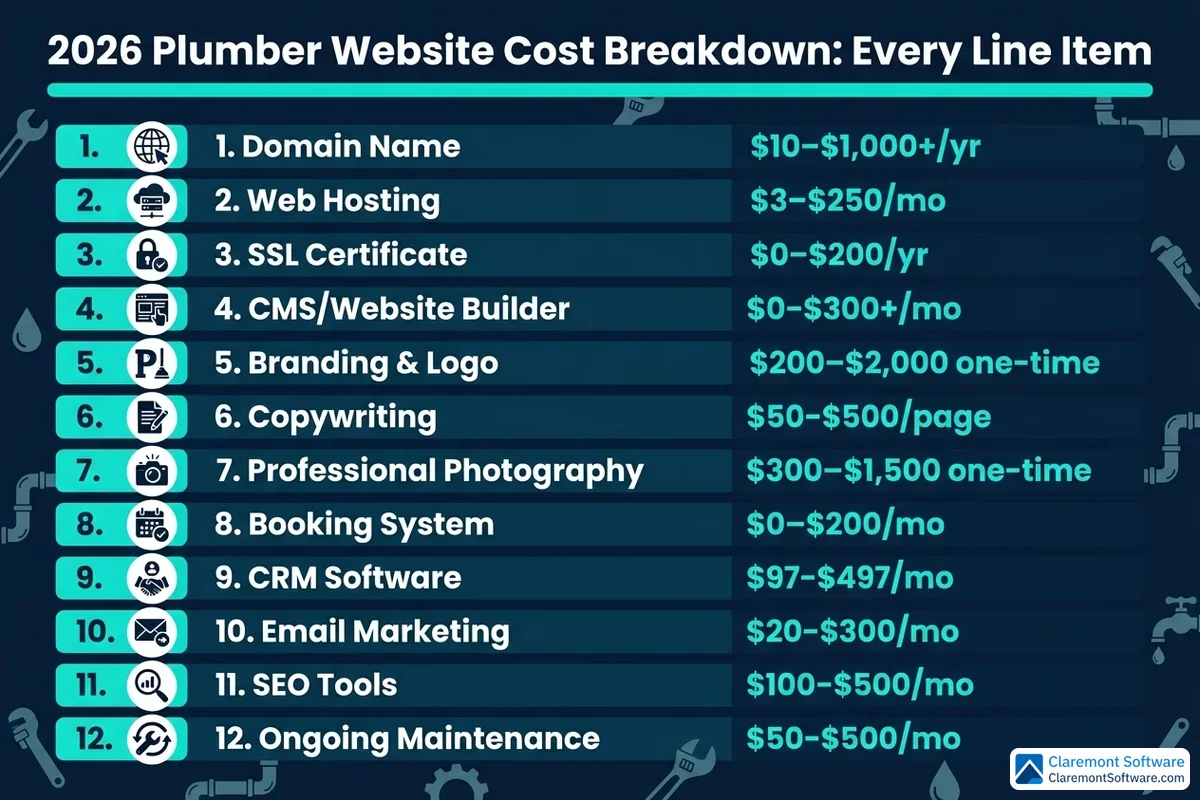
Before you can evaluate any agency quote or DIY platform price, you need to understand what you're actually paying for. A plumber website isn't a single purchase — it's a stack of individual components, each with its own cost range. Here's every line item broken down for 2026.
Domain Name: $10–$50/year (or $1,000+ for premium) Your web address is one of the cheapest line items, typically running $10–$50 per year for a standard domain like yourplumbingcompany.com. The exception is premium exact-match domains — think "emergencyplumber[yourcity].com" — which can command $500–$1,000+ if someone already owns them and is willing to sell.
Web Hosting: $3–$250/month Shared hosting is the budget option at $3–$15/month, but it comes with slower load speeds and shared server resources. Managed WordPress hosting runs $20–$100/month and handles security updates and performance optimization for you. Dedicated servers for high-traffic multi-location operations can reach $150–$250/month. Given that 53% of mobile users abandon sites that take longer than 3 seconds to load, skimping on hosting is a false economy.
SSL Certificate: $0–$200/year Most reputable hosting providers now include a basic SSL certificate free. Extended validation certificates — which display additional trust indicators in the browser — cost $100–$200/year and are worth considering for plumbing businesses where trust is a primary conversion factor.
Website Builder or CMS Platform: $0–$300+/month Open-source platforms like WordPress are free to install, though you'll pay for premium themes and plugins. All-in-one website builders with built-in hosting and templates range from $16–$300+/month depending on the tier and features included.
Branding and Logo Design: $200–$2,000 If you don't already have professional branding, budget for it here. A polished logo and consistent color scheme are foundational to the trust signals that convert visitors into callers.
Content and Copywriting: $50–$500 per page Professional plumbing-specific copy — the kind that ranks in local search and actually persuades homeowners to call — costs $50–$500 per page depending on length and writer experience. With each service page requiring 800–1,500 words of original content, this line item adds up quickly across a full site.
Professional Photography: $300–$1,500 Stock photos of generic plumbers won't build trust. Real team photos, job-site images, and equipment shots signal legitimacy and professionalism to homeowners spending 5–10 minutes vetting you before they call.
Interactive Features: $0–$500/month Online booking systems, AI chatbots, and payment processing integrations range from free basic tools to $500/month for full-featured platforms — costs that recur every month after launch.
Email Marketing and Automation: $20–$300/month Drip campaigns for follow-up sequences and seasonal promotions are increasingly standard for competitive plumbing businesses, adding another recurring monthly expense to factor into your Year 1 budget.
Hidden Costs That Can Double Your Budget

You've seen the line items. You know what a domain costs, what hosting runs, and what professional copywriting adds to your budget. But here's what most agency proposals and website builder pricing pages won't tell you: the quoted price is often just the beginning. For plumbing businesses that don't ask the right questions upfront, hidden costs can quietly double — or even triple — the total investment within the first twelve months.
CRM Software: $97–$497/Month
Customer relationship management software is non-negotiable for a plumbing business that wants to capture, track, and follow up on every lead its website generates. The problem is that many agencies bundle CRM access into their monthly retainer without making it explicit — and others quote you a website price that doesn't include it at all, leaving you to discover the $97–$497/month standalone cost after you've already signed. Before you commit to any agency or platform, ask directly: is CRM software included, and if so, which platform and which tier?
SEO Tools and Revision Charges: $100–$650/Month and Up
Ranking a plumber website in local search requires ongoing access to keyword research tools, rank trackers, backlink analyzers, and technical audit platforms. These tools alone typically run $100–$500/month — costs that are often absorbed by agencies but passed directly to clients on lower-tier packages. On top of that, hourly revision charges of $75–$150/hour beyond your initial project scope can accumulate fast, especially if your service area expands, you add new offerings, or you simply want to update your homepage messaging after launch.
The Real Cost of Cheap SEO
This one deserves its own warning. Budget SEO providers — the ones promising first-page rankings for $299/month — frequently rely on link farms, spammy directory submissions, and keyword-stuffed content that violates Google's guidelines. In the short term, you might see a rankings bump. In the medium term, you risk a Google penalty that can crater your visibility entirely, sometimes for months. Recovering from a manual penalty or algorithmic hit requires specialized remediation work that costs far more than legitimate SEO would have in the first place. The cheapest SEO option is rarely the most affordable one over a 12-month horizon.
Ongoing Content Creation: An Essential That's Rarely Included
Ranking and staying ranked in local search requires a steady stream of fresh, relevant content. The standard recommendation is 2–4 blog posts per month targeting local plumbing keywords — think "how to prevent frozen pipes in [your city]" or "signs you need a water heater replacement." This content signals to Google that your site is active and authoritative. Yet it's almost never included in an initial website build quote. At $50–$500 per page depending on quality and length, a consistent content program adds $100–$2,000/month to your ongoing costs.
The Overlooked Expenses That Add Up Fast
Beyond the big-ticket items, a cluster of smaller recurring costs tends to catch plumbing business owners off guard:
- Citation management across 100+ directories (Google, Yelp, Angi, and dozens of niche directories) requires either dedicated software or agency time to keep your business name, address, and phone number consistent — inconsistencies actively hurt local rankings
- Review management platforms for monitoring and responding to reviews across multiple sites typically run $50–$150/month
- Call tracking software to measure which pages and keywords are actually generating phone calls adds another $30–$100/month
- Analytics setup and reporting — proper Google Analytics 4 configuration, Google Search Console integration, and monthly performance reporting — is often quoted as an add-on rather than a standard inclusion
When you add it all up — SSL, hosting, CRM, email automation, booking systems, SEO tools, content creation, citation management, and revision charges — the total hidden cost burden can reach $20,000 or more per year on top of whatever you paid for the initial website build. That's not a worst-case scenario; it's a realistic picture of what a fully operational, competitive plumber website actually costs to run. The solution isn't to avoid these investments — most of them are genuinely necessary. The solution is to demand a complete Year 1 cost estimate before you sign anything, so you're comparing total investment, not just sticker prices.
What's New in 2026: AI Tools, Subscription Models, and Google Changes
The plumber website landscape looks meaningfully different in 2026 than it did even two years ago. Three forces are reshaping what you should expect to pay, what you should expect to get, and how you should think about ongoing optimization: the rapid maturation of AI-powered tools, the rise of subscription-based website models, and Google's increasingly aggressive algorithm evolution.
AI Is Compressing Build Times — and Initial Costs
AI-assisted design tools can now generate a functional, visually credible plumber website in hours rather than weeks. What once required a designer, a developer, and a copywriter working in sequence can now be scaffolded by an AI platform that produces layout suggestions, placeholder copy, and image recommendations almost instantly. For plumbers on tight budgets, this is genuinely good news — initial build costs at the DIY and entry-level tiers are lower than they've ever been.
AI chatbot integration is following close behind. Bots capable of answering common plumbing questions, capturing lead information after hours, and routing urgent calls appropriately are becoming a standard feature rather than a premium add-on. Expect to pay $30–$200/month for a plumbing-specific chatbot — a worthwhile investment when you consider that 35–40% of emergency searches happen when your office is closed and every unanswered inquiry is a lead handed to a competitor.
Subscription Models Are Changing the Upfront Math
The traditional model — pay $5,000–$10,000 upfront, own your site — now has a credible alternative. Subscription-based website services offer professionally built plumber sites for $49–$199/month with no large initial outlay. For a solo plumber or a business in its early growth phase, this dramatically lowers the barrier to entry. The trade-off is long-term cost: over three years, a $149/month subscription totals nearly $5,400 — comparable to a mid-tier custom build, but without full ownership of the asset.
Google's Algorithm Changes Demand Ongoing Investment
Google updates its algorithm more than 500 times per year, and its AI Overviews feature — which now surfaces direct answers at the top of search results — is fundamentally changing how plumber websites need to be structured and written. Ranking isn't a one-time achievement; it requires continuous optimization, fresh content, and technical upkeep.
Voice search is adding another layer. As more homeowners ask smart speakers to find an "emergency plumber near me" at midnight, websites need to be optimized for conversational, question-based queries — a specialization that adds to ongoing SEO costs but captures high-value urgent leads.
Finally, ADA and WCAG accessibility compliance is no longer optional background noise. Accessibility lawsuits targeting small business websites are increasing, and bringing a site into compliance can add $500–$2,000 to your build cost. It's an investment that protects against legal liability while also improving usability for all visitors.
ROI: How Fast Does a Plumber Website Pay for Itself?

The math on a plumber website investment is simpler than most business owners expect — and the numbers are compelling once you run them honestly.
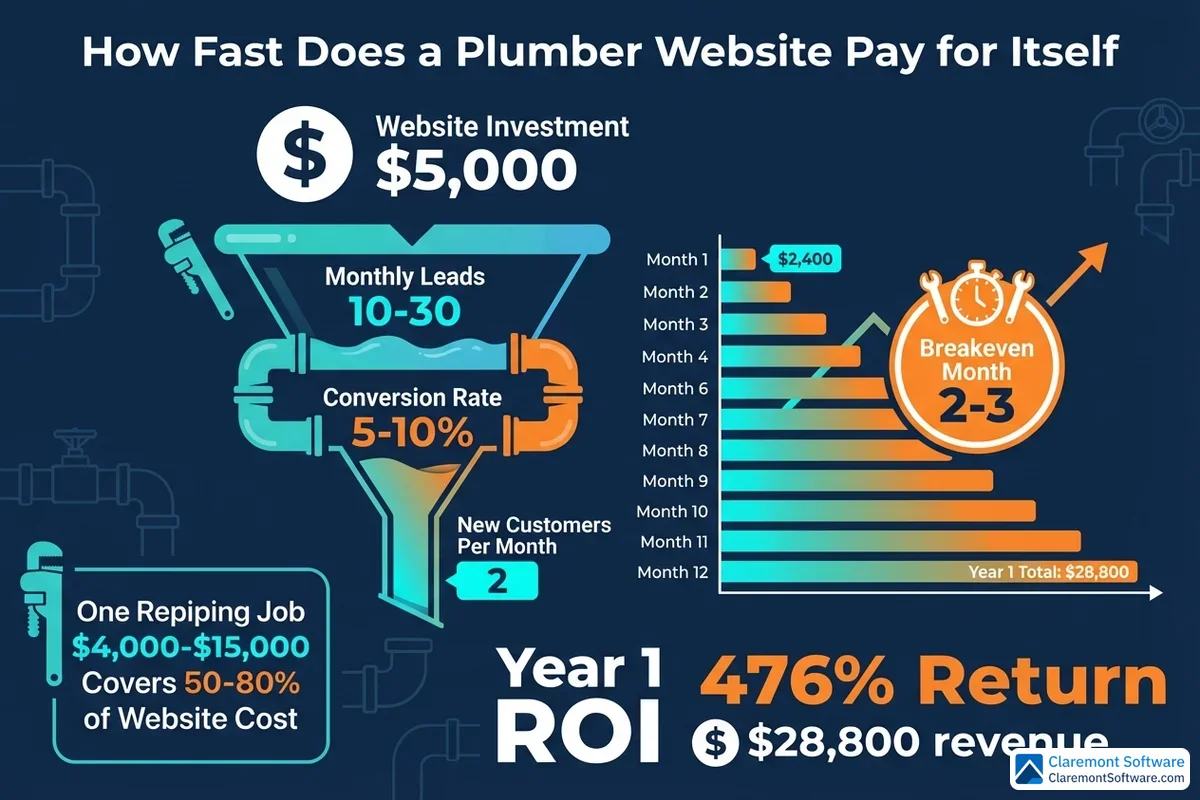
A professionally built plumbing website typically generates 10–30 leads per month once it's ranking in local search. Apply a realistic 5–10% conversion rate from lead to booked job, and you're looking at 1–3 new customers every month from organic traffic alone. At an average job value of $1,200, that's $1,200–$3,600 in new monthly revenue attributable directly to your website. A $4,000 website investment pays for itself in two to four months — and then keeps generating revenue indefinitely.
Here's a concrete example: 20 leads per month × 10% conversion = 2 new customers × $1,200 average job = $2,400 in new monthly revenue. Over 12 months, that's $28,800 in business generated by a single asset that cost a fraction of that to build.
High-value services accelerate the payback period dramatically. A single repiping job brings in $4,000–$15,000. One water heater replacement runs $1,500–$4,000. Either job, booked through your website, can cover 50–80% of your entire build cost in a single afternoon's work. This is why emergency plumber websites tend to see the fastest ROI — they're capturing high-intent, high-urgency searches from homeowners who need help immediately and are ready to book on the spot. Factor in that 35–40% of those emergency searches happen after hours, and a website with 24/7 visibility becomes something no amount of office staffing can replicate.
The long-term comparison against paid advertising is where the ROI argument becomes undeniable. Pay-per-click campaigns require continuous spending to generate continuous results — the moment you stop funding them, the leads stop. Organic search visibility compounds over time. A well-optimized plumber website that ranks for local keywords in year one will typically rank higher and generate more leads in year two, without a proportional increase in cost. Over a three-to-five year horizon, organic visibility delivers 3–5x better ROI than Google Ads — meaning a $2,500–$5,000 website investment can outperform $30,000 or more in annual ad spending. That's not a theoretical projection; it's the consistent experience of plumbing businesses that commit to building a genuine organic presence rather than renting visibility through paid channels.
The website isn't a cost. It's your highest-returning marketing asset.
How to Choose the Right Option for Your Plumbing Business
Matching your website investment to your actual business stage is the most important decision you'll make in this process. Overspending on a custom build when you're a solo operator with three months of revenue behind you is just as problematic as underspending on a template site when you're running a five-truck operation competing for high-value commercial contracts. Here's how to think through the decision clearly.
Solo Plumber or Just Starting Out (Budget Under $1,000)
If you're in your first year or working with a tight budget, a DIY builder or subscription service is the right starting point — not a compromise, but a genuinely appropriate choice for your stage. Focus on the fundamentals: mobile responsiveness, a prominent click-to-call button, and a clean contact form. Get something professional-looking online quickly, claim your Google Business Profile, and upgrade as your revenue grows. The goal at this stage is presence, not perfection.
Growing 2–5 Truck Operation
At this stage, a template site is actively costing you leads. Invest $3,000–$5,000 in a freelancer or small agency build with dedicated service pages, basic local SEO, and proper conversion elements. You're now competing for jobs that justify the investment, and a professionally built site will consistently outperform a DIY build in local search rankings.
Established Multi-Location Company
Budget $8,000–$15,000+ for a custom lead-generation site with location-specific pages, CRM integration, and comprehensive ongoing SEO. At this scale, your website is a revenue engine, not a business card.
Red Flags When Vetting Agencies
Before signing anything, watch for these warning signs:
- No experience with plumbing or home service businesses
- No portfolio or case studies they're willing to share
- Vague answers about who owns your domain and hosting after the project ends
- Locking you into proprietary platforms you can't transfer or control
Questions to Ask Before You Sign
- Who owns the domain and hosting — you or the agency?
- What exactly is included in the monthly fee?
- How many revisions are included, and what's the hourly rate beyond that?
- What happens to the site if you end the relationship?
Platforms like Claremont Software are built specifically for service businesses, offering transparent pricing, clear ownership terms, and no hidden fees — exactly the kind of straightforward arrangement you should be looking for before committing your budget.
Essential Features Every Plumber Website Must Have

Your website's feature set determines whether visitors call you or click back to a competitor. Getting the pricing right matters — but a site that's missing critical conversion elements will underperform regardless of what you paid to build it. These are the non-negotiables every plumber website must have in 2026, and the features you'll consistently find across the best plumber websites of 2026.
Mobile-First Design and Speed
More than half of your potential customers are searching for a plumber on their phones — often in a stressful, urgent moment. A site that takes longer than three seconds to load loses 53% of those mobile visitors before they've even seen your phone number. Mobile-first design isn't a bonus feature; it's the baseline. Every element — buttons, forms, images, text — needs to be optimized for a small screen and a slow connection before anything else.
Click-to-Call Buttons and Booking Forms
Your phone number should be impossible to miss on every single page, without scrolling. A tap-to-call button in the header, repeated in the footer, and embedded within service page content removes every barrier between a motivated visitor and a booked job. Pair this with an online booking form for customers who prefer not to call — especially useful for capturing the 35–40% of searches that happen after your office closes.
Dedicated Service Pages
A single "Services" page listing everything you offer won't rank in local search. Each service — drain cleaning, water heater repair, repiping, leak detection, sewer line replacement — needs its own dedicated page with 800–1,500 words of original, location-specific content. These pages are how Google understands what you do and where you do it.
Trust Signals
Plumbing is a trust-based purchase. Customers are letting a stranger into their home. Display your state license number, insurance badges, certifications, and years in business prominently. Customer reviews, before-and-after project galleries, and any industry awards all reinforce credibility before a single word is exchanged.
Local SEO Foundations
Your site needs proper schema markup for local businesses, consistent NAP (name, address, phone) information across every page, integration with your Google Business Profile, and dedicated location pages if you serve multiple cities or neighborhoods.
Emergency Service Visibility
Prominent "Available 24/7" badges, after-hours messaging options, and urgent call routing aren't optional for plumbers — they're revenue capture tools for your highest-value jobs.
Conclusion
The numbers don't lie: a professionally built plumber website generating just two new customers per month pays for itself within 90 days — and keeps compounding returns long after that. Whether you start with a $200 DIY build or invest $12,000 in a custom lead-generation system, the right choice is the one that matches your current business stage while positioning you to grow into the next.
What separates smart investments from expensive mistakes isn't the upfront price — it's understanding the complete picture. Always demand a full Year 1 cost estimate that includes hosting, CRM, content, and SEO tools before signing anything. A $2,500 quote that balloons to $18,000 in hidden annual costs isn't a deal; it's a trap.
Start where your budget allows. Prioritize mobile speed, click-to-call functionality, dedicated service pages, and local SEO from day one. Scale your investment as your revenue grows.
The plumbers who will dominate their local markets in 2026 and beyond aren't necessarily the ones who spent the most — they're the ones who invested strategically. If you're ready to build a website that actually works as a business asset, Claremont Software offers transparent, service-business-focused solutions built to deliver measurable results without the hidden fees.
Related Reading
- Best Plumber Websites 2026: Examples That Generate Calls
- Why Most Plumber Websites Don't Generate Calls
- Plumbing Website Templates vs Custom Design
- How Much Does a Website Cost in Lake County? (Real 2026 Numbers)
Frequently Asked Questions
How much does a basic plumber website cost in 2026?
A basic plumber website in 2026 can cost as little as $16/month using a DIY website builder, putting your Year 1 total around $200–$500 including a domain name. If you hire a freelancer for a semi-custom build, expect to pay $1,500–$4,500 as a one-time fee. Most professional plumbing businesses spend between $3,000 and $5,000 for a properly built site with service pages, mobile optimization, and basic local SEO. Keep in mind that the upfront build cost is just the starting point — hosting, maintenance, and SEO add ongoing monthly expenses on top.
Is it worth paying $5,000+ for a custom plumbing website?
Yes — for most established plumbing businesses, a $5,000–$15,000 custom website is one of the best investments you can make. A professionally built, lead-generation-focused site can generate 10–30 leads per month. At a conservative 10% conversion rate, that's 2–3 new customers per month. At an average job value of $1,200, you're looking at $2,400+ in new monthly revenue — meaning the site pays for itself within 2–3 months. High-value jobs like repiping ($4,000–$15,000) or water heater replacement ($1,500–$4,000) can cover the entire website cost from a single booking. Over time, organic SEO delivers 3–5x better ROI than paid advertising.
Can I build my own plumber website for free?
Technically yes — several website builders offer free plans that let you get a basic site online at no cost. However, free plans typically come with the builder's branding in your URL, limited design options, no custom domain, and virtually no SEO capability. You'll also need to invest 20–40 hours of your own time to set it up — time you could spend on billable plumbing jobs. For a credible online presence, a paid DIY plan starting around $16/month is the realistic minimum. Free websites rarely rank in local search or convert visitors into calls, so the opportunity cost in lost leads is often far greater than the cost of a paid plan.
How much should a plumber pay for SEO each month?
Monthly SEO costs for plumbers vary widely based on the level of service. Basic local SEO (Google Business Profile optimization, citation management, and on-page fixes) typically starts at $300–$800/month. Comprehensive SEO management — including ongoing content creation, link building, technical audits, and rank tracking — runs $2,000–$10,000/month for competitive markets. Be cautious of providers charging under $300/month; cheap SEO services often rely on link farms and spammy directories that can result in Google penalties, costing far more to recover from. A realistic budget for a growing plumbing business is $500–$1,500/month for solid local SEO results.
What's the difference between a template website and a custom-built plumber website?
A template website uses a pre-designed layout that you fill in with your own content and branding. It's fast and affordable but looks similar to thousands of other sites, offers limited flexibility, and typically lacks the deep SEO structure needed to rank competitively in local search. A custom-built plumber website is designed and developed specifically for your business, with dedicated service pages (800–1,500 words each), location pages for your service areas, schema markup, conversion-optimized layouts, and CRM integrations. Custom sites cost more upfront ($5,000–$15,000+) but are built to generate leads, rank in Google, and grow with your business — making them a far more powerful long-term asset.
How long does it take for a plumber website to pay for itself?
A well-built plumber website can pay for itself surprisingly quickly. Using a straightforward example: 20 leads per month at a 10% conversion rate equals 2 new customers, and at an average job value of $1,200, that's $2,400 in new monthly revenue. A $3,000–$5,000 website investment would be recovered within 2–3 months at that rate. High-value jobs accelerate the timeline even further — a single water heater replacement ($1,500–$2,500) or repiping job ($4,000–$15,000) can cover 50–80% of the entire website cost. Emergency plumber websites tend to see the fastest ROI because they capture urgent, high-intent searches — including the 35–40% that happen outside of business hours.
What hidden costs should plumbers watch out for when building a website?
Many plumbers are surprised by costs that aren't included in the initial website quote. The most common hidden expenses include: CRM software ($97–$497/month), SEO tools ($100–$500/month), ongoing content creation for blog posts and service pages, citation management across 100+ directories, review management platforms, call tracking software, and hourly revision charges ($75–$150/hour) beyond the agreed project scope. SSL certificates, premium hosting, email marketing tools, and booking system integrations can also add up quickly. In total, these hidden fees can add $20,000 or more per year on top of your quoted website price. Always ask for a complete Year 1 cost estimate — including all tools and ongoing services — before signing any contract.
Should I choose a subscription website service or pay for a one-time custom build?
It depends on your business stage and cash flow. Subscription website services (typically $49–$199/month) are a great entry point for new or solo plumbers who need a professional online presence without a large upfront investment. They lower the barrier to getting started and often include hosting and basic support. However, subscription sites may limit your ownership, customization, and SEO potential over time. A one-time custom build ($3,000–$15,000+) gives you full ownership, a site built specifically for lead generation, and a stronger long-term SEO foundation. If budget allows, a custom build typically delivers better ROI. If cash flow is tight, start with a subscription service and upgrade as your revenue grows — just make sure you own your domain name from day one.