
With the average cost-per-click for plumber marketing keywords exceeding $54, choosing the wrong marketing agency doesn't just waste your budget — it can set your plumbing business back an entire year while competitors quietly dominate your service area.
The plumber marketing agency landscape in 2026 is more specialized, more competitive, and more consequential than ever. Agencies now offer everything from AI-powered advertising optimization to full business growth consulting, making the selection process genuinely overwhelming for busy plumbing business owners who'd rather be running jobs than evaluating marketing proposals.
This guide cuts through the noise. We've compared the top plumber marketing companies across the criteria that actually matter: pricing transparency, service depth, industry specialization, contract terms, technology integrations, and — most importantly — proven, verifiable results.
You'll learn what separates niche plumbing specialists from generalist agencies, which red flags to watch for before signing anything, and what realistic ROI looks like at every budget level. Whether you're a solo operator exploring affordable done-for-you marketing or a multi-truck operation ready to scale aggressively, this comparison will help you find the right partner — not just the most persuasive sales pitch.
Why Plumber Marketing Agencies Exist (And Why Generalist Agencies Often Fail Plumbers)

Plumbing is not like selling software subscriptions or running an e-commerce store. When a homeowner has a burst pipe at 11 PM, they're not browsing Instagram ads or comparing blog posts — they're grabbing their phone and searching "emergency plumber near me" on Google. That single moment of intent is where plumbing businesses are won or lost, and capturing it consistently requires a very specific kind of marketing expertise that most generalist agencies simply don't have.
The challenges facing plumbing businesses are genuinely unique. You're competing in a hyper-local arena where ranking in the top three results on Google Maps can mean the difference between a fully booked schedule and a slow week. Your demand fluctuates dramatically with the seasons — frozen pipes drive winter call spikes, while spring brings sewer line issues and summer fuels water heater replacements. And unlike most service businesses, a significant portion of your revenue comes from emergency calls where the customer has zero brand loyalty and will simply hire whoever appears first and looks trustworthy.
This is where generalist marketing agencies consistently fall short. An agency that spends most of its time managing campaigns for restaurants, law firms, and retail brands won't instinctively understand why Google Local Service Ads deserve a larger budget allocation than Facebook in your market, or why your service pages need to be structured around specific neighborhoods rather than just your city. They won't know the difference between a drain cleaning lead and a water heater replacement lead — and they certainly won't understand how those different average ticket values should influence your bidding strategy.
Niche plumber marketing agencies, by contrast, arrive with pre-built systems. They've already done the keyword research, tested the ad copy, and built the conversion-optimized website templates. They know your industry benchmarks — what a healthy cost-per-lead looks like, what call volume a two-truck operation should expect from a well-run LSA campaign, and how long organic SEO typically takes to move the needle in a competitive metro market. That institutional knowledge dramatically shortens the time between signing a contract and seeing real results.
The best specialized agencies also understand how marketing connects to your actual business operations — truck count growth, dispatch efficiency, average ticket values, and seasonal cash flow. Some maintain formal partnerships with field service software platforms, trade associations like the PHCC, and Google programs that give their clients a genuine competitive edge that no generalist agency can replicate.
Key Services Every Plumber Marketing Agency Should Offer
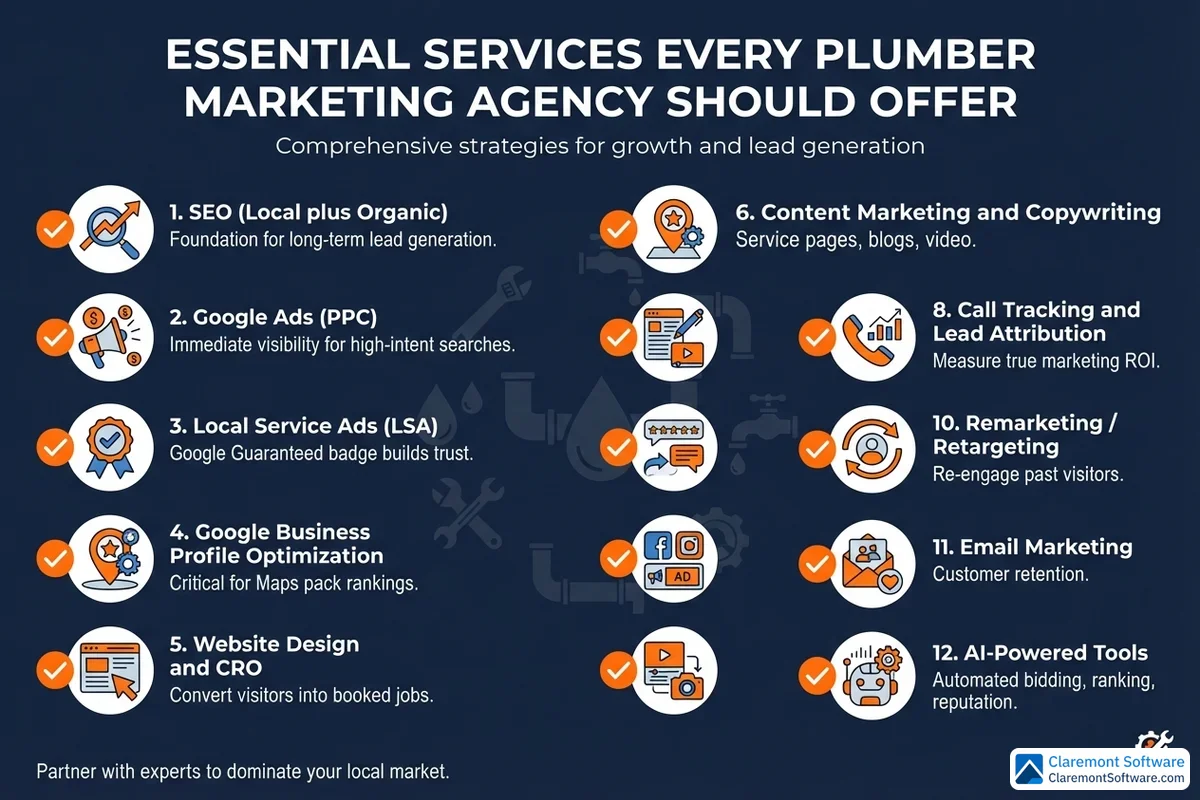
Not every marketing agency that claims to serve plumbers actually delivers the full range of services your business needs to compete in 2026. Before you evaluate specific agencies, it's worth establishing a baseline — a clear picture of what a genuinely capable plumber marketing partner should bring to the table. Some of these services are non-negotiable; others represent the advanced capabilities that separate good agencies from great ones.
Core Digital Services: The Foundation
Any plumber marketing agency worth considering must have deep expertise in the four pillars of local digital visibility:
- Local and organic SEO — optimizing your website and online presence to rank for high-intent searches like "water heater replacement [city]" or "emergency plumber near me." This includes technical SEO, on-page optimization, local citation building, and link acquisition.
- Google Ads (PPC) management — running paid search campaigns that put your business in front of homeowners actively searching for plumbing services, with bidding strategies calibrated to your specific average ticket values and service mix.
- Google Local Service Ads (LSA) — managing your Google Guaranteed badge and LSA campaigns, which consistently deliver some of the lowest cost-per-lead figures available to plumbers. Agencies should handle verification, budget management, and lead dispute processes on your behalf.
- Google Business Profile optimization — your Maps listing is often the first thing a potential customer sees. Agencies should actively manage your profile, including photos, service categories, Q&A, and posting cadence.
Website Design Built for Plumbing Conversions
A generic website template won't cut it. Your agency should build or optimize a site that is mobile-first and fast-loading — because the majority of plumbing searches happen on smartphones, often during stressful situations. Every page should feature prominent click-to-call buttons, online booking integration, and trust signals like licenses, insurance badges, and review counts. The goal isn't a pretty website; it's a website that converts visitors into booked jobs.
Content Marketing with Plumbing-Specific Intent
Effective content for plumbing companies goes well beyond generic blog posts. Your agency should develop service pages targeting specific jobs (tankless water heater installation, hydro jetting, sewer line repair) and location pages targeting the neighborhoods and suburbs within your service area. Video content — job walkthroughs, explainer videos, and customer testimonials — is increasingly important for both SEO and conversion. Every piece of content should be built around how real customers search for plumbing help, not just what sounds good.
Reputation Management and Review Generation
Online reviews directly influence both your Google Maps rankings and your conversion rate. A strong agency will implement systematic review generation — automated follow-up sequences that prompt satisfied customers to leave reviews on Google — alongside active monitoring and response management. This isn't a set-it-and-forget-it feature; it's an ongoing process that compounds in value over time.
Advanced Services That Drive Competitive Advantage
Once the foundation is in place, leading agencies layer in capabilities that amplify results:
- Call tracking and lead attribution — knowing exactly which campaigns generate booked jobs, not just calls
- Remarketing and retargeting — re-engaging website visitors who didn't convert on their first visit
- Social media advertising — particularly useful for promoting seasonal offers and building brand awareness in your service area
- Email marketing — reactivating past customers for maintenance, upgrades, and referrals
- AI-powered optimization tools — automated bid adjustments, performance forecasting, and intelligent budget allocation across channels
The presence — or absence — of these services tells you a great deal about whether an agency is equipped to grow with your business over the long term.
How to Evaluate a Plumber Marketing Agency: The Criteria That Actually Matter
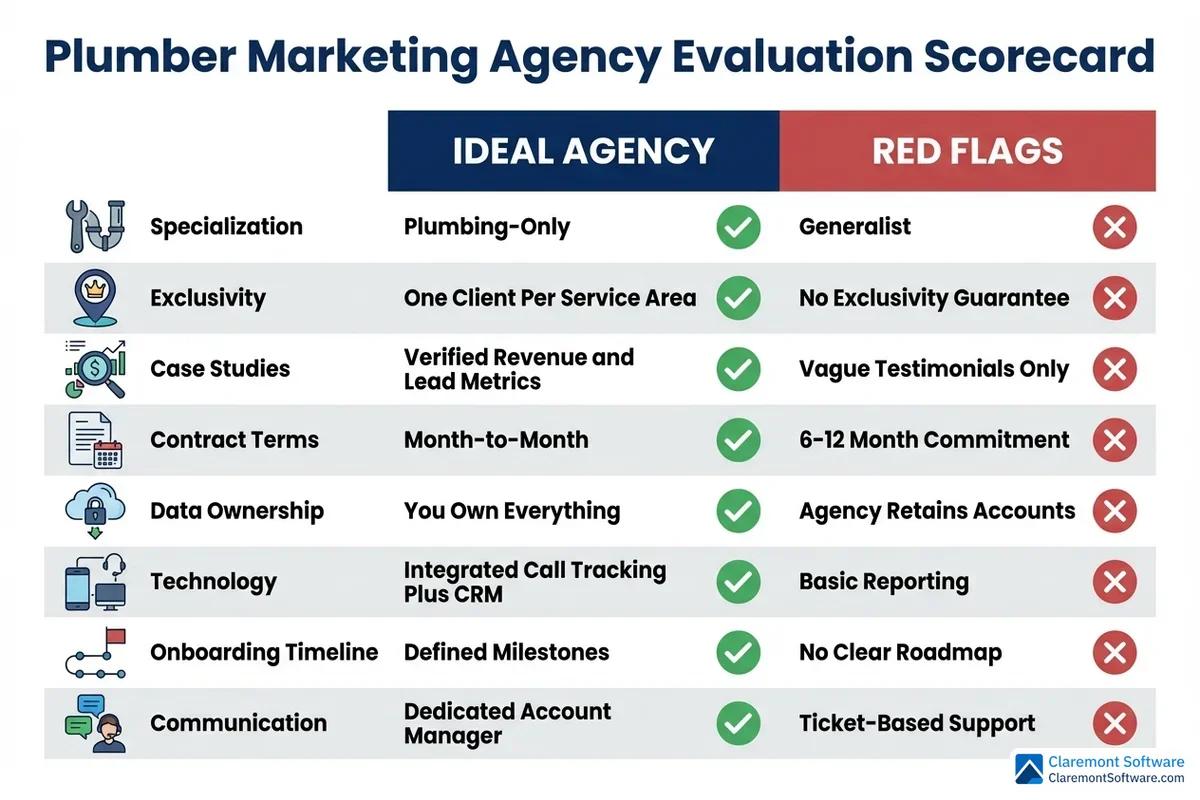
Not all plumber marketing agencies are created equal — and the criteria most plumbing business owners use to evaluate them (price, website appearance, a slick sales pitch) are often the wrong ones. Before you sign anything, here are the five evaluation criteria that actually predict whether an agency will deliver meaningful results for your business.
1. Industry Specialization Depth
The first question to ask any prospective agency is simple: who else do you work with? An agency that exclusively serves plumbing companies brings a fundamentally different level of expertise than one that splits its attention between plumbers, dentists, law firms, and e-commerce brands. Plumbing-only specialists have already built out their keyword libraries, tested their ad copy across dozens of markets, and developed a genuine understanding of your customer psychology — the urgency of an emergency call, the trust signals that convert a comparison shopper, the seasonal patterns that should drive budget decisions.
That said, broader home service agencies — those serving plumbing alongside HVAC, electrical, and similar trades — aren't automatically inferior. They often have larger teams, more sophisticated technology infrastructure, and greater capacity for enterprise-level campaigns. The key is understanding how deep their plumbing expertise actually runs, not just whether it exists. Ask how many active plumbing clients they currently serve, who specifically on their team manages plumbing accounts, and whether they have documented benchmarks for plumbing-specific metrics like cost-per-lead by service type.
2. Exclusivity Agreements in Your Service Area
This is the single most overlooked question plumbers ask — and potentially the most important. If an agency is simultaneously marketing for two competing plumbing companies in the same city, those campaigns are, by definition, working against each other. Your ad dollars are competing with their ad dollars. Your SEO gains are offset by theirs.
Top-tier agencies address this directly by partnering with only one plumbing company per service area. This isn't just an ethical nicety — it's a structural commitment that aligns the agency's success entirely with yours. Before signing any contract, ask explicitly: "Do you currently work with any other plumbing companies in my service area, and will you agree in writing not to take on competitors while we work together?" Any hesitation or vague answer is a red flag worth taking seriously.
3. Proven Results with Verifiable Case Studies
Every agency will tell you they generate leads and grow businesses. What separates credible agencies from the rest is their ability to back those claims with specific, verifiable numbers. Look for case studies that include concrete metrics: percentage revenue growth, lead volume increases, cost-per-lead figures, and realistic timelines to results. A case study that describes a client achieving a 500% revenue increase within 10 to 12 months — with documented call volume improvements within the first 10 weeks — tells you far more than a testimonial that simply says "they did a great job."
Push for details. Ask what the client's starting point was, what channels drove the results, and whether you can speak directly with that client. Agencies confident in their results will welcome that request. Those who deflect or offer only vague success stories are telling you something important about what you can realistically expect.
4. Technology Stack and Integrations
The best plumber marketing agencies don't just run campaigns — they build systems that connect your marketing spend directly to booked jobs and revenue. This requires a professional technology stack: call tracking software that records and scores inbound calls, transparent reporting dashboards that show performance by channel, and direct integrations with field service management platforms so you can see the full journey from ad click to completed job.
Ask any prospective agency which call tracking platform they use, what their reporting dashboard looks like, and which field service software they integrate with. If their reporting stops at "clicks" and "impressions" rather than connecting through to booked jobs and revenue, you'll have no reliable way to measure whether your investment is actually working.
5. Contract Terms, Data Ownership, and Cancellation Policies
Finally, understand exactly what happens if you leave. Who owns your website? Who owns your Google Ads account and its accumulated performance history? Who owns the content that's been written for your service pages? Some agencies build your entire digital presence on infrastructure they control — meaning if you cancel, you walk away with nothing and start from scratch.
The best agencies offer month-to-month arrangements because they're confident enough in their results that they don't need to trap clients in long-term commitments. They'll also confirm in writing that you own your domain, your ad accounts, and all content produced on your behalf. Agencies that insist on 12-month contracts with no performance guarantees are prioritizing their revenue security over your results — and that misalignment rarely ends well.
Pricing Models and Cost Comparison: What Plumber Marketing Actually Costs in 2026

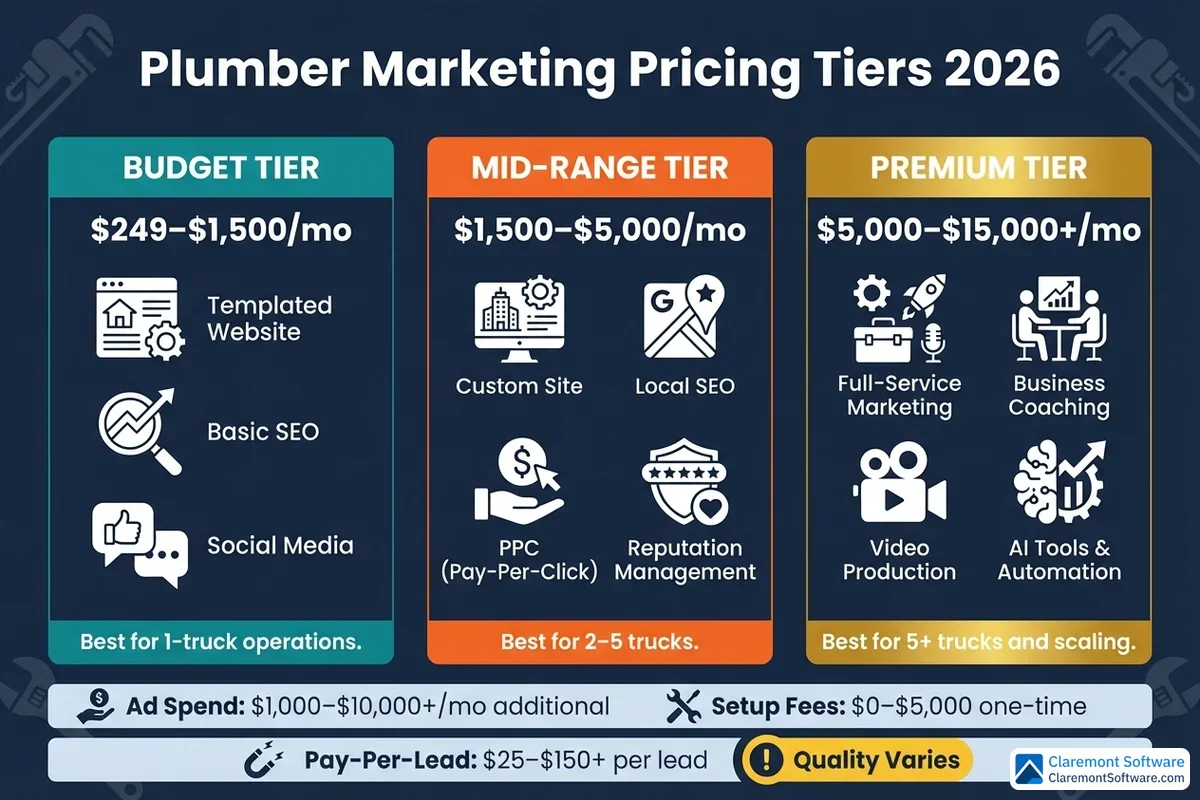
Understanding what plumber marketing actually costs in 2026 — and what you get at each price point — is essential before you start reaching out to agencies. The range is wider than most plumbing business owners expect, and the differences between tiers aren't just about budget. They reflect fundamentally different levels of service, customization, and growth potential.
Budget Tier: $249–$1,500/Month
Entry-level plumber marketing packages are designed for solo operators and small shops that need a professional digital presence without a significant monthly commitment. At this tier, you'll typically receive a templated website built on a shared platform, basic local SEO setup, and scheduled social media posting. Some providers at this level offer no-contract arrangements with money-back guarantees — a meaningful sign of confidence given the price point.
What you won't get is customization, dedicated account management, or active campaign optimization. These packages are largely automated and systematized, which keeps costs low but limits how aggressively they can compete in crowded markets. If you're a one-truck operation just establishing your online presence, this tier can be a reasonable starting point. If you're already running two or three trucks and competing against established local players, you'll likely outgrow it quickly.
One important note: ad spend is almost always separate from the management fee at every tier. A $500/month package does not include $500 worth of Google Ads. Budget accordingly.
Mid-Range Tier: $1,500–$5,000/Month
This is where most growing plumbing businesses — typically two to five trucks — find the right balance of investment and return. At this level, agencies deliver custom website design built specifically for plumbing conversions, active local SEO management, Google Ads and/or Local Service Ads campaign management, reputation management with review generation, and a dedicated account manager who knows your business.
The shift from templated to custom is significant. Your website is built around your specific service area, service mix, and competitive landscape rather than a generic plumbing template. Your campaigns are actively monitored and adjusted rather than set and forgotten. You're getting a genuine marketing partner rather than a software subscription.
This tier is where meaningful ROI becomes realistic — and where the quality differences between agencies become most apparent.
Premium Tier: $5,000–$15,000+/Month
Full-service plumber marketing at the premium level is built for aggressive scaling, multi-location operations, and business owners who want marketing to be a true growth engine rather than just a lead source. Expect the complete stack: SEO, PPC, LSA, video production, content marketing, social media advertising, AI-powered campaign optimization, and advanced reporting tied directly to revenue.
Many premium agencies at this level also layer in business growth consulting — covering areas like recruitment, operational efficiency, and even mergers and acquisitions strategy. For plumbing companies targeting eight-figure valuations or multi-market expansion, this integrated approach can be genuinely transformative.
Pricing Models Compared
- Monthly retainers — the most common structure, offering predictable costs and ongoing service
- Pay-per-lead — attractive in theory, but lead quality is notoriously inconsistent and agencies have little incentive to optimize for booked jobs rather than raw call volume
- Performance-based — rare but growing, typically involving a base retainer plus bonuses tied to revenue milestones
- Hybrid models — a base management fee plus a percentage of ad spend, common at mid-range and premium tiers
Hidden Costs to Watch For
Beyond the monthly management fee, budget for these common additional expenses:
- Ad spend — typically $500–$3,000/month at the mid-range tier, separate from management fees
- Setup or onboarding fees — ranging from $500 to $5,000 depending on the scope of initial work
- Website redesign — sometimes billed as a one-time upfront cost rather than included in the monthly retainer
- Call tracking software — occasionally billed separately, though top agencies include it in their packages
The cheapest option is rarely the most cost-effective one. A $249/month package that generates no qualified leads costs you far more in lost revenue than a $2,500/month investment that consistently delivers booked jobs.
Niche-Exclusive Plumber Agencies vs. Broader Home Service Marketing Firms
The choice between a plumbing-only agency and a broader home service marketing firm isn't simply a matter of preference — it's a strategic decision that should reflect where your business is today and where you intend to take it over the next three to five years.
The Case for Plumbing-Only Specialists
Agencies that work exclusively with plumbing companies bring a level of industry fluency that's genuinely difficult to replicate. Their keyword libraries have been built and refined across dozens of markets. Their ad copy has been tested against real plumbing customers in real competitive environments. Their understanding of your business model — average ticket values, emergency call dynamics, seasonal demand patterns, the difference between a drain cleaning lead and a water heater replacement lead — comes from accumulated experience rather than a quick onboarding call.
Some of the most respected names in this space were founded by people who spent a decade or more working in the plumbing industry before transitioning to marketing. That background matters. An agency founder who has dispatched trucks, managed callbacks, and understood the economics of a service call thinks about your marketing differently than someone who learned the industry from a client intake form. They know that a missed call at 11pm on a Sunday isn't just a lost lead — it's potentially a $3,000 job that went to your competitor.
Plumbing-only agencies also tend to move faster during onboarding. Their systems, templates, and processes are already calibrated for your industry, which means less time spent educating your agency and more time generating results.
The Case for Broader Home Service Firms
Agencies that serve plumbing alongside HVAC, electrical, and other trades typically operate at a larger scale — and that scale has real advantages. Larger teams mean dedicated specialists for each channel rather than generalists wearing multiple hats. More sophisticated technology infrastructure means better integrations, more advanced reporting, and greater capacity to run complex multi-channel campaigns simultaneously.
For plumbing companies operating at the enterprise level — multiple locations, significant monthly ad budgets, aggressive expansion timelines — a larger home service agency may simply have more horsepower to match your ambitions.
Exclusivity Remains the Critical Variable
Regardless of which category an agency falls into, exclusivity within your service area is the single most important structural factor to evaluate. An agency that markets for two competing plumbing companies in the same city is, by definition, working against itself — and against you. Your campaigns compete for the same keywords, the same ad placements, and the same potential customers. The best agencies in both categories address this directly by committing to one plumbing client per market, ensuring their expertise and effort are fully aligned with your growth rather than divided across competitors.
The Growing Value of Bundled Business Services
A notable trend in 2026 is the expansion of agency offerings beyond pure marketing. Some agencies now bundle sales training, dispatch optimization, and business coaching alongside their digital services — and a select few have moved into territory like merger and acquisition consulting and exit strategy planning. For growth-minded owners building toward a significant business valuation, this kind of integrated support can be genuinely valuable. Marketing that drives revenue growth is more powerful when it's paired with operational guidance that helps you capture and retain that growth efficiently.
Matching Agency Type to Your Growth Trajectory
If your plumbing business is focused exclusively on plumbing services for the foreseeable future, a specialist agency's depth of knowledge is a meaningful advantage. But if you're planning to add HVAC or electrical services — a common growth path for scaling home service businesses — a broader agency that already understands those verticals may serve you better as you expand. Think about the agency relationship you're building for the next two to three years, not just the next quarter.
What Top-Performing Plumber Marketing Campaigns Look Like: Results and Benchmarks

Numbers tell the real story when evaluating a plumber marketing agency. Promises are easy to make — verifiable results are what separate agencies worth hiring from those worth avoiding.
Revenue Growth: What's Actually Achievable
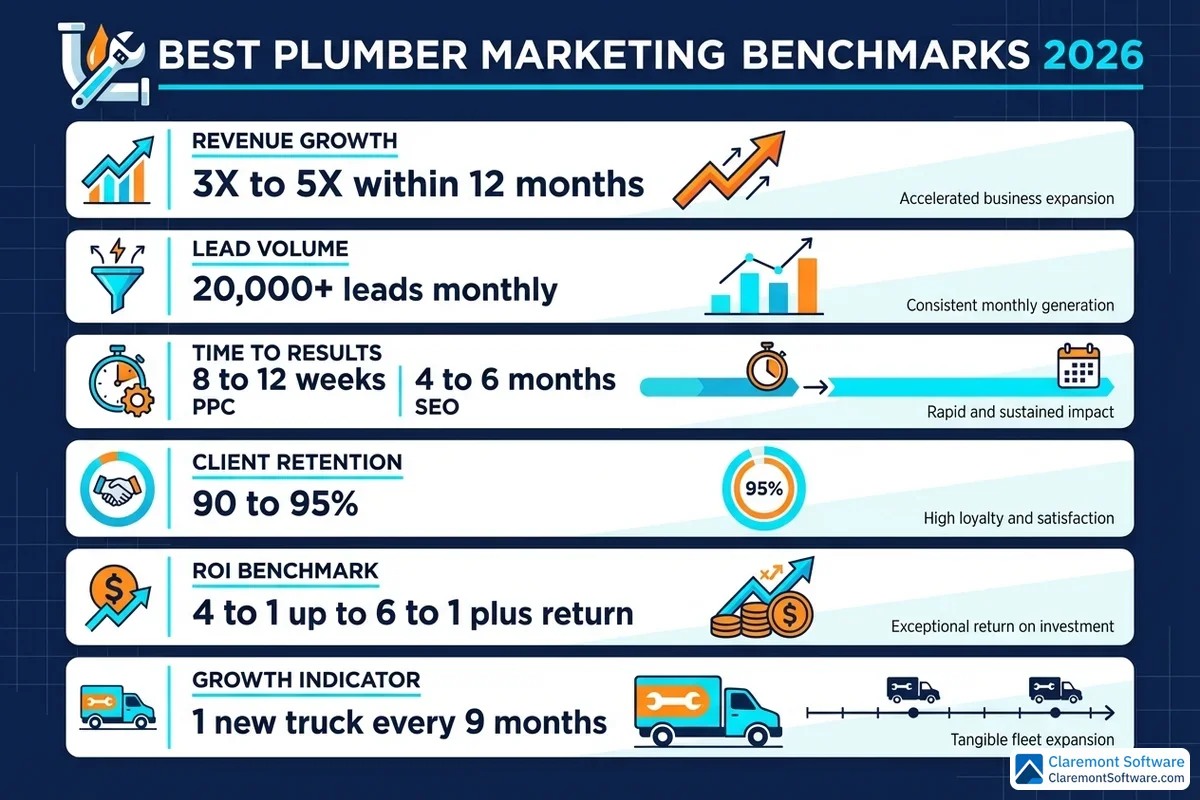
The best-performing plumber marketing campaigns don't just generate more calls. They fundamentally change the trajectory of a plumbing business. Top agencies in this space report helping clients achieve 3X–5X revenue growth within a single calendar year, and documented case studies show 500% revenue increases achieved in as little as 10 to 12 months. These aren't outlier results reserved for businesses that were already positioned for explosive growth — they reflect what happens when the right marketing infrastructure meets consistent execution in a market with real demand.
That said, results at this level require the right budget tier, a competitive service area, and a business operation capable of handling increased call volume. Marketing can fill your phones; it can't fix a broken dispatch system or an undertrained team.
Lead Generation Benchmarks
At the agency level, high-performing firms generate 20,000 or more leads monthly across their entire client base — a figure that reflects both the scale of their operations and the consistency of their systems. For individual plumbing companies, the more meaningful benchmark is what happens within the first 8 to 12 weeks of a campaign launch. Well-structured Google Ads and Local Service Ads campaigns can produce measurable call volume increases within that window, often within 14 business days for paid channels specifically.
Organic SEO takes longer to compound, but the leads it eventually generates tend to carry lower cost-per-acquisition over time.
ROI by Channel: Setting Realistic Expectations
Not all marketing channels deliver returns on the same timeline or at the same cost:
- Google Local Service Ads (LSA) — typically delivers the lowest cost-per-lead of any paid channel, with the added credibility of the Google Guaranteed badge driving higher conversion rates
- Google Ads PPC — faster to launch than SEO, highly controllable, and effective for targeting high-intent searches like "emergency plumber near me" — but costs rise in competitive markets
- Organic SEO — the slowest channel to produce results (expect 4–6 months before meaningful ranking movement), but the highest long-term ROI once established, as traffic compounds without proportional increases in spend
Client Retention as a Proxy for Quality
One of the most underused evaluation metrics when choosing an agency is client retention rate. Agencies that consistently deliver results don't need to replace churning clients with new ones — their existing clients stay and grow. Retention rates above 90% are a meaningful signal that an agency's results hold up beyond the honeymoon period of a new engagement. Always ask a prospective agency for their retention rate and average client tenure before signing anything.
What Real Growth Looks Like in Practice
The most telling benchmark isn't a percentage — it's a truck. Plumbing businesses with well-executed marketing programs report adding one new service truck approximately every nine months, a growth rate that reflects sustained lead volume, higher average ticket values, and improved operational efficiency working in concert. That's the kind of compounding, measurable outcome that distinguishes a true marketing partner from a vendor simply billing a monthly retainer.
AI and Emerging Technology in Plumber Marketing for 2026
The marketing technology powering plumber campaigns in 2026 looks fundamentally different from what existed even two years ago. Agencies that haven't adapted are quietly falling behind — and the plumbing businesses working with them are paying the price in wasted ad spend and missed opportunities.
AI-Powered Advertising Optimization
The days of manually adjusting bids and budgets based on weekly performance reports are largely over at the premium agency level. Leading firms now deploy artificial intelligence that monitors campaign performance in real time and automatically adjusts bids, budget allocation, and audience targeting across Google Ads and Local Service Ads simultaneously. When a competitor drops out of an auction, when search volume spikes after a cold front moves through your service area, or when a particular ad variation starts outperforming others — AI systems respond in minutes rather than days. For plumbing businesses operating in competitive markets where cost-per-click can exceed $50, that responsiveness translates directly into lower cost-per-lead and higher return on ad spend.
AI Reputation Management
Reputation management has historically been one of the most time-consuming aspects of plumber marketing — monitoring review platforms, crafting thoughtful responses, and systematically requesting reviews from satisfied customers. AI is now handling significant portions of that workflow automatically. Automated review response tools can generate personalized, contextually appropriate replies within minutes of a new review posting. Sentiment analysis flags negative feedback before it compounds. Proactive review solicitation sequences trigger automatically after job completion, dramatically increasing review volume without requiring manual follow-up from your office staff. At premium agencies, these capabilities are increasingly standard rather than optional add-ons.
SEO in the Age of AI Search
Perhaps the most significant shift in plumber marketing right now is happening in search itself. Google's AI Overviews now appear above traditional organic results for a growing percentage of plumbing-related queries, and AI-powered search tools are becoming a meaningful source of referral traffic for local service businesses. Forward-thinking agencies are no longer optimizing exclusively for traditional blue-link rankings — they're structuring plumber content to be cited and surfaced by AI systems, which favor authoritative, well-organized, locally specific information. Agencies still focused purely on legacy SEO tactics are leaving a growing slice of search visibility on the table.
24/7 AI Customer Service and Lead Capture
For plumbing businesses, the phone call that comes in at midnight on a holiday weekend is often the highest-value lead of the week. AI-powered chat and phone answering tools now qualify those leads, gather job details, and book appointments without requiring a human on the other end — capturing emergency calls that would otherwise go to voicemail and straight to a competitor.
Predictive Analytics and Seasonal Forecasting
The most sophisticated agencies are using AI-driven predictive tools to anticipate demand before it arrives. Historical data combined with weather forecasting and regional trend analysis allows agencies to pre-position marketing spend ahead of frozen pipe season, spring sewer line surges, and other predictable demand spikes — so your campaigns are already running at full strength when customers start searching.
Integration with Field Service Software: Why It Matters More Than You Think
Most plumbing business owners evaluate marketing agencies on two things: price and promises. The metric that actually predicts whether you'll get a return on your investment is something far more operational — how deeply the agency connects its marketing activity to your actual business outcomes.
The best plumber marketing agencies don't just track clicks and calls. They integrate directly with field service management platforms to create a closed-loop system that follows every lead from the first touchpoint through to a booked job, completed service, and recorded revenue. When that infrastructure is in place, you're no longer guessing whether your marketing is working. You can see exactly which campaign generated a specific call, whether that call converted to a booked appointment, and what that job was ultimately worth.
Why Closed-Loop Reporting Changes Everything
Without this integration, you're making budget decisions based on incomplete information. An agency might report that your Google Ads campaign generated 80 calls last month — but if 30 of those were existing customers, 15 were wrong numbers, and 10 went to voicemail and were never followed up, the actual performance picture looks very different from the headline number. Closed-loop reporting eliminates that ambiguity by connecting marketing data to the job records inside your field service software, giving you cost-per-booked-job figures rather than just cost-per-call.
Call tracking technology is the bridge that makes this possible. Professional call tracking assigns unique phone numbers to each marketing channel, records calls for quality scoring, flags missed calls for follow-up, and feeds conversion data back into your ad campaigns so the algorithm optimizes toward calls that actually become jobs — not just any calls.
CRM Integration and Lifetime Value
The integration advantage extends beyond lead attribution. When your marketing platform connects to your CRM, automated follow-up sequences can trigger after estimates that didn't close, review requests can deploy automatically after completed jobs, and dormant customer reactivation campaigns can run in the background without anyone on your team lifting a finger. These workflows compound over time, increasing the lifetime value of every customer your marketing originally acquired.
When evaluating any agency, ask directly: which field service platforms do you integrate with, and does your reporting connect marketing spend to revenue — not just lead volume? The answer will tell you more than any case study they put in front of you.
Red Flags and Common Mistakes When Choosing a Plumber Marketing Agency

Protecting your plumbing business from a bad agency partnership is just as important as finding a great one. The warning signs are usually visible before you sign anything — if you know what to look for.
They Can't Show You Specific Numbers
Any agency can claim they "increased leads" or "improved online visibility" for their clients. What separates legitimate agencies from underperformers is the ability to back those claims with verifiable, specific metrics: percentage revenue growth, cost-per-lead figures, call volume increases, and the timeline over which those results were achieved. If a prospective agency responds to your request for case studies with vague testimonials and general success language — no numbers, no timelines, no named outcomes — treat that as a serious warning sign. Real results leave a paper trail.
They Own Your Digital Assets
This is one of the most damaging traps plumbing business owners fall into. Some agencies build your website on their proprietary platform, register your domain in their name, or set up your Google Ads account under their agency umbrella rather than yours. When you eventually leave — and at some point, most businesses change agencies — you discover you're walking away empty-handed. Your website disappears. Your ad account history, which Google's algorithm uses to optimize campaign performance, stays with them. You're starting from zero. Before signing anything, confirm in writing that you own your domain, your website files, and your advertising accounts outright.
Long Contracts Without Performance Accountability
Month-to-month arrangements have become a meaningful differentiator among confident, results-driven agencies. When an agency insists on locking you into a 12-month contract with no performance benchmarks attached, ask yourself why they need that protection. Agencies that consistently deliver results don't need contractual handcuffs to retain clients — their outcomes do that work for them. Long contracts without performance guarantees shift all the risk onto you.
No Service-Area Exclusivity
If an agency is simultaneously running campaigns for two competing plumbing companies in the same city, your marketing dollars are effectively bidding against each other in the same Google auctions. Always ask directly: do you currently work with any other plumbing companies in my service area, and will you take on competitors while I'm a client? Exclusivity isn't just a nice-to-have — it's a fundamental conflict-of-interest protection.
Choosing on Price Alone
The cheapest option is rarely the least expensive in practice. A $249/month package that generates low-quality leads, no leads, or leads your team can't convert costs you far more than a mid-range investment that delivers consistent, bookable jobs. Evaluate agencies on cost-per-booked-job potential, not monthly retainer size.
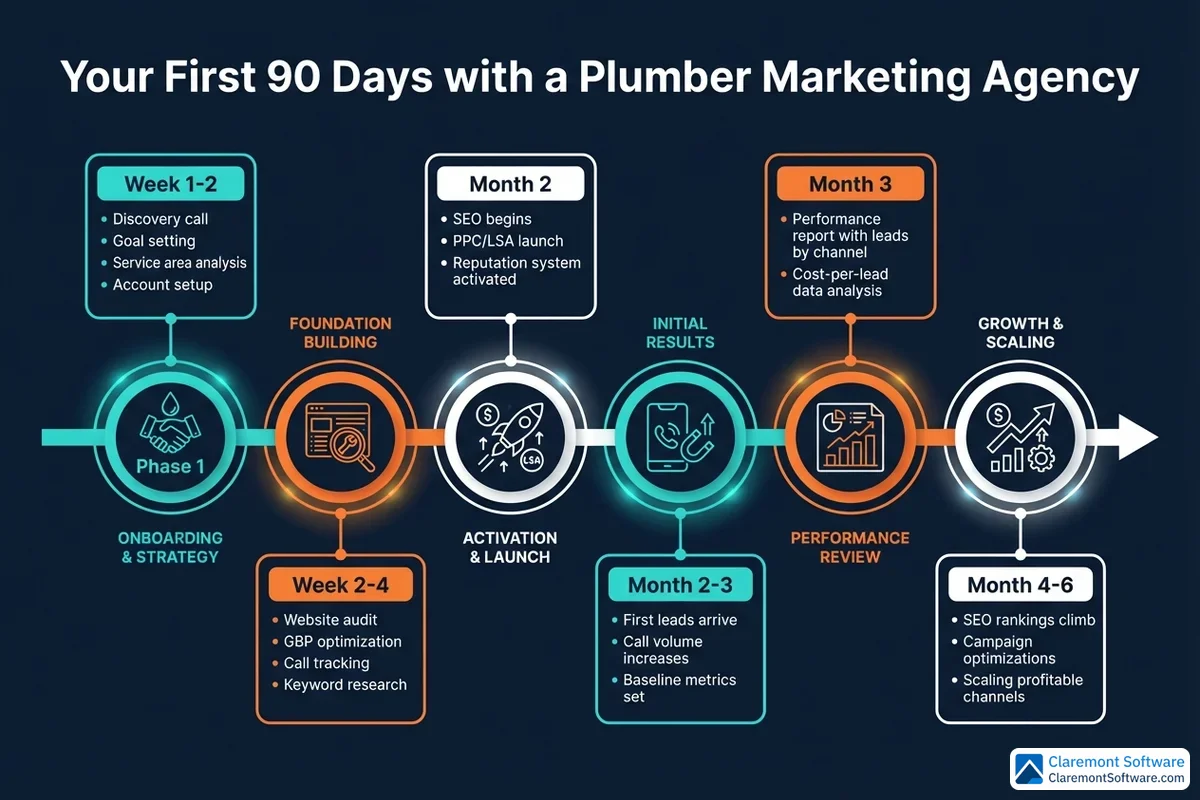
How to Get Started: Your First 90 Days with a Plumber Marketing Agency
Signing with a plumber marketing agency is just the beginning. What happens in the first 90 days largely determines whether the relationship delivers real growth or becomes another line item you quietly resent. Knowing what a well-structured onboarding process looks like — and what milestones to hold your agency accountable to — puts you in a far stronger position from day one.
Weeks 1–2: Discovery and Foundation
A serious agency doesn't start building anything until they understand your business. Expect a thorough discovery call that covers your service area boundaries, the specific services you want to prioritize (drain cleaning, water heaters, emergency calls), your average ticket value, current call volume, existing marketing efforts, and your growth targets for the next 12 months. This isn't small talk — it's the data that shapes every campaign decision that follows.
Use this phase to evaluate the agency as much as they're evaluating your business. Are they asking smart, specific questions? Do they understand the difference between a $150 drain snake call and a $4,000 repipe? Agencies that treat onboarding as a formality tend to deliver generic results.
Weeks 2–4: Infrastructure Setup
With discovery complete, the groundwork begins. This typically includes a full audit of your existing website, a Google Business Profile optimization pass, call tracking implementation across all your marketing channels, and a competitive keyword analysis of your service area. If a new website is part of your package, the design and development process kicks off here.
This phase is largely behind the scenes, but it's critical. Skipping or rushing it produces campaigns built on a weak foundation — and weak foundations produce weak results.
Month 2: Campaigns Go Live
By the second month, the visible work begins. SEO implementation starts with on-page optimization, service page development, and local citation building. Google Ads and Local Service Ads campaigns launch, targeting your highest-priority services and service areas. Your reputation management system activates, beginning the process of systematically generating reviews from satisfied customers.
Equally important: baseline metrics get established. You should receive a reporting dashboard that shows calls by channel, cost-per-lead, and lead quality — giving you a clear starting point to measure progress against.
Month 3: First Real Data
This is where the picture starts to come into focus. Expect meaningful increases in call volume from your PPC and LSA campaigns — these paid channels can generate leads within weeks of launch. Early SEO movement may appear in the form of improved rankings for lower-competition local keywords, though significant organic traffic growth takes longer.
Set realistic expectations going in. Paid advertising delivers speed; SEO delivers compounding long-term value. Any agency promising page-one Google rankings within 30 days is either misleading you or planning to use tactics that will eventually hurt your site. Honest agencies will tell you that organic SEO typically takes four to six months to produce significant ranking improvements — and that timeline is worth the wait.
Done-for-You vs. DIY Plumber Marketing: When to Hire an Agency
If you're running a one-truck plumbing operation and every dollar counts, the idea of paying an agency $1,500 or more per month can feel out of reach — and honestly, at that stage, it might be. DIY marketing is a legitimate starting point, and the tools available to solo operators today are better than they've ever been. Optimizing your Google Business Profile costs nothing but time. Collecting reviews from satisfied customers requires a system, not a budget. Posting consistently on social media can build local brand recognition without spending a cent on ads.
The honest caveat: DIY marketing requires real time investment. Every hour you spend writing a service page, responding to reviews, or figuring out why your Google Business Profile isn't showing up in the map pack is an hour you're not on a job, not training a helper, and not running your business. For a solo operator with flexible hours, that trade-off can make sense. For a growing operation, it rarely does.
The Break-Even Point Most Plumbers Miss
The math shifts significantly once you're running two or three trucks. At that scale, your time has a measurable dollar value — and the opportunity cost of doing your own marketing almost always exceeds what a mid-range agency would charge. You're not just paying for marketing execution when you hire an agency; you're buying back the hours you'd otherwise spend on tasks that aren't your highest-value work.
A useful rule of thumb: if your time is worth more than what an agency charges per hour to manage your marketing, outsourcing is the financially rational choice. For most plumbing business owners at the 2–3 truck stage, that calculation tips toward hiring help.
What an Agency Brings That DIY Can't Replicate
Beyond time savings, agencies bring structural advantages that are genuinely difficult to replicate on your own:
- Professional-grade tools for call tracking, keyword research, competitive analysis, and campaign optimization that cost thousands per month to access independently
- Dedicated channel specialists — an SEO strategist, a PPC manager, a web developer — rather than one generalist (you) trying to stay current across every discipline
- Industry benchmarks that tell you whether your cost-per-lead is competitive or whether you're overpaying for traffic
- Scalability — when a cold snap hits and emergency calls spike, a good agency can increase your ad spend and adjust targeting within hours, not days
The Hybrid Middle Ground
Not every plumber needs to hand over everything. A practical middle path works well for budget-conscious operators who want to stay involved: manage your own social media and review responses while outsourcing your SEO, Google Ads, and website to an agency. This keeps your monthly costs lower while ensuring the highest-complexity, highest-impact channels are handled by specialists.
The real question was never whether you can afford an agency. It's whether you can afford to keep doing it yourself — and what that choice is actually costing your business in missed calls, lost rankings, and growth that isn't happening.
Conclusion
Choosing the right plumber marketing agency is ultimately a business decision, not a marketing one. The agency that's right for a solo operator just building an online presence looks nothing like the right partner for a five-truck operation targeting aggressive market expansion — and treating those decisions as interchangeable is how plumbing businesses end up locked into contracts that don't serve them.
The fundamentals don't change regardless of budget: demand service-area exclusivity, insist on full ownership of your digital assets, and hold any prospective agency accountable to real metrics — booked jobs and revenue, not clicks and impressions. Ask for verifiable case studies, confirm their technology integrations, and walk away from anyone who can't answer those questions directly.
Use the pricing benchmarks, evaluation criteria, and red flags in this guide to build your shortlist. Reach out to three to five agencies that genuinely match your current size and growth goals, ask the hard questions, and compare their answers side by side.
The plumbing market in 2026 rewards businesses with consistent, intelligent marketing behind them. The right agency doesn't just fill your phones — it builds the foundation your business grows on for years to come.
Related Reading
- Plumber Digital Marketing: The Complete Guide
- Plumber Advertising: What Works in 2026
- Plumber Lead Generation: 12 Strategies That Book Jobs
Frequently Asked Questions
How much does a plumber marketing agency cost per month in 2026?
Plumber marketing agency costs in 2026 range widely depending on the scope of services. Budget-tier packages start as low as $249/month and typically include templated websites, basic SEO, and social media posting — suitable for solo operators. Mid-range packages run $1,500–$5,000/month and include custom websites, local SEO, Google Ads management, and dedicated account support — ideal for 2–5 truck operations. Premium full-service engagements cost $5,000–$15,000+/month and include SEO, PPC, Local Service Ads, video production, and growth consulting for aggressive scaling. Keep in mind that ad spend is almost always billed separately on top of management fees, and some agencies charge one-time setup fees ranging from $500 to $5,000.
How long does it take to see results from a plumber marketing agency?
The timeline depends heavily on which marketing channels are being used. Google Local Service Ads and Pay-Per-Click campaigns can start generating leads within days to a few weeks of launch — some agencies report meaningful call volume increases within 8–12 weeks. SEO, however, is a longer game: expect 4–6 months before you see significant organic ranking improvements, with the strongest ROI building over 12+ months. Be cautious of any agency promising page-one SEO rankings within 30 days — that's not realistic. A well-structured campaign typically shows clear, measurable progress across all channels by the end of the first 90 days.
Should I choose a plumbing-only marketing agency or a general home service marketing firm?
Both have legitimate advantages, and the right choice depends on your business goals. Plumbing-only agencies bring deep industry knowledge, pre-built keyword strategies, and often have founders with hands-on plumbing experience — meaning they understand your business model, seasonal demand, and customer psychology from day one. Broader home service agencies (serving plumbing, HVAC, electrical, etc.) tend to have larger teams, more sophisticated technology, and greater capacity for enterprise-level campaigns. If you plan to expand into HVAC or electrical services, a broader agency may scale with you more naturally. The most critical factor regardless of agency type is whether they offer service-area exclusivity — ensuring they aren't also marketing for your direct competitors.
What is the most effective marketing channel for plumbers — SEO, PPC, or Local Service Ads?
Each channel serves a different purpose, and the most effective plumber marketing strategies use all three together. Google Local Service Ads (LSA) typically deliver the lowest cost-per-lead and highest trust factor thanks to the Google Guaranteed badge, making them ideal for capturing emergency service calls. Google Ads PPC provides fast, scalable lead volume with precise targeting but requires ongoing budget and management. Organic SEO has the slowest ramp-up — usually 4–6 months — but delivers the highest long-term ROI and compounds over time. For most plumbing businesses, LSA and PPC should drive immediate leads while SEO builds a sustainable foundation. Prioritizing all three channels together produces the strongest overall results.
Do I need a marketing agency if I'm a one-truck plumbing operation?
Not necessarily — but it depends on your growth goals and available time. Solo operators can get meaningful traction using free tools for Google Business Profile management, basic social media, and review collection. However, if you're looking to grow beyond one truck, the opportunity cost of doing your own marketing quickly outweighs the cost of hiring an agency. Budget-tier done-for-you packages starting around $249/month can provide professional-grade visibility without a large financial commitment. Some one-truck operators also take a hybrid approach — managing their own social media and reviews while outsourcing SEO and Google Ads to a specialist. The real question is whether your time is better spent on marketing or on running and growing your business.
What should I look for in a plumber marketing agency contract?
Before signing, scrutinize four key areas. First, data ownership: confirm that you own your website, domain name, Google Ads account history, and all content — if you leave, everything should come with you. Second, exclusivity: the contract should explicitly state that the agency will not market for another plumbing company in your service area. Third, contract length: the best agencies offer month-to-month arrangements because they're confident in their results — be wary of long-term lock-ins without performance guarantees. Fourth, reporting transparency: the contract should specify what metrics will be reported, how often, and whether reporting ties marketing spend directly to booked jobs and revenue — not just clicks or impressions.
How do I know if my plumber marketing agency is actually delivering results?
The clearest sign of a high-performing agency is a direct connection between their work and your revenue — not just vanity metrics like website traffic or social media likes. Ask for a reporting dashboard that shows leads by channel, cost-per-lead, call volume, and booked job rates. Agencies that integrate with field service management software can provide closed-loop reporting, showing exactly which marketing dollar generated which booked job. Key performance indicators to track include: inbound call volume growth, cost per booked job, Google Business Profile views and calls, and organic ranking improvements over time. If your agency can't clearly show how their work translates to revenue, that's a serious red flag.
Can a plumber marketing agency help me grow from a small shop to a multi-truck operation?
Yes — and the best agencies are specifically built to drive that kind of growth. Top-performing plumber marketing campaigns have helped small shops achieve 3X–5X revenue growth within a single year, with some case studies showing 500% revenue increases in 10–12 months. Real-world growth benchmarks include adding a new service truck roughly every 9 months as a direct result of increased lead volume and booked jobs. The most growth-oriented agencies go beyond marketing and offer business coaching, sales training, dispatch optimization, and even merger and acquisition consulting — treating your business growth holistically. When evaluating agencies, ask for specific case studies with verifiable metrics that reflect businesses at a similar starting point to yours.