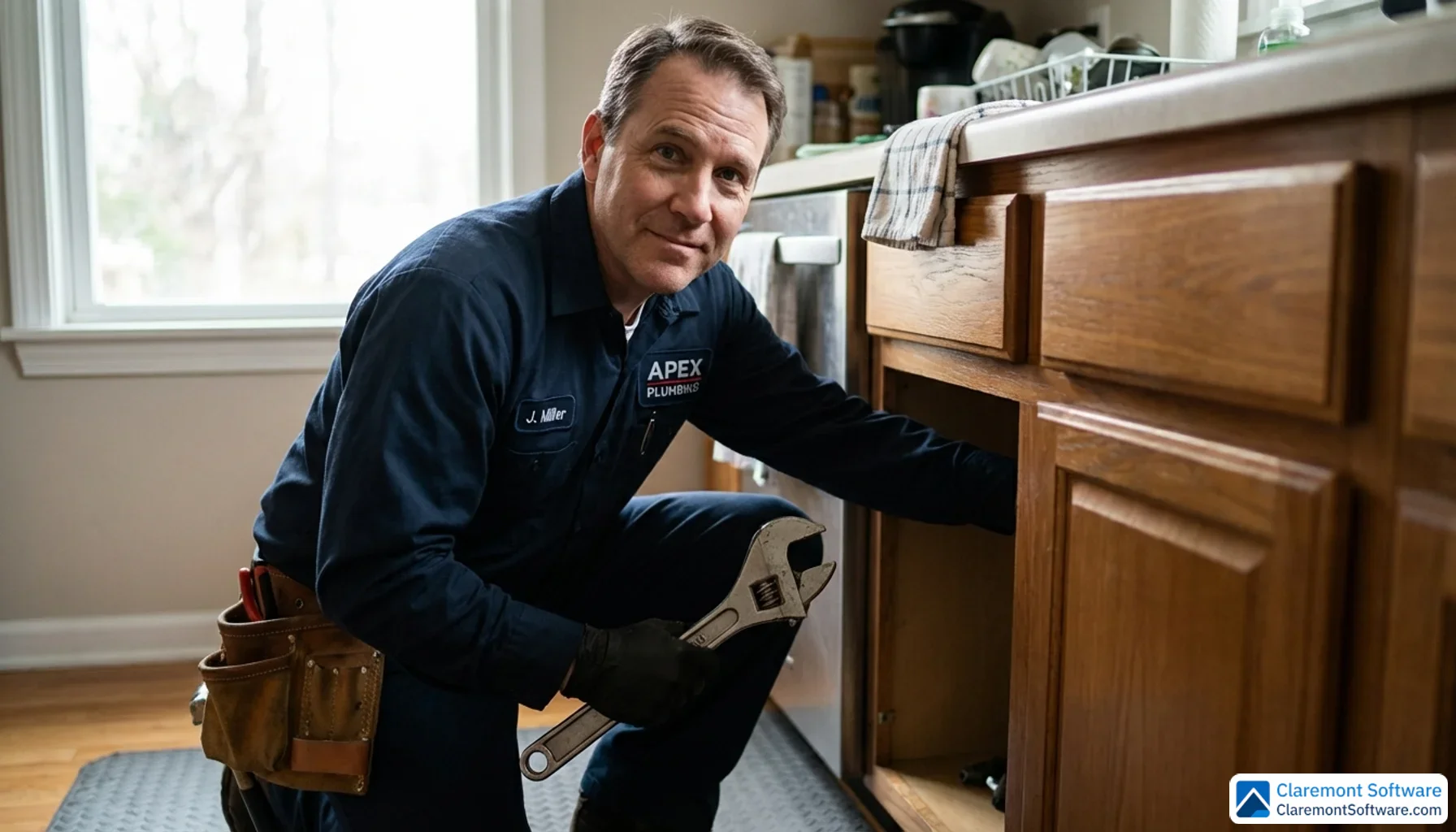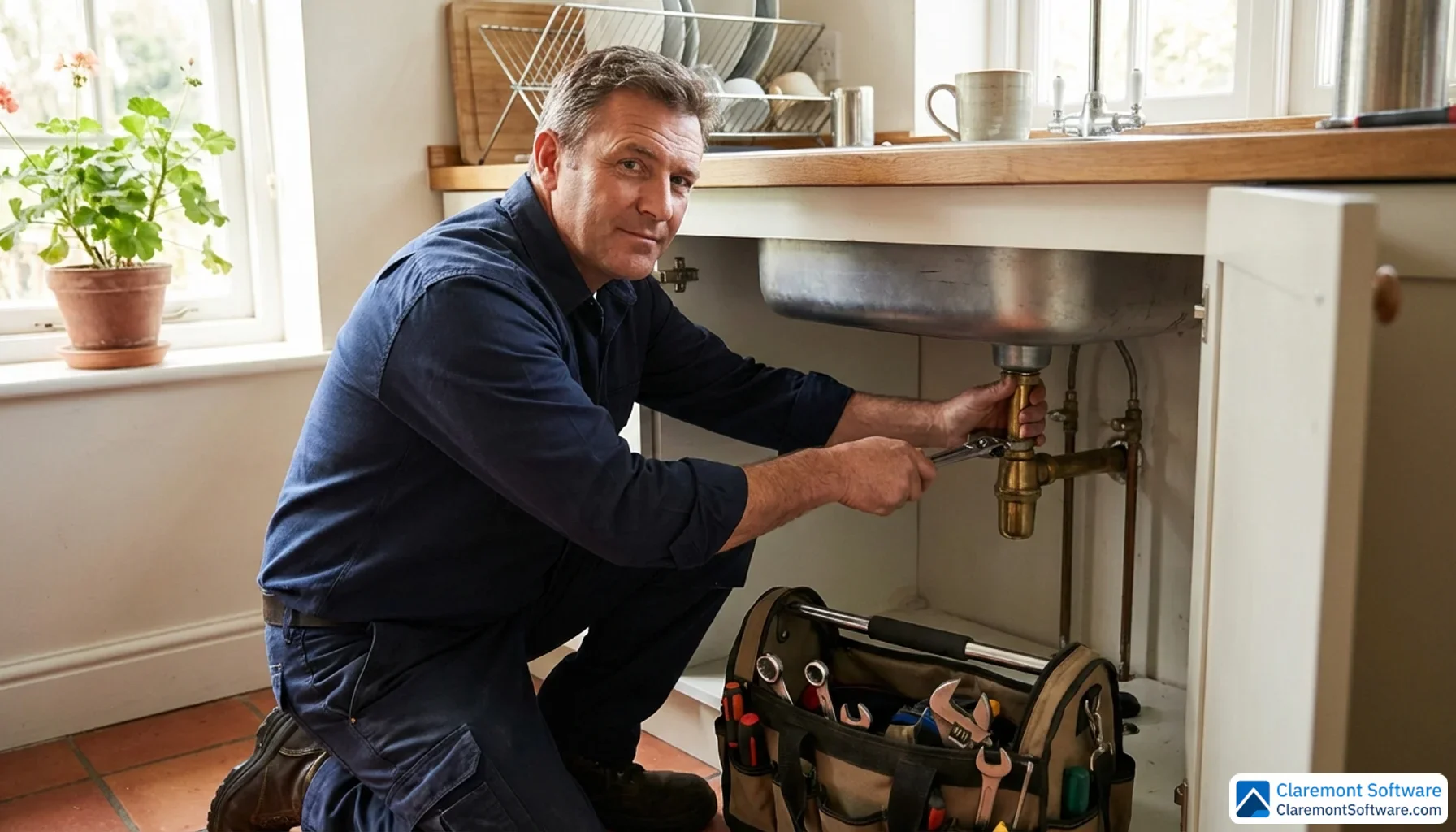
When a pipe bursts at 2 a.m., homeowners don't flip through the Yellow Pages — they grab their phone and call the first plumber who looks reliable, available, and professional. If that's not you, you're losing jobs to competitors who simply showed up first.
Here's the frustrating reality: most plumbers do excellent work. The problem isn't skill — it's visibility. And in 2026, the gap between plumbers who advertise strategically and those who don't has never been wider. Some channels are delivering qualified leads for under $30. Others are quietly draining budgets with nothing to show for it.
This guide cuts through the noise. Whether you're a solo operator trying to keep your schedule full or running a multi-truck operation looking to scale, you'll find a clear breakdown of every major advertising channel — what actually generates calls, what wastes money, and how to allocate your budget based on where you are right now.
Expect concrete cost-per-lead benchmarks, ad copy formulas that convert, and the specific mistakes that bleed plumbing ad budgets dry. No fluff, no vague advice — just what works.
Why Plumbing Businesses Can't Survive on Word of Mouth Alone
Word of mouth is a beautiful thing — until it isn't. When business is booming, referrals feel like free money. But when a slow season hits, a loyal customer moves away, or a key referral source dries up, there's nothing in the pipeline to fall back on. This feast-or-famine cycle is the silent killer of plumbing businesses, and it affects even the most skilled tradespeople in the industry.
The hard truth is that the homeowner decision process has fundamentally changed. Today, more than 90% of customers search online before picking up the phone — and when they do call, they're dialing whoever appeared first and looked trustworthy. They're not asking their neighbor for a recommendation. They're not waiting for a referral. They're typing "emergency plumber near me" at 11 p.m. and calling the first result that looks professional and available. If that's not you, the job goes to someone else — full stop.
This is where the real cost of not advertising reveals itself. It's not what you spend on ads — it's the revenue you never see because a potential customer found your competitor first. Every day without visibility is a day of missed calls, unbooked jobs, and revenue quietly walking out the door.
Here's what makes this especially frustrating: your competitors don't have to be better plumbers than you. They just have to show up first. Businesses that invest in advertising are systematically capturing the leads that should be yours, building review profiles that reinforce their credibility, and staying top of mind in your own service area.
The good news is that advertising isn't about abandoning word of mouth — it's about amplifying it. A strong referral from a happy customer is still gold. Advertising simply fills the gaps between those referrals, smooths out the slow seasons, and ensures you're visible to the customers who don't happen to know someone who knows you.
Think of it this way: your reputation gets you rehires and referrals. Advertising gets you the first call.
The Channels That Actually Generate Plumbing Leads in 2026
Not all plumbing leads are created equal — and neither are the channels that generate them. Before diving into the specifics of each platform, it helps to understand the landscape you're working with.
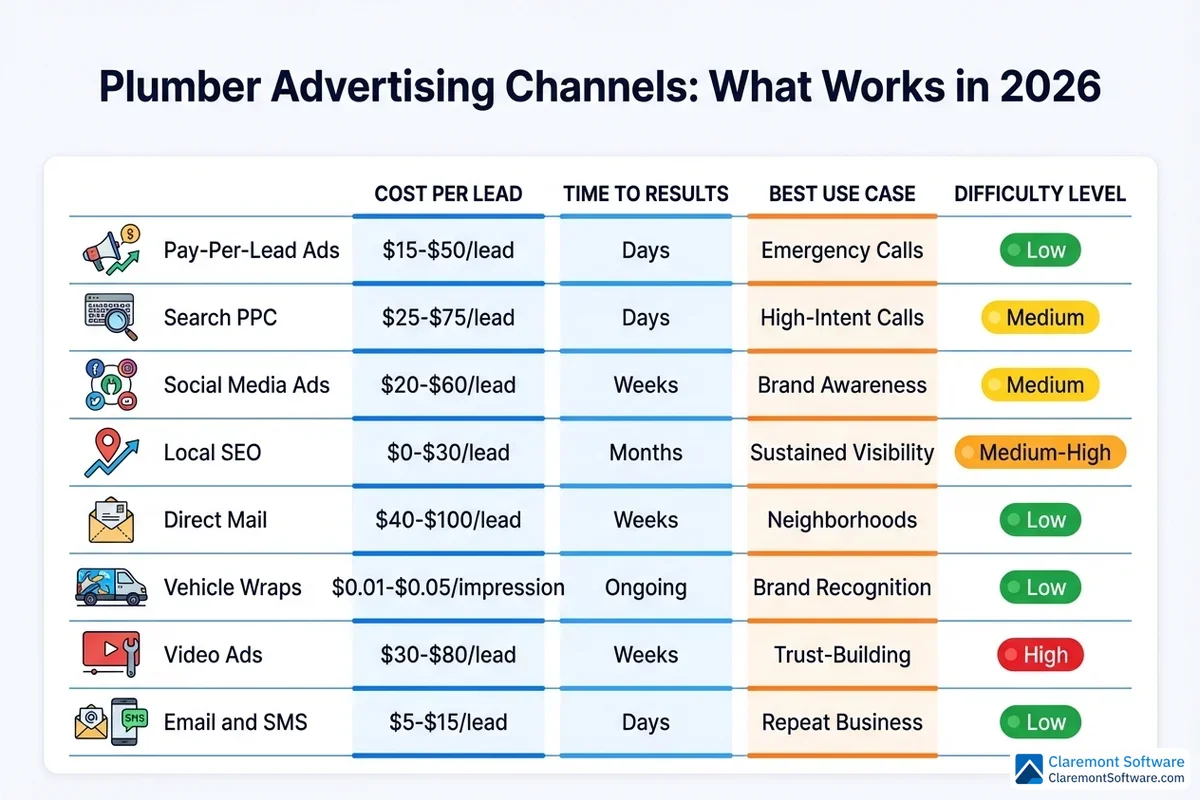
In 2026, plumber advertising breaks down into five broad categories:
- Pay-per-lead platforms — you pay only when a customer contacts you directly
- Pay-per-click search ads — you pay for each click on your ad, regardless of whether it converts
- Organic channels — local SEO, your business profile, and content that earns visibility without ongoing ad spend
- Offline advertising — vehicle wraps, direct mail, yard signs, and community sponsorships
- Hybrid channels — social media advertising and video, which blend paid reach with organic trust-building
The critical thing to understand is that these channels don't all do the same job. Pay-per-lead and search ads are built for capturing demand — they reach homeowners who are already searching for a plumber right now. Organic and offline channels build the brand recognition that makes customers choose you over a competitor when the moment arrives. The most effective plumbing marketing strategies combine both: channels that generate calls today and channels that build the reputation that generates calls tomorrow.
When evaluating any channel, run it through four filters: cost per lead, lead quality, speed to results, and scalability. A channel that delivers cheap leads filled with tire-kickers isn't a bargain. A channel that takes six months to produce results isn't right for a plumber who needs calls next week.
Finally, your company size matters enormously here. A solo plumber with a $700 monthly budget needs a completely different strategy than a 15-truck operation with $10,000 to deploy. The sections ahead are structured with that reality in mind.
Pay-Per-Lead Ads: The Closest Thing to Guaranteed Calls
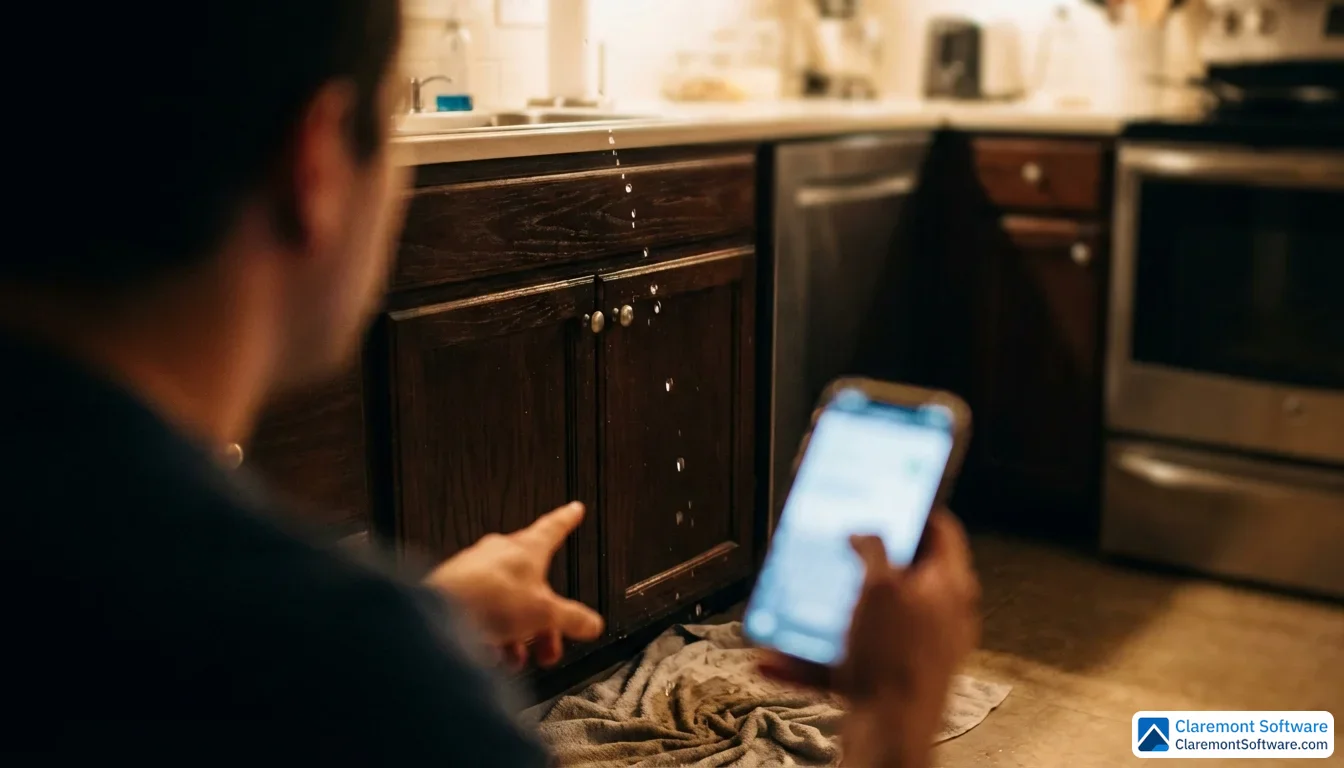
Of all the advertising options available to plumbers in 2026, pay-per-lead platforms come closest to a guaranteed return on your investment — and for good reason. Unlike traditional advertising where you pay for exposure and hope it converts, pay-per-lead works exactly the way it sounds: you only pay when a real customer actually contacts you. No clicks from curious browsers, no impressions from people who scrolled past, no wasted spend on traffic that never had any intention of hiring a plumber. You pay for contact. That's it.
Here's how it works in practice. You create a profile on the platform, set your service area and the types of jobs you want, and pass a verification process that typically includes a background check and proof of insurance. Once approved, your listing appears at the very top of search results — above traditional pay-per-click ads — when homeowners in your area search for plumbing services. When a customer calls or messages you through the platform, you're charged for that lead. If the lead turns out to be invalid — a wrong number, a spam contact, or a request for a service you don't offer — you can dispute it and get your money back.
That verification process is worth paying attention to. The background check and insurance confirmation aren't just administrative hoops — they translate into a visible trust badge displayed directly on your listing. For a homeowner who's about to let a stranger into their home to deal with a flooding basement at midnight, that badge does real psychological work. It signals legitimacy before you've said a single word, which is why these listings consistently outperform unverified competitors in click-through and call rates.
To get the most out of pay-per-lead platforms, treat your profile like a sales page, not a business card:
- Complete every field — service categories, photos, business hours, and service area all affect how often your listing appears
- Respond within minutes — platforms reward fast responders with better placement, and homeowners with urgent problems will simply move to the next listing if you don't answer quickly
- Collect reviews aggressively — ask every satisfied customer to leave a review directly on the platform; review count and recency directly influence your ranking
- Dispute invalid leads promptly — don't let bad leads eat into your budget; most platforms have a straightforward dispute process, and legitimate disputes are routinely honored
On cost: in 2026, expect to pay between $15 and $50 per lead, depending on your market size, competition level, and the type of job. Routine service calls tend to land on the lower end. Emergency plumbing leads — burst pipes, sewage backups, water heater failures — command a premium because the homeowner's urgency is high and the job value is typically significant. In dense urban markets with heavy competition, costs can push toward the top of that range. In smaller markets, you may find strong leads well below $30.
For solo plumbers and small operations just getting started with paid advertising, pay-per-lead is often the smartest first dollar spent — high intent, low complexity, and a clear cost-per-lead you can measure from day one.
Search PPC Ads: Capturing High-Intent Customers at the Moment of Need
When a homeowner types "emergency plumber near me" into Google at 11 p.m. with water spreading across their kitchen floor, they are not browsing — they are buying. Search PPC ads exist precisely to capture that moment, and no other paid channel puts you in front of customers with higher purchase intent at a more critical point in their decision.
Unlike pay-per-lead platforms, search ads charge you per click rather than per contact, which means your ad copy, landing page, and targeting all need to work together to convert that click into a call. Done right, search PPC is one of the most scalable and controllable advertising tools available to plumbing businesses. Done carelessly, it burns through budget at an alarming rate with very little to show for it.
Keyword strategy is where most plumbers either win or lose their campaigns. The instinct is to go broad — bid on "plumber" and let Google figure out the rest. The problem is that broad terms attract an enormous range of searchers, most of whom have no intention of hiring anyone. Bid on service-specific terms instead: "drain cleaning service," "water heater repair," "emergency pipe burst," "sump pump installation." These searches come from people who know exactly what they need and are ready to call. They convert at significantly higher rates and, despite sometimes costing more per click, deliver a far lower cost per actual booked job.
Negative keywords are the other half of that equation — and they're non-negotiable. Without them, your ads will routinely appear for searches like "plumbing jobs hiring," "how to fix a leaky faucet DIY," "plumber salary," and "plumbing school near me." Every one of those clicks costs you money and produces zero revenue. Build your negative keyword list before your campaign goes live, and review your search term reports weekly to catch new irrelevant queries as they appear.
For emergency plumbing services specifically, call-only ad formats are worth prioritizing. These ads display exclusively on mobile devices and replace the standard website link with a direct tap-to-call button. There's no landing page to navigate, no form to fill out — the customer taps and your phone rings. Pair call-only ads with tight radius geotargeting so you're only paying for calls from homeowners actually within your service area, and schedule your ads to run during the hours you're available to answer.
Performance Max campaigns represent Google's AI-driven evolution of search advertising, automatically distributing your budget across search, display, maps, YouTube, and Gmail based on conversion signals. In 2026, they're worth testing — particularly for larger operations with enough conversion data for the algorithm to optimize effectively. That said, they require careful monitoring. Performance Max can drift toward cheaper, lower-intent placements if left unchecked, so review your asset group performance and placement reports regularly to ensure your budget is actually reaching high-intent searchers rather than being diluted across low-value display inventory.
For most plumbing businesses, expect to pay between $8 and $25 per click in competitive markets, with emergency keywords commanding the higher end. The goal isn't to minimize cost per click — it's to minimize cost per booked job. A $20 click that converts into a $600 water heater installation is a far better outcome than a $6 click that goes nowhere.
Social Media Advertising: The Long Game That Pays Off
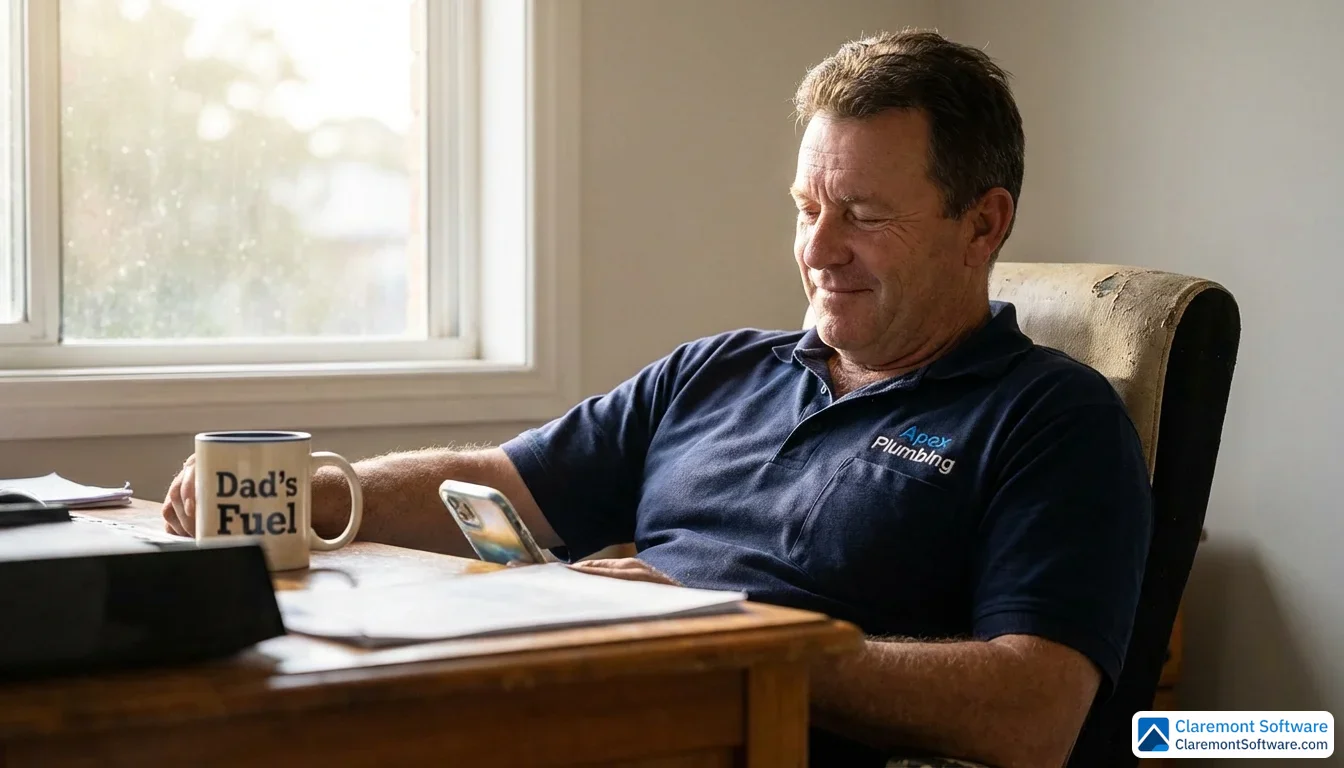
Unlike search ads that capture customers mid-crisis, social media advertising works on a completely different psychological timeline — and understanding that distinction is what separates plumbers who see results from those who write off the channel entirely.
Nobody scrolls through their Facebook feed hoping to find a plumber. Social media advertising for plumbers isn't about catching someone at the moment of need — it's about making sure your name is already familiar when that moment arrives. Think of it as a familiarity engine. When a pipe finally gives out at 7 a.m. on a Tuesday, homeowners don't call a stranger. They call the plumber they've seen around. Social ads put you in that position before the emergency ever happens.
This is why patience matters here. Social media advertising typically takes 60 to 90 days before it starts paying meaningful dividends. The plumbers who quit after three weeks never see the return that comes from consistent, compounding brand recognition.
Lead form ads are the exception to the slow-burn rule — and they're worth running alongside your awareness campaigns. These ads let homeowners request a quote or schedule a service call without ever leaving the app. No website to load, no form to hunt for, no friction. For routine, non-emergency work like water heater replacements, bathroom remodels, or annual maintenance, that reduced friction meaningfully increases the number of people who follow through. Someone who might have closed the browser tab instead submits their contact details in two taps.
Retargeting is where social media advertising gets genuinely powerful for plumbing businesses. Once someone visits your website or watches even a portion of your video content, you can serve them follow-up ads specifically designed to bring them back. These audiences are warmer than cold traffic, they cost less to reach, and they convert at higher rates. A homeowner who watched your video about water heater warning signs last week is a far better prospect than a random person in your zip code.
On the content side, short-form video dramatically outperforms static images for both engagement and trust-building. Before-and-after transformations, quick walkthroughs of a completed job, or a genuine day-in-the-life clip showing your crew at work — these formats humanize your business in a way that a logo and phone number simply cannot. Customers hire people they trust, and video builds that trust faster than any other format available on social platforms.
For platform selection in 2026, neighborhood-based communities and local community groups have emerged as surprisingly high-converting, low-cost channels for plumbers. These hyper-local environments are where homeowners already ask each other for contractor recommendations — showing up there, either through targeted ads or genuine participation, puts you directly inside the conversation that leads to booked jobs.
Local SEO and Your Business Profile: Free Leads on Autopilot
Paid ads put you in front of customers who are actively searching — but every click costs money. Local SEO does something different: it generates calls from people who found you organically, without you paying a cent per lead. For plumbing businesses, it's one of the highest-ROI investments you can make, and the geographic nature of the work makes it far more achievable than most business owners realize.
Here's the fundamental advantage: you're not trying to rank nationally. You're trying to rank in two or three towns where you actually work. That's a dramatically smaller competitive landscape, and with consistent effort, most plumbing businesses can reach the top of local search results within a few months.
Your Google Business Profile is the single most important piece of local SEO real estate you own. When someone searches "plumber near me," the map pack — those three business listings that appear before the organic results — is often the first thing they see. Businesses that dominate that map pack share a few common traits: complete profiles with accurate hours and service areas, a library of real job photos, and a consistent stream of recent reviews. Profiles with 50 or more reviews and regular photo updates consistently outperform sparse, neglected listings, regardless of how long the business has been operating.
On your website, the most impactful move is creating dedicated service pages for each thing you do, structured around "[service] + [city]" keyword combinations. A single page titled "Drain Cleaning in [Your City]" will outperform a generic services page every time. Do this for water heater installation, sump pump repair, emergency plumbing, and every other core service — then repeat the structure for each city or town in your service area.
When it comes to reviews, velocity matters more than volume. A business with 200 reviews collected over five years will often rank below a competitor with 60 reviews collected steadily over the past six months. Google interprets a consistent flow of recent reviews as a signal that the business is active, trustworthy, and currently serving customers. Build a simple system for requesting reviews after every completed job — a text message with a direct link is enough.
Finally, voice search is no longer a future consideration — it's happening now. Homeowners ask smart speakers and phones conversational questions like "find a plumber near me" or "who fixes water heaters in [city]." Optimizing for these queries means writing content that answers natural-language questions directly, and ensuring your business profile information is accurate enough for Google to confidently surface you in spoken results.
Offline Advertising That Still Works: Direct Mail, Vehicle Wraps, and Yard Signs
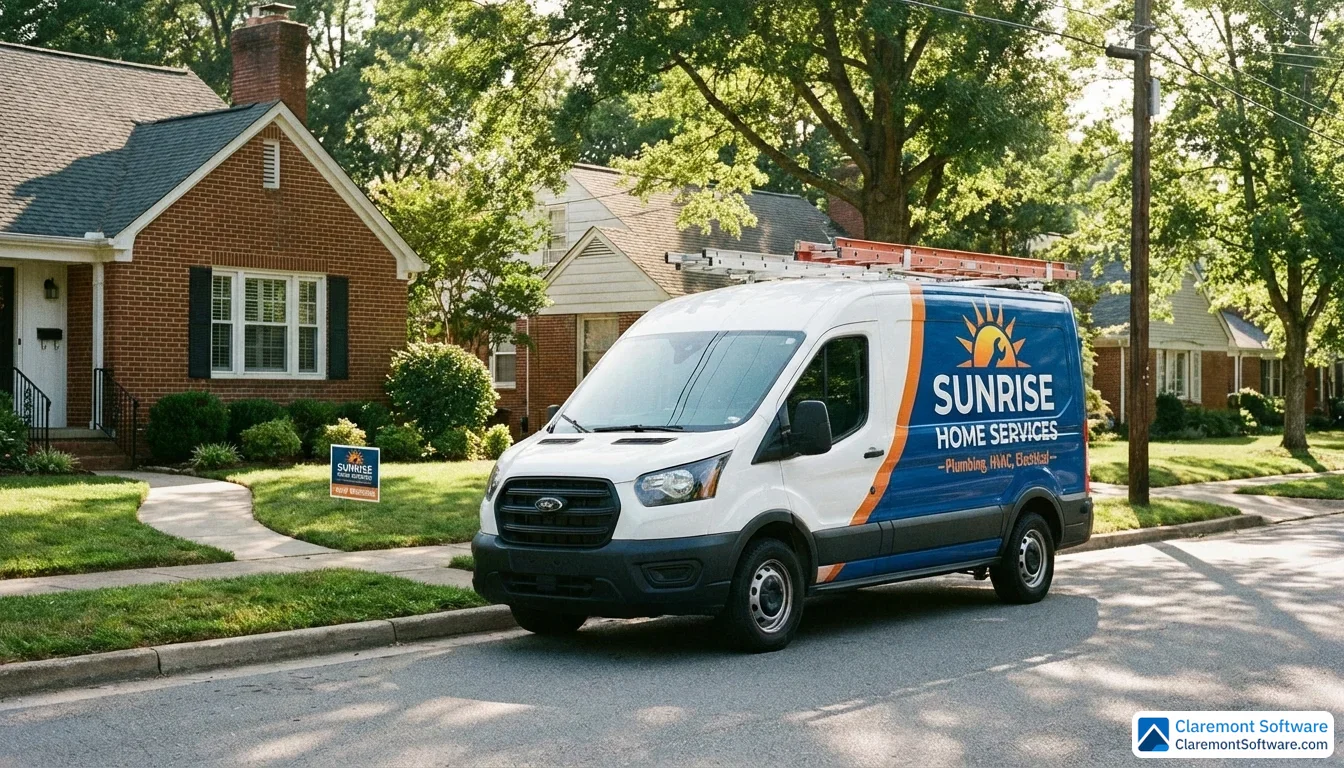
Digital advertising gets most of the attention, but the plumbers with the most recognizable names in their local markets almost always have one thing in common: you see them everywhere offline, too. Their trucks are hard to miss. Their signs show up in front yards across the neighborhood. Their name appears on the banner at the youth soccer tournament. That kind of omnipresence doesn't happen by accident — and it doesn't require a massive budget.
Vehicle wraps are the single best offline investment most plumbing businesses can make. A professionally wrapped truck or van is essentially a moving billboard that works every hour your crew is on the road — commuting to a job, parked in a driveway, sitting at a red light. In a dense service area, a single wrapped vehicle can generate thousands of impressions per day from people who live and work exactly where you want to be known. Unlike digital ads that stop the moment you pause your campaign, a vehicle wrap keeps working for years from a one-time investment. The visibility compounds over time as more people in your area see the same truck repeatedly, building the kind of passive familiarity that makes your name the first one that comes to mind when something breaks.
Direct mail and flyers still work — but only when they're focused. The mistake most plumbers make is sending a generic mailer that lists every service they offer, hoping something resonates. That approach gets ignored. What actually generates calls is a mailer built around a single, specific offer: a seasonal drain cleaning special, a water heater inspection before winter, or a discounted sump pump check before the rainy season. One service, one clear offer, one call to action. That specificity gives the recipient a reason to act now rather than set it aside and forget it.
Yard signs turn every completed job into a neighborhood advertisement. When your truck is parked in front of a house and a professional sign goes up in the yard, neighbors notice. They're already aware something is being fixed — the sign tells them who to call when it's their turn. This is especially effective in tightly clustered neighborhoods where one aging water heater often signals that others on the street are close behind.
Community sponsorships build the kind of goodwill that digital ads simply can't manufacture. Putting your name on a little league jersey or sponsoring a local event creates a genuine connection with families in your service area. It signals that you're invested in the community, not just extracting business from it — and that perception carries real weight when someone is deciding who to trust inside their home.
The critical rule for all offline advertising: always attach a trackable phone number or unique URL to every channel. Without it, you're guessing at what's working. A dedicated number for your direct mail campaign and a separate one for your vehicle wrap takes minutes to set up and gives you the data to make smarter decisions about where to keep spending.
Ad Copy That Makes Customers Call: The Proven Formula
Open any search results page for plumbers in your city and read the ads. You'll see the same words repeated so many times they've lost all meaning: fast, reliable, affordable, professional, licensed and insured. Every competitor is saying the same thing, which means prospects are effectively hearing nothing. When your ad sounds identical to the five ads surrounding it, the only differentiator left is price — and that's a race to the bottom you don't want to run.
The fix isn't creativity for its own sake. It's a proven structure that moves a stressed homeowner from "I have a problem" to "I'm calling this number right now."
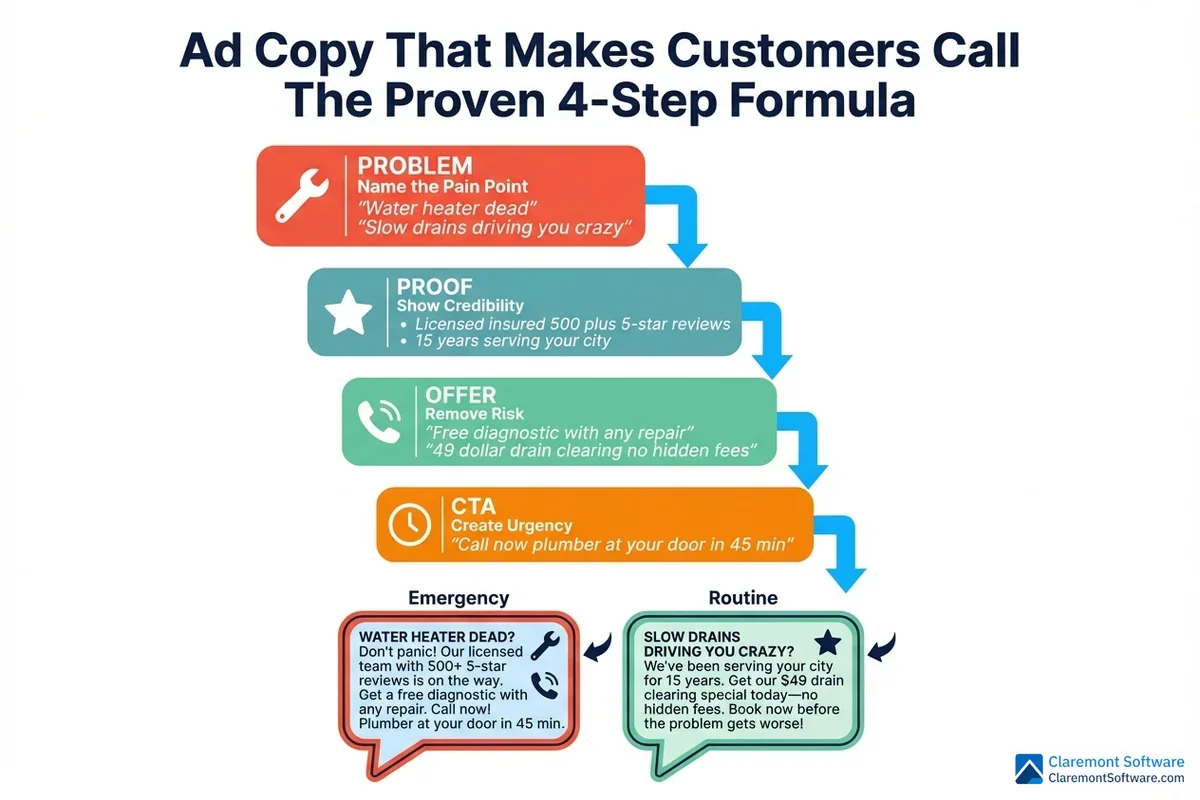
The formula that consistently converts follows four steps: Problem → Proof → Offer → CTA.
Here's what that looks like in practice: "Burst pipe flooding your home? Over 500 five-star reviews. Free diagnostic with any repair. Call now — we answer 24/7." Every element is doing specific work. The problem statement creates instant recognition — the reader feels seen. The proof removes doubt before it forms. The offer reduces the risk of calling. The CTA removes any ambiguity about what to do next. Strip out any one of those four elements and the ad gets weaker.
The second critical insight is that your customers aren't all in the same headspace — and your copy needs to reflect that.
Emergency customers — the ones with water coming through the ceiling at midnight — are not thinking about price. They're thinking about speed and availability. Your copy for those situations should lead with response time and around-the-clock access: "45-minute response, any hour, any day" signals exactly what they need to hear. Contrast that with a homeowner scheduling a water heater replacement on a Tuesday afternoon. They have time to compare options, so your copy should emphasize value, trust signals, and what makes the experience easy and professional.
Specificity is what separates forgettable ads from ones that generate calls. Concrete numbers do the heavy lifting that vague claims cannot. "45-minute response time" is a promise. "Fast service" is noise. "$49 drain clearing" gives someone a reason to act today. "Affordable prices" gives them nothing. Whenever you're tempted to use a generic descriptor, ask yourself: what's the actual number behind that claim? Use it.
The same principle applies to your plumbing slogan or tagline. The strongest ones speak directly to what the customer is worried about — not what the company is proud of. "Here when you need us most" outperforms "Family-owned since 1987" because one is about the customer and one is about you.
What Wastes Your Money: Plumber Advertising Mistakes to Avoid
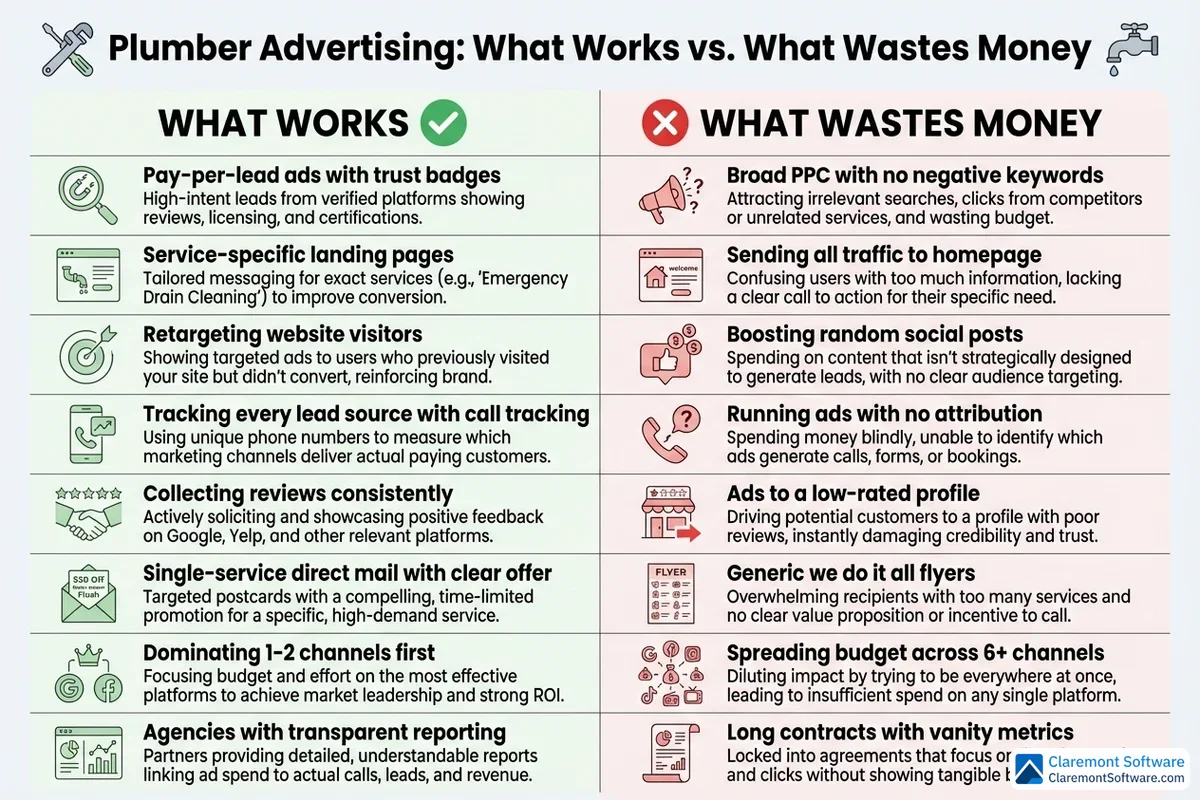
Most plumbing advertising budgets don't fail because the wrong channels were chosen. They fail because of entirely avoidable mistakes that quietly drain money month after month while the owner assumes the ads just "aren't working." Here's where the money actually goes to waste.
Bidding on broad keywords without negative keyword filters. If you're running Google Ads and haven't built out a negative keyword list, you're almost certainly paying for clicks from people searching for plumbing jobs, DIY repair tutorials, plumber salary information, and students writing trade school essays. None of them will ever call you. Filtering out terms like "plumbing jobs," "how to fix," "DIY," "salary," and "apprenticeship" is one of the fastest ways to cut wasted spend and improve your cost per lead overnight.
Running ads with no call tracking or attribution. If you can't tell which channel generated a specific call, you're not managing a marketing strategy — you're guessing with real money. A plumber spending $2,000 a month across three channels with no tracking has no idea whether one channel is carrying all the weight while the other two produce nothing. Call tracking with unique phone numbers assigned to each channel takes minimal setup and gives you the data to make every future dollar work harder.
Signing agency contracts that lock you out of your own accounts. Some agencies retain ownership of your ad accounts, your campaign data, and your conversion history. When you leave, you start from zero. Before signing anything, confirm that you own your Google Ads account, your business profile, and all associated data. Demand transparent monthly reporting that shows actual leads and booked jobs — not impressions and click-through rates dressed up to look like progress.
Optimizing for vanity metrics instead of revenue. Impressions, follower counts, and social media likes feel like momentum, but they don't pay invoices. The only metrics that matter are cost per lead, cost per booked job, close rate by channel, and average ticket value by lead source. If your agency or your own reporting isn't anchored to those numbers, you're measuring the wrong things.
Spreading budget across too many channels at once. A $1,500 monthly budget split six ways produces mediocre results everywhere. That same budget concentrated into one or two high-performing channels — pay-per-lead ads and an optimized business profile, for example — can generate a consistent, measurable flow of calls. Dominate a channel before you expand. Thin coverage across many platforms is how plumbers spend real money and feel like advertising doesn't work.
Ignoring your reviews while running ads. Paid ads drive people to look you up. If what they find is a 3.2-star rating with unanswered complaints, the ad spend actively works against you — you've paid to introduce a skeptical customer to a reason not to call. Before scaling any advertising, make sure your review profile can close the deal once the ad does its job.
Overpaying for premium directory listings. Certain directory platforms charge significant monthly fees for "featured" placement and deliver leads that are simultaneously sent to four or five competing plumbers. The prospect is price-shopping from the start, close rates are low, and the economics rarely justify the cost. Treat directory listings as a supplementary presence, not a primary lead source.
Budget Allocation: How to Spend Your Advertising Dollars by Company Size

There's no universal advertising budget that works for every plumbing business, and trying to copy what a 20-truck operation does when you're running solo is one of the fastest ways to burn through money with nothing to show for it. The right budget — and the right channels — depend almost entirely on where you are right now.
Solo plumber ($500–$1,500/month): Keep it simple and focused.
At this stage, complexity is your enemy. Put the overwhelming majority of your budget into pay-per-lead ads and your business profile optimization. These two channels require minimal ongoing management, deliver measurable results quickly, and don't demand marketing expertise to run effectively. A complete, review-rich business profile costs nothing but time, and pay-per-lead ads mean you're only spending money when someone actually contacts you. Get these two working before you touch anything else.
Small team of 2–5 trucks ($1,500–$5,000/month): Build on what's working.
Once you have consistent lead flow, it's time to add layers. Search PPC captures high-intent customers your pay-per-lead ads might miss. Basic social media retargeting keeps your name in front of people who've already visited your website — a warm audience that converts at a fraction of the cost of cold traffic. Vehicle wraps on every truck in your fleet turn daily driving into continuous local advertising for a one-time investment.
Mid-size operation of 5–20 trucks ($5,000–$15,000/month): Diversify and compound.
At this scale, you can afford to build brand recognition alongside direct response. Add social media advertising, direct mail campaigns targeting specific neighborhoods, video content, and content marketing that strengthens your organic search presence over time.
Large plumbing company with 20+ trucks ($15,000+/month): Go omnichannel.
Full-scale operations can support TV, streaming, aggressive SEO, and dedicated marketing staff or agency partnerships.
Regardless of budget size, apply the 70/20/10 rule: put 70% into proven performers, 20% into channels you're actively testing, and 10% into experimental tactics. This structure lets you grow without gambling.
Finally, let customer lifetime value anchor every spending decision. If a new customer is realistically worth $3,000 or more over their relationship with your business, paying $100 to acquire them isn't a cost — it's one of the best investments you can make.
Tracking ROI: How to Know What's Actually Working
Spending money on advertising without knowing what's generating calls is the same as running your truck with no gauges — you won't know something's wrong until you're already broken down. Tracking ROI isn't optional; it's the mechanism that turns advertising from a cost into a controllable investment.
Call tracking is the foundation. Assign a unique phone number to every channel you're running — one for your pay-per-lead profile, one for your Google Ads campaign, one for your direct mail piece, one for your vehicle wraps. When a call comes in, you know exactly where it originated. Without this, you're crediting every call to whichever channel feels most active, which is rarely accurate and almost always misleading. Call tracking tools are inexpensive relative to what they protect, and setup takes hours, not weeks.
Close the loop between your ads and your field software. Knowing a channel generated a call is useful. Knowing it generated a call that turned into a booked job worth $800 is actionable. Integrate your field service management software with your advertising platforms so you can trace the full journey — from the ad that triggered the search, to the call, to the booked appointment, to the invoice collected. This closed-loop reporting is what separates plumbers who manage their marketing from those who merely run it.
Track the metrics that actually matter:
- Cost per lead by channel
- Cost per booked job (not just per lead)
- Close rate by lead source
- Average ticket value by channel
- Customer lifetime value over 12–24 months
Build a monthly reporting rhythm. Once a month, sit down with your numbers. Identify which channels are producing booked jobs at an acceptable cost, which are generating calls that don't convert, and which are simply burning budget. Pause underperformers, reallocate that spend to winners, and introduce one new tactic to test. Consistency here compounds — small optimizations made monthly produce dramatically better results over a full year than a single annual review.
In 2026, AI-powered attribution tools have made this process more precise than ever, tracking the full customer journey across multiple touchpoints and revealing which combination of ads actually influenced the final call — not just the last one a customer saw before dialing.
DIY Marketing vs. Hiring a Plumbing Marketing Agency
At some point, every growing plumbing business faces the same question: should I keep managing my own marketing, or hand it off to someone who does this full-time? The honest answer depends less on budget and more on where your time creates the most value.
DIY marketing makes sense when you're starting out. If you're a solo plumber or running a small crew, you likely have more time than money — and that's actually an advantage. Pay-per-lead platforms and your business profile are genuinely manageable without marketing expertise. Setting up a profile, collecting reviews, and responding to leads quickly doesn't require an agency. Many plumbers successfully handle these channels themselves for years, keeping overhead low while building a steady lead flow. If you're willing to learn the basics and stay consistent, DIY is a legitimate long-term strategy at this stage.
Hiring an agency makes sense when your time is worth more on the job. Once you're dispatching three or more trucks, the hours you spend managing ad campaigns are hours you're not quoting jobs, training technicians, or running your business. That's when professional management starts paying for itself. A good plumbing-focused agency brings platform expertise, tested campaign structures, and ongoing optimization that would take you months to develop independently.
The problem is that not every agency deserves your trust. Watch for these red flags:
- They won't give you access to your own ad accounts. If you leave, you should take your data and campaign history with you — not start from zero.
- They guarantee specific rankings or lead volumes. No one can guarantee search rankings. Anyone who does is either lying or setting expectations they can't meet.
- They lock you into contracts of 12 months or longer with no performance benchmarks or exit clauses.
- They report impressions and clicks instead of leads and booked jobs. Vanity metrics aren't revenue.
Before signing anything, ask these questions directly: What's a realistic cost per lead in my market? How do you track which ads are generating actual calls? Can you show me results from other plumbing clients? Do I own my ad accounts and all associated data?
Budget-wise, expect to pay $1,000–$3,000 per month in management fees for a reputable agency that specializes in plumbing or home services — on top of your actual ad spend. Be cautious of anyone charging significantly less or bundling management fees and ad spend into a single opaque number. Transparency isn't a bonus feature; it's the baseline.
Conclusion
The path to a full schedule isn't paved with the biggest advertising budget — it's built on smart, focused decisions made consistently over time. Start with pay-per-lead ads and an optimized business profile, prove the return, then expand. Resist the urge to spread thin across every channel at once. Master one or two before adding more.
Every ad you run should follow the Problem → Proof → Offer → CTA formula, calibrated to whether you're speaking to someone with water pouring through their ceiling or someone planning a renovation three weeks out. Those are different customers in different mindsets, and the copy that converts one will fall flat with the other.
Above all, track everything. Call tracking, closed-loop reporting, and monthly performance reviews aren't administrative overhead — they're what separates plumbers who grow from plumbers who guess.
You already do great work. The only thing standing between you and a consistently full schedule is making sure the right customers can find you at the right moment. That's an advertising problem — and it's entirely solvable.
Related Reading
- Plumber Lead Generation: 12 Strategies That Book Jobs
- Plumber Digital Marketing: The Complete Guide
- Why Most Plumber Websites Don't Generate Calls
Frequently Asked Questions
How much should a plumber spend on advertising per month?
Your ideal monthly ad budget depends on your company size. Solo plumbers typically see strong returns spending $500–$1,500/month, focused almost entirely on pay-per-lead ads and optimizing their business profile. Small teams of 2–5 trucks should budget $1,500–$5,000/month, adding search PPC and vehicle wraps. Mid-size operations with 5–20 trucks can invest $5,000–$15,000/month across multiple channels. Companies with 20+ trucks often spend $15,000+/month on a full omnichannel strategy. A useful rule of thumb: if a new customer is worth $3,000+ over their lifetime, spending $100 to acquire them is a smart investment — let customer lifetime value guide your ceiling.
What is the best advertising platform for plumbers in 2026?
For most plumbers, Google Local Services Ads (pay-per-lead) deliver the highest ROI, especially for emergency calls. They appear above traditional search ads, and the Google Guarantee badge — earned by passing a background check and verifying insurance — builds instant credibility with homeowners. For plumbers ready to scale, combining pay-per-lead with Google Search Ads and an optimized Google Business Profile creates a dominant local presence. Social media platforms work well for building long-term brand familiarity and retargeting past website visitors. The best platform ultimately depends on your budget, market size, and whether you're chasing emergency calls or routine scheduled work.
How do pay-per-lead ads work for plumbing businesses?
Pay-per-lead platforms charge you only when a potential customer actually contacts you — not when someone simply sees or clicks your ad. This makes them far more budget-efficient than traditional pay-per-click advertising. To participate, plumbers typically must pass a background check and verify their insurance, which earns them a trust badge that appears prominently in search results. These ads show up at the very top of search results, above standard PPC ads, capturing the most urgent buyers. To get the most out of pay-per-lead ads, keep your profile fully complete, respond to leads within minutes, collect reviews consistently, and dispute any invalid leads promptly. Expect to pay $15–$50 per lead depending on your market.
What is a good cost per lead for a plumbing company?
A good cost per lead for a plumbing company typically falls between $15 and $50 on pay-per-lead platforms, with emergency service leads trending toward the higher end due to their urgency and higher job value. On Google Search Ads, cost per lead can vary widely based on your market's competition level. The more important benchmark is cost per booked job — factor in your close rate to determine your true acquisition cost. If your average job is worth $400–$600 and a new customer has a lifetime value of $3,000+, a cost per lead of even $75–$100 can still be highly profitable. Always track leads all the way through to revenue, not just the initial contact.
Do Facebook ads work for plumbers?
Yes, but they work differently than search ads. Facebook ads are most effective as a long-term familiarity engine — building recognition so that when a homeowner needs a plumber, your business is already top of mind. Lead form ads let homeowners request a quote without ever leaving the app, which reduces friction for routine services like drain cleaning or water heater installation. Retargeting campaigns that show follow-up ads to people who've already visited your website or watched your video content are particularly cost-effective. Short-form video content — such as before-and-after transformations or day-in-the-life clips — consistently outperforms static image ads for engagement and trust-building on social platforms.
How can I advertise my plumbing business for free?
The most powerful free advertising channel for plumbers is your Google Business Profile. A fully completed profile — with photos, accurate service areas, business hours, and a steady stream of recent customer reviews — can land you in the local map pack, which is often the first thing homeowners see when searching for a plumber. Beyond that, posting in local community groups and neighborhood social platforms costs nothing but time. Yard signs at active job sites turn every completed job into a neighborhood advertisement. Asking satisfied customers for referrals and online reviews is also free and directly impacts both your reputation and your search visibility. These tactics won't replace paid advertising as you grow, but they're an excellent starting point.
Should I hire a marketing agency or do my own plumber advertising?
DIY advertising makes sense when you're starting out, have more time than money, and are willing to learn the platforms — many plumbers successfully manage their own pay-per-lead profiles and Google Business Profile. Hiring an agency becomes worthwhile once your time is more valuable spent managing jobs than managing ads, typically around the 3+ truck mark. When evaluating agencies, watch for red flags: they won't give you access to your own ad accounts, they guarantee specific rankings, they lock you into 12+ month contracts, or they report impressions instead of actual leads and booked jobs. A reputable plumbing-focused agency typically costs $1,000–$3,000/month in management fees, on top of your actual ad spend.
How do I track which plumber ads are actually generating calls?
Call tracking with unique phone numbers assigned to each advertising channel is the foundation of proper attribution — it's the only reliable way to know which ads are actually driving calls. Assign a different tracking number to your Google Ads, your direct mail campaign, your vehicle wrap, and any other active channel. From there, integrate your call tracking with your field service management software to close the loop: connecting ad clicks all the way through to booked jobs and revenue collected. Key metrics to monitor include cost per lead, cost per booked job, close rate by channel, and average job value by lead source. Review performance monthly, pause underperforming channels, and reallocate budget to what's working.