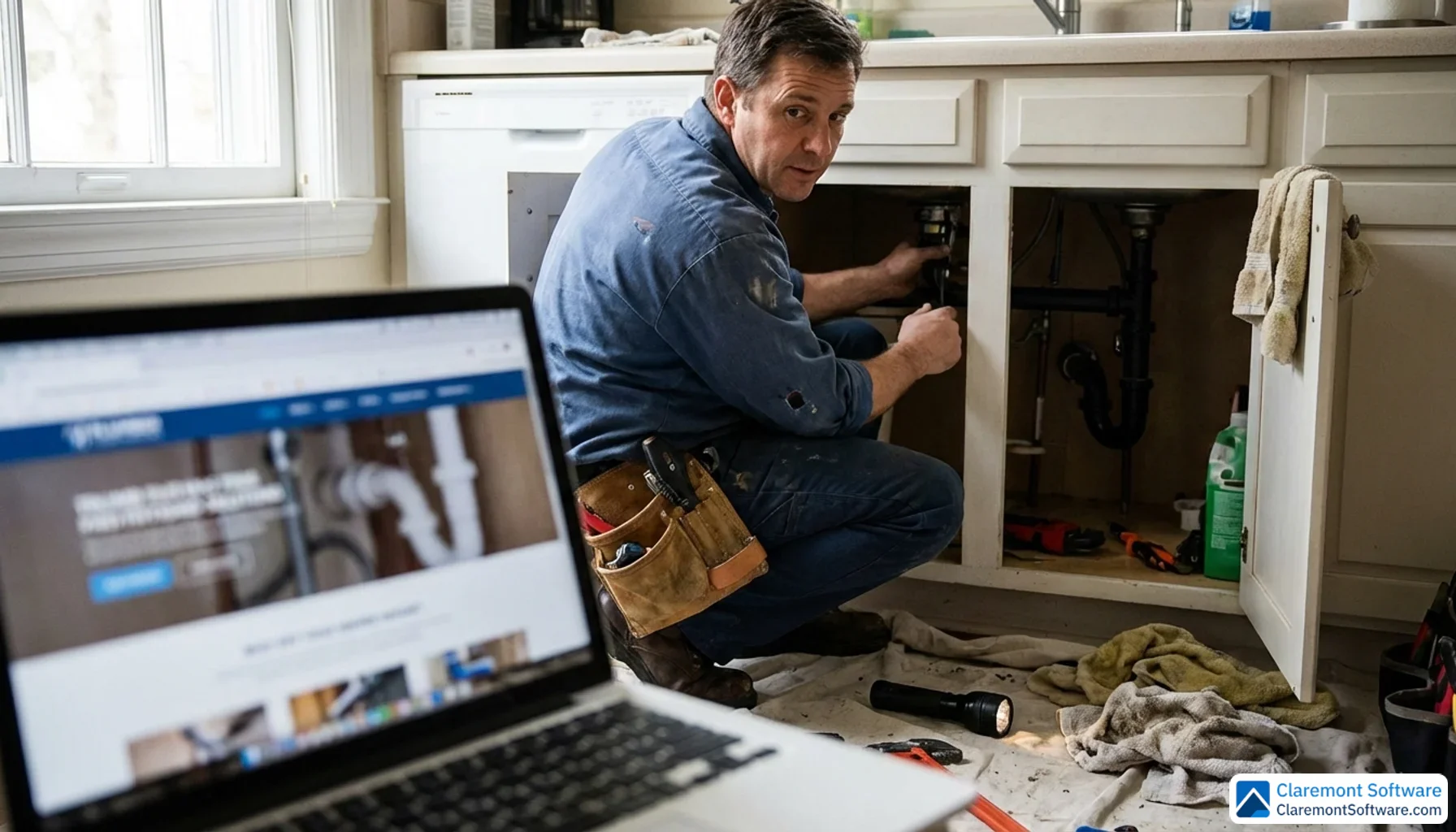
Most plumber websites are losing customers before a single pipe gets fixed — and the data proves it.
Claremont Software analyzed 47 plumber websites across 15 US cities, measuring everything that actually determines whether a website wins or loses business: page speed, content depth, platform choice, analytics adoption, social media readiness, and more. What we found was a performance gap wide enough to drive a service van through.
The fastest site loads in 255ms. The slowest takes nearly 5 seconds. That's not a minor technical difference — it's the difference between capturing an emergency caller and watching them dial your competitor. Meanwhile, 40% of plumber websites have zero analytics installed, meaning the owners have no idea whether their site is generating a single lead.
Whether you're running a one-truck operation or managing a multi-location plumbing company, this study gives you something the industry has never had before: a real, data-driven benchmark built from sites that are already ranking and competing in your market.
Read on to see exactly where the gaps are, which platforms and practices separate the top performers from the stragglers, and what you can do today to make sure your website isn't quietly costing you business.
How We Conducted This Study
To build this study, Claremont Software cast a deliberate net. We identified 47 plumber websites across 15 US cities, focusing exclusively on companies that appear on page one of Google for local plumbing searches — the sites already competing for the same customers you're trying to win. These aren't random results. They represent the current competitive landscape for plumbing businesses investing in their online presence.
For each site, we measured eight distinct variables:
- Time to Interactive (TTI) — how long before a visitor can actually use the page
- Homepage word count — the depth of written content on the primary landing page
- Content-to-code ratio — what percentage of the delivered HTML is readable content versus framework overhead
- SSL/HTTPS status — whether the site uses a secure connection
- Platform or CMS — what technology powers the site
- Analytics presence — whether Google Analytics or Google Tag Manager is installed
- Open Graph tags — whether the site is configured for clean social media sharing
- Contact information visibility — whether a phone number and email address are prominently displayed
Every measurement followed a consistent methodology. Page speed data came from Lighthouse audits, the same tool Google uses internally. Content and code analysis involved direct source code inspection. Contact information and OG tag findings were confirmed through manual review of each homepage.
The goal was straightforward: give plumbing company owners a reliable, data-driven benchmark — not guesswork, not anecdotes — so you can see exactly where your website stands against the competition that's already winning on local search rankings.
Page Speed: The 255ms vs. 4,981ms Divide

Of all the metrics we measured, page speed tells the most urgent story — because in plumbing, speed isn't just a technical preference. It's the difference between answering an emergency call and losing it to a competitor whose site loaded half a second faster.
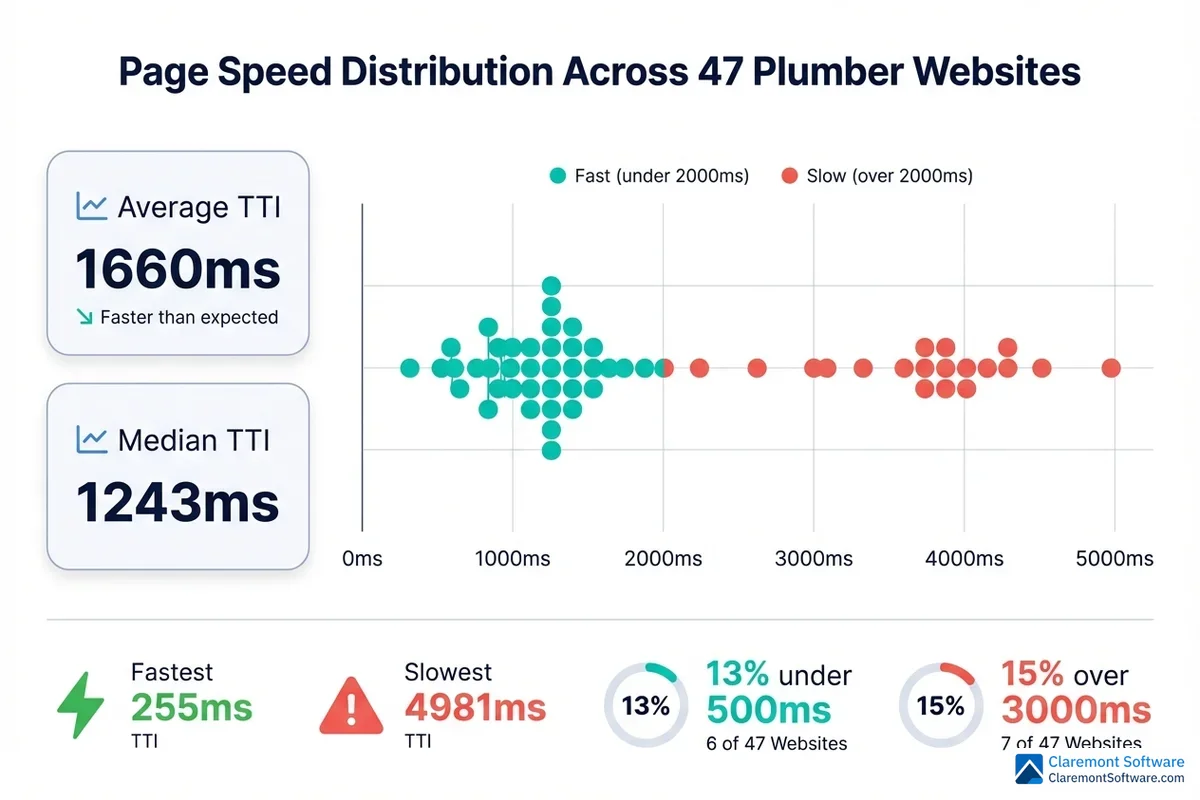
Across all 47 sites, the average Time to Interactive was 1,660ms, with a median of 1,243ms. That means the typical plumber website takes well over a full second before a visitor can tap a phone number, submit a form, or do anything at all. On mobile — where the majority of emergency plumbing searches happen — that delay is felt immediately.
The range, however, is where things get striking.
The fastest site loaded in just 255ms, running on a lightweight website builder platform with optimized hosting. The slowest crawled in at 4,981ms — nearly five full seconds — running on WordPress with uncompressed HTML and render-blocking scripts stacking up on every page load. That's not a minor gap. That's the difference between a site that feels instant and one that feels broken.
Here's how the distribution breaks down:
- Only 13% of sites (6 of 47) loaded under 500ms — these are the outliers delivering a genuinely fast mobile experience
- 15% of sites (7 of 47) took over 3,000ms to become interactive — slow enough that an impatient homeowner with a burst pipe has already hit the back button
The 3,000ms threshold matters because research consistently shows that mobile users abandon pages that take longer than three seconds to load. For a plumbing company, that abandoned page isn't a bounce statistic — it's a lost job.
It's worth noting that platform alone doesn't determine speed. The best-performing WordPress sites in our study combined CDN delivery — typically through a service like Cloudflare — with a caching plugin, and they competed directly with lighter platforms on load time. WordPress can be fast. It just rarely is by default.
The takeaway is simple: if your site takes more than two seconds to become interactive, you are losing emergency callers to competitors who invested in plumber web design built for performance.
Platform Breakdown: What 47 Plumber Websites Are Built On
When we catalogued the technology powering all 47 sites in our study, one finding stood above the rest: the platform a plumbing company chooses shapes nearly every other metric we measured — speed, content quality, code cleanliness, and long-term maintainability.
Here's how the breakdown shook out.
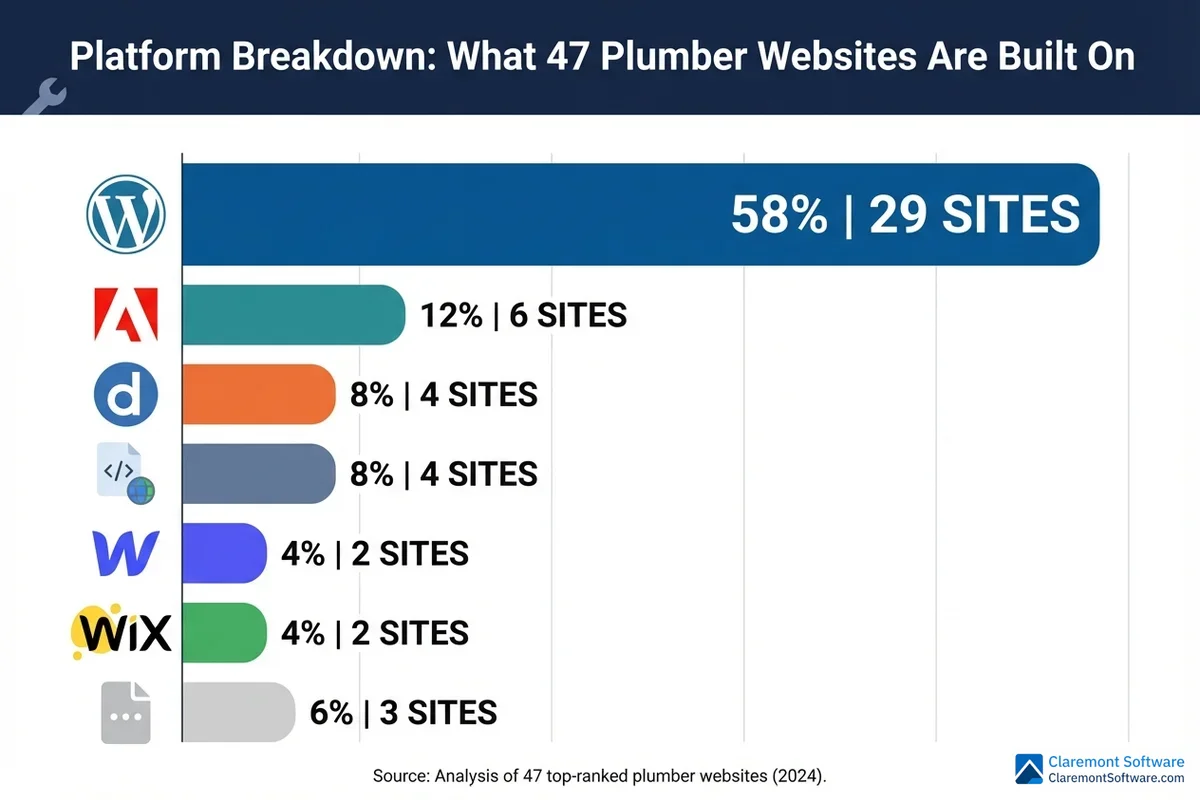
WordPress dominates at 58% (29 of 50 sites), and it isn't particularly close. For better or worse, WordPress is the default choice for plumber websites — used by independent operators, regional chains, and everyone in between. Its dominance makes sense: it's flexible, widely supported, and most web developers know it. But as we'll cover in the speed and code sections, WordPress requires deliberate optimization to perform well. Out of the box, it often doesn't.
Enterprise CMS platforms account for 12% (6 of 50 sites), and this segment tells a very specific story. Every single enterprise CMS site in our study belonged to a large multi-location franchise brand operating under centralized web management. These organizations trade raw performance for brand consistency and control — a reasonable tradeoff at scale, but not a model that applies to the typical independent plumbing company.
Lightweight website builders are gaining ground. DudaOne captured 8% of sites (4 of 50), and Webflow accounted for another 4% (2 of 50). Both platforms are attracting plumbing businesses that want faster default performance and easier day-to-day maintenance without relying on a developer for every update. Webflow in particular posted the second-best content-to-code ratio in our study at 5.0%, suggesting its cleaner code output is a genuine advantage.
Consumer-oriented builders like Wix represented just 4% of sites (2 of 50) — but those two sites were consistent underperformers. One had just 52 words of homepage content. Both posted the worst content-to-code ratios in the entire study at 0.1%. Wix may look affordable upfront, but the hidden costs show up in SEO performance and page speed.
Custom and static HTML sites also accounted for 8% (4 of 50), and they produced the cleanest code by a significant margin — an 11.8% content rate compared to the 4.4% overall average. The tradeoff is flexibility: without a CMS, updating content, adding service pages, or running promotions typically requires a developer every time.
The bottom line is that platform choice isn't just a technical decision — it's a business decision with direct consequences for how your site performs in search, how fast it loads for emergency callers, and how easily you can keep it updated as your business grows — all factors worth considering when investing in plumber web design.
Content Depth: Why Top-Ranking Plumber Sites Average 1,400+ Words

Speed gets the headlines, but content is what earns the rankings. Once a visitor lands on your site, the question shifts from did it load fast enough? to does this page give me a reason to call? The word count data from our study reveals something important: the plumber websites that show up on page one of Google aren't getting there by accident — they're getting there with content.
The average homepage word count across all 47 sites was 1,462 words, with a median of 1,073. Those aren't thin, placeholder pages. That's substantive content — service descriptions, local area callouts, trust signals, FAQs, and the kind of detail that tells both search engines and anxious homeowners that this company knows what it's doing.
60% of sites — 28 of 47 — had over 1,000 words on their main page. That's a meaningful majority, and it suggests that content depth is no longer a differentiator among competitive plumber websites. It's becoming the baseline expectation. If your homepage is running on a few paragraphs and a contact form, you're not competing with the sites that are outranking you — you're operating in a different category entirely.
The extremes in our data tell an equally clear story. The thinnest site had just 52 words — essentially a logo, a phone number, and a tagline sitting on a consumer website builder. It's the digital equivalent of a blank business card. At the other end, the most content-rich site packed in 6,774 words, covering every service, every neighborhood, and every common plumbing question a homeowner might search for.
Only 4% of sites — 2 of 47 — had fewer than 300 words, and both were outliers that almost certainly struggle to rank for anything competitive. Thin content at that level isn't just an SEO problem; it's a credibility problem. A homeowner comparing two plumbing companies will instinctively trust the one whose website demonstrates knowledge and depth.
The pattern is consistent: plumber websites that rank well in plumber local search rankings invest in content that answers real customer questions, covers specific services in detail, and signals genuine expertise. Word count alone doesn't cause rankings — but it's a reliable proxy for the kind of thorough, useful content that does.
The Content-to-Code Ratio Problem Nobody Talks About
Here's a metric that almost never comes up in conversations about plumber websites — but probably should.
When we analyzed the source code of all 47 sites in our study, we measured what's called the content rate: the percentage of each page's raw HTML that consists of actual readable text, as opposed to code, markup, scripts, and framework overhead. The average across all 47 sites was just 4.4%.
Read that again. On the typical plumber website, 95.6% of everything the server sends to a visitor's browser is code — not content.
That matters for a few reasons. Bloated HTML means more data to download, which contributes directly to slower load times. It means more work for the browser before anything useful appears on screen. And while search engines are sophisticated, a page that buries its readable content inside layers of JavaScript framework code isn't making their job any easier.
The platform breakdown here is striking. Custom and static HTML sites posted the cleanest ratio by a wide margin at 11.8% — nearly three times the overall average. When a developer hand-codes a page without a CMS or visual builder in the way, the output is lean. There's no framework overhead, no auto-generated wrapper divs, no plugin scaffolding. Just code that does exactly what it needs to do.
At the other end of the spectrum, consumer website builder sites came in at just 0.1% — the worst content rate in the entire study, and it isn't close. These platforms generate enormous amounts of JavaScript-driven markup to power their drag-and-drop interfaces, and that overhead gets delivered to every visitor on every page load, regardless of whether any of it is visible or useful.
The middle of the pack tells its own story. WordPress sites averaged 4.3%, roughly in line with the overall average. Enterprise CMS platforms came in at 2.8%, weighed down by the heavy markup overhead that comes with centralized brand management systems built for large organizations. Webflow sites averaged 5.0% — a modest but meaningful edge over WordPress, and a sign that modern visual builders can produce cleaner output than their legacy counterparts when built thoughtfully.
If you're a plumbing company owner, here's the practical question to ask your web developer: What's our content rate, and what's driving the bloat? The most common culprits are render-blocking scripts loaded on every page, slider and animation plugins that add hundreds of kilobytes of JavaScript for a single visual effect, and redundant third-party tags that were added over time and never cleaned up. None of these are inevitable — they're choices, and they have consequences for every visitor who lands on your site.
Analytics: 40% of Plumber Websites Are Flying Blind

Of all the findings in this study, this one stopped us cold.
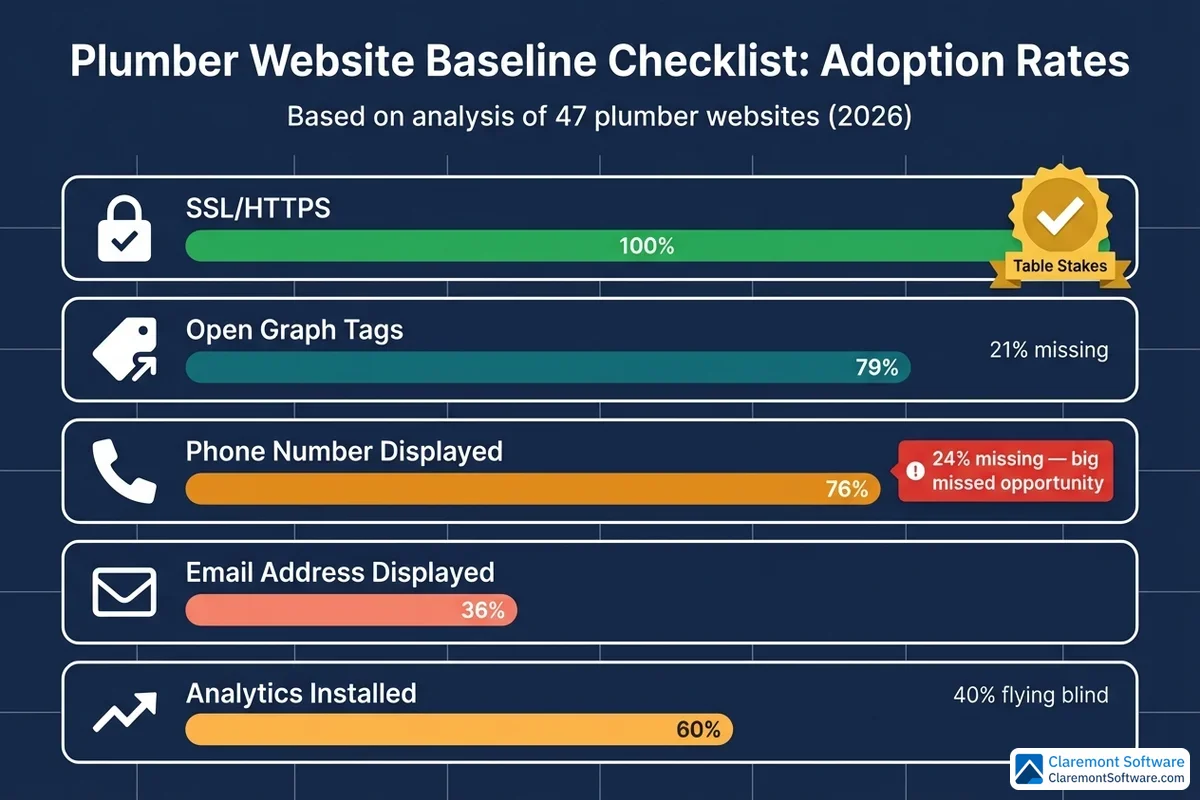
When Claremont Software audited all 50 plumber websites for analytics tracking, we expected to find a few gaps. What we found instead was a systemic blind spot: only 60% of plumber websites — 30 of 50 — had Google Analytics or Google Tag Manager installed. The other 40% had nothing. No tracking code. No data collection. No visibility whatsoever into what's happening on their website.
That means 2 in 5 plumbing companies are operating their website with zero information about how many people visit, which pages they land on, how long they stay, or whether anyone converts into a lead. They're spending money on SEO, running Google Ads campaigns, paying for local service listings — and they have no way to know if any of it is working.
Think about what that means in practice. If you're a plumbing company owner without analytics installed, you cannot answer basic questions: Is my website getting more traffic this month than last month? Which service page drives the most calls? Is my Google Ads spend generating leads or burning budget? Without data, every marketing decision is a guess. You might be pouring money into a channel that's delivering nothing, or unknowingly starving a channel that's quietly driving your best customers.
The frustrating part is that this is the easiest problem to fix in the entire study. Installing Google Analytics 4 or Google Tag Manager is free. It takes under 30 minutes. There are step-by-step guides, free plugins for WordPress, and no technical expertise required beyond copying and pasting a snippet of code. There is genuinely no excuse for running a business website without it in 2026.
If you take nothing else from this article, take this: check your site for analytics today. It's the single highest-leverage improvement most plumber websites can make — and it costs nothing but a few minutes of attention.
SSL, OG Tags, and Contact Info: The Baseline Checklist
After the analytics blind spot, the next set of findings might seem less dramatic — but don't let that fool you. These are the baseline elements that every plumber website should have locked down before worrying about anything else.
The good news first: SSL/HTTPS adoption is now 100% across all 50 sites we analyzed. Every single plumber website in the study is running a secure connection. That's genuinely encouraging, and it reflects how thoroughly browsers and hosting providers have pushed the industry toward encryption over the past several years. But here's the important caveat — SSL is no longer a competitive advantage. It's the floor, not the ceiling. Any site still running on HTTP in 2026 isn't just behind; it's actively flagged as insecure by every major browser, which means visitors see a warning before they even read your headline.
The picture gets less clean when you move down the checklist.
79% of sites have Open Graph tags properly implemented — the metadata that controls how your pages appear when someone shares a link on social media. That sounds solid until you flip it around: 1 in 5 plumber websites still has no OG tags at all. When someone shares one of those links on a neighborhood platform, a community group, or a local Facebook page, the preview either looks broken or pulls in whatever random image and text the platform can scrape together. For a business that depends heavily on word-of-mouth and local referrals, that's a quietly damaging gap.
The contact information finding is the one that should concern plumbing company owners most directly. 24% of plumber websites — nearly 1 in 4 — do not prominently display a phone number. In an industry where a significant portion of new customers are calling because a pipe just burst or a water heater just failed, making someone hunt for your phone number isn't a minor UX issue. It's a conversion killer. The customer will simply call the next result on the page.
On email: only 36% of sites display an email address, which suggests most plumbers have made a deliberate choice to funnel inquiries toward phone calls. That's a reasonable business decision — but it's worth noting that some customers, particularly those researching non-emergency work, prefer to reach out asynchronously first.
Taken together, these four elements — SSL, OG tags, a visible phone number, and contact information — form a non-negotiable baseline checklist. They're not differentiators. They're the minimum. Any plumber website launching or relaunching in 2026 should treat all four as done before the site goes live.
The Hidden Technical Debt Dragging Plumber Websites Down
Speed and content gaps get most of the attention in website audits — but underneath many of the underperforming sites in this study, there's a quieter problem doing just as much damage: accumulated technical debt that nobody has bothered to clean up.
The most common culprit is render-blocking scripts. Across the WordPress sites in particular, Claremont Software found a recurring pattern of unnecessary JavaScript loading before the page could display anything useful — jQuery libraries, slider plugins, live chat widgets, and in several cases, multiple redundant analytics tags firing simultaneously. Each one adds milliseconds. Stack enough of them together and you've turned a potentially fast site into the kind of sluggish experience that sends emergency callers straight to the next Google result.
Then there's the security issue. Several WordPress sites in the study were running version 4.x — software that is years out of date and no longer receiving security patches. For a business that collects customer contact information and processes service requests online, running an outdated CMS isn't just a performance problem. It's an open door for malicious actors. A hacked plumber website doesn't just go offline — it can be blacklisted by Google entirely, wiping out years of SEO progress overnight.
Enterprise CMS platforms present a different kind of overhead. The franchise brands in this study running centralized web management solutions averaged just a 2.8% content rate — the lowest of any platform group outside of consumer builders. That's the cost of centralized brand control: heavy markup, rigid templates, and code infrastructure built for scale rather than performance.
The encouraging finding is that technical debt is not inevitable, even on WordPress. The best-performing WordPress sites in the study paired the platform with a CDN and a caching plugin, achieving load times competitive with far lighter platforms. The infrastructure was the same — the optimization made all the difference.
Newer platforms like Webflow are also worth watching. With a 5.0% average content rate and cleaner default code output, they offer a compelling middle ground: more flexibility than static HTML, less bloat than legacy CMS platforms, and a maintenance experience that doesn't require a developer for every small update.
What the Best Plumber Websites Have in Common
After analyzing 47 plumber websites across 15 cities, a clear pattern emerged at the top of the performance rankings. The best-performing sites aren't succeeding by accident — they share a consistent set of characteristics that separate them from the competition.
Speed is the foundation. The top-performing sites in this study achieved Time to Interactive scores well under one second, accomplished through a combination of platform optimization, CDN delivery, and ruthless elimination of render-blocking resources. Whether they were running an optimized WordPress stack or a lighter modern platform, the fastest sites treated every unnecessary script as a liability. When a homeowner's basement is flooding at 11pm, a site that loads in 300ms wins the call. A site that takes 3 seconds loses it.
Content depth is non-negotiable. The best plumber websites don't just list services — they explain them. With averages exceeding 1,400 words on their main pages, these sites answer the questions customers are actually searching: What does a water heater replacement cost? How do I know if I need a full repipe? What happens during a drain inspection? That depth builds trust, demonstrates expertise, and gives search engines the signals they need to rank the page competitively.
The baseline checklist is fully complete. SSL, analytics, Open Graph tags, and a prominently displayed phone number — the top sites have all four locked down without exception. No gaps, no oversights.
Code is clean and purposeful. The best sites deliver content efficiently, without layers of framework bloat burying the actual information visitors came for.
The conversion path is obvious. The phone number is visible above the fold. The call-to-action is clear. An emergency caller can find what they need within seconds — because the site was built with that exact scenario in mind.
How to Benchmark Your Plumber Website Against These Findings
Reading through the data and previous sections, you now have everything you need to measure your own site against the 47 plumber websites in this study. Here's how to do it in under an hour — no technical background required.
Check your page speed first. Open Google Chrome, navigate to your homepage, and press F12 to open DevTools. Click the "Lighthouse" tab and run a mobile audit. Look for your Time to Interactive score. If it's above 2,000ms, you're slower than the average site in this study — and you're likely losing emergency callers to faster competitors before they ever read a word on your page.
Count your words. Paste your homepage URL into any free word count tool and check your body content total. If you're under 1,073 words, you're below the median of the 47 sites we analyzed. Under 300 words puts you in the bottom 4% — territory where ranking for competitive local terms becomes extremely difficult.
Verify your analytics. Right-click your homepage, select "View Page Source," and search for "gtag" or "GTM-". If neither appears, you have no analytics installed. That means every visitor, every call, every lead your website generates is invisible to you. This takes less than 30 minutes to fix and costs nothing.
Test your Open Graph tags. Paste your URL into the sharing debugger tool inside Facebook's developer portal. If the preview image is missing or the description looks generic, you're losing credibility every time someone shares your link on Nextdoor or Facebook.
If any of these checks reveal a problem, you're not alone — but you are leaving revenue on the table. Claremont Software builds plumber websites engineered to outperform on every metric in this study. Visit claremontsoftware.com/plumber-web-design/ to see how we can help.
Conclusion
The data from this study draws a clear dividing line between plumber websites that win customers and those that quietly lose them. The best sites load in under 500ms, carry 1,000+ words of substantive content, and track every visitor with analytics. The worst are slow, thin, and completely blind to their own performance — and far too many fall into that second category.
The most actionable takeaways are also the most accessible. Forty percent of plumber websites have no analytics installed — a free fix that takes under 30 minutes. Nearly one in four don't display a phone number prominently — a conversion killer in an emergency-driven business. And the majority of sites are carrying unnecessary technical debt that slows every page load without delivering any value to the visitor.
Platform matters, content matters, and speed matters — but none of these problems are permanent. They're choices, and they can be changed.
If your website came up short against any benchmark in this study, Claremont Software builds plumber websites engineered to outperform on every metric we measured. Visit claremontsoftware.com/plumber-web-design/ to see what a high-performance plumber website looks like — and what it can do for your business.
Frequently Asked Questions
How fast should a plumber website load in 2026?
Based on Claremont Software's analysis of 47 plumber websites, the average Time to Interactive (TTI) is 1,660ms — but you should aim for under 1,000ms to stand out. Only 13% of sites (6 of 47) loaded under 500ms, which represents the gold standard for mobile performance. The fastest site in the study loaded in just 255ms. If your TTI is over 2,000ms, you're in the bottom tier and likely losing impatient emergency callers before they ever see your phone number. For a plumbing business where customers often need help urgently, every extra second of load time directly costs you leads.
What is the best website platform (CMS) for a plumbing company?
There's no single "best" platform, but the data points to clear winners and losers. WordPress dominates at 58% of plumber websites and can perform excellently when paired with a CDN like Cloudflare and a caching plugin. Webflow is emerging as a strong alternative with cleaner code output (5.0% content rate) and faster default performance. DudaOne is popular among local service businesses and produced the fastest site in Claremont Software's study at 255ms. Avoid consumer-oriented builders like Wix — they had the worst content-to-code ratio (0.1%) and consistently underperformed on SEO metrics. Platform choice is one of the most consequential decisions you'll make for your website.
How many words should a plumber's homepage have for good SEO?
Aim for at least 1,000 words — that's the median across the 47 plumber websites Claremont Software analyzed. The average was even higher at 1,462 words, and 60% of sites exceeded the 1,000-word mark. The most content-rich site in the study had 6,774 words. By contrast, the thinnest site had just 52 words and almost certainly struggles to rank for any competitive search terms. Only 4% of sites had fewer than 300 words, and both were extremely thin pages. More content gives search engines more to index, demonstrates your expertise to potential customers, and answers the questions people are actually searching for.
Why do 40% of plumber websites have no analytics installed?
Claremont Software's study found that 40% of plumber websites — 20 out of 50 — have zero analytics tracking installed. This is likely due to a combination of factors: websites built by non-specialist designers who skipped the setup, business owners who didn't know to ask for it, or sites that were simply never updated after launch. The consequence is severe — without Google Analytics or Google Tag Manager, you have no idea how many people visit your site, which pages they view, or whether your SEO and ad spend is generating any leads at all. Installing analytics is free and takes under 30 minutes. There is no good reason to operate without it in 2026.
Do plumber websites really need Open Graph tags for social media?
Yes — and 21% of plumber websites are still missing them. Open Graph (OG) tags control how your website looks when someone shares a link on Facebook, Nextdoor, or other social platforms. Without them, your link may display with no image, a broken preview, or generic placeholder text — which looks unprofessional and gets far fewer clicks. For plumbers, Nextdoor in particular is a high-value referral channel where neighbors recommend local services. If your link looks broken when someone shares it, you're losing warm referral traffic. OG tags are simple to add and take minutes to implement — they should be on every plumber website's baseline checklist.
Is WordPress still the best choice for plumber websites in 2026?
WordPress remains the most widely used platform for plumber websites at 58% market share, and it can absolutely be the right choice — but only when properly optimized. The slowest site in Claremont Software's study (4,981ms TTI) was a poorly configured WordPress site, while the best-performing WordPress sites used a CDN and caching plugins to achieve competitive speeds. WordPress also carries risks: several sites in the study were running outdated versions (4.x) with known security vulnerabilities. Newer platforms like Webflow offer cleaner code and faster defaults with less maintenance overhead. WordPress is still a strong choice, but it requires ongoing optimization and security management to perform at its best.
What is a good content-to-code ratio for a plumber website?
The overall average content rate across 47 plumber websites was just 4.4% — meaning 95.6% of the HTML delivered to visitors is code, not readable content. Custom and static HTML sites performed best at 11.8%, while Webflow sites averaged 5.0% and WordPress sites averaged 4.3%. The worst offender was Wix at just 0.1%, where the page is almost entirely JavaScript framework code. A higher content rate generally means cleaner, faster-loading pages with stronger signals to search engines about what your page is actually about. While there's no universal benchmark, anything above 5% is solid for a CMS-built site — and anything below 1% is a red flag worth investigating.
How can I tell if my plumber website is underperforming compared to competitors?
Start with four free checks. First, run a Lighthouse audit in Chrome DevTools — if your Time to Interactive is over 2,000ms, you have a speed problem (the study average is 1,660ms). Second, count your homepage words using any free word count tool — if you're under 1,000 words, you're below the median. Third, check your page source for Google Analytics or Google Tag Manager — if it's missing, you're among the 40% flying blind. Fourth, paste your URL into Facebook's Sharing Debugger to test your Open Graph tags — a broken preview means lost social traffic. If you're failing two or more of these checks, your website is likely underperforming relative to the competition. Claremont Software builds plumber websites engineered to pass every one of these benchmarks — learn more at claremontsoftware.com/plumber-web-design/.