
With 96% of potential clients turning to search engines before ever picking up the phone to call a lawyer, your website isn't just a digital business card — it's your firm's most powerful client acquisition tool. Yet most attorneys approach website budgeting the same way they'd buy a used car: with little information, a vague sense of what's fair, and a nagging feeling they're about to overpay.
The truth is, law firm website costs range dramatically — from $15 per month for a DIY solution to $40,000 or more for an enterprise-level custom build. That's a staggering spectrum, and without a clear roadmap, it's nearly impossible to know where your firm should land.
This guide changes that.
Whether you're a solo practitioner launching your first site or a growing firm overdue for a redesign, you'll find a fully transparent, line-item breakdown of every cost involved — upfront and ongoing. We'll walk through every tier of investment, expose the hidden fees most agencies won't mention, and give you the tools to make a confident, ROI-driven decision for 2025 and beyond.
The Real Cost Spectrum: From DIY to Enterprise
Understanding where your firm falls on the cost spectrum is the essential first step before you talk to a single vendor or request a single quote. The range is genuinely vast — and without a clear map, it's easy to overpay for features you don't need or, just as commonly, underpay for a site that quietly costs you clients every month.
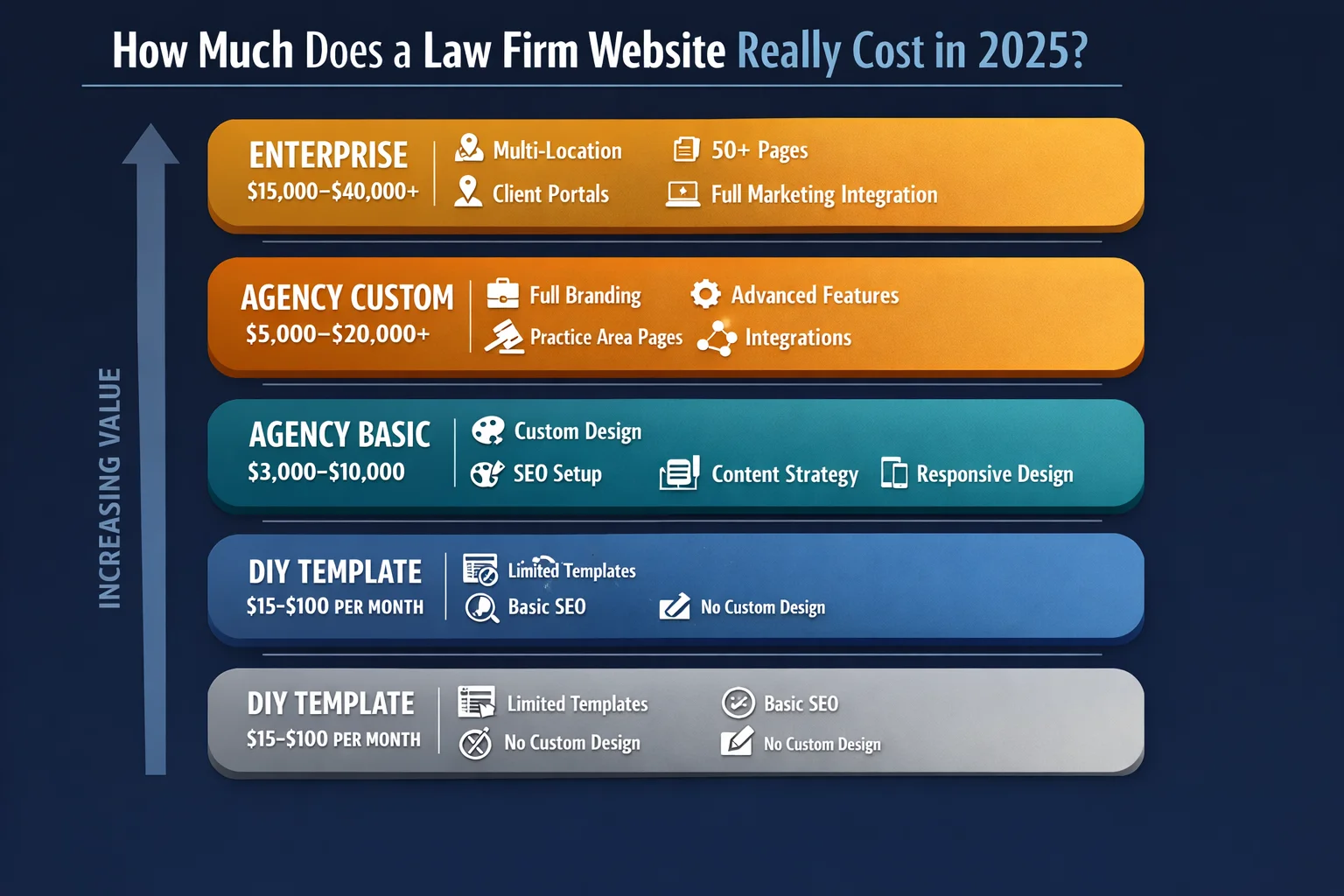
DIY Website Builders ($15–$100+/month)
At the entry level, drag-and-drop website builders offer the lowest barrier to getting online. For roughly $15 to $100 per month, you can have a site live within days. The tradeoff? These platforms come with meaningful limitations in customization, SEO performance, and professional credibility. For a law firm competing in a local market, a generic template can signal to prospective clients that you're not established — and that perception matters.
Freelancer and Small Agency Builds ($3,000–$10,000)
This is where most solo attorneys and small firms land. A freelance designer or boutique agency can deliver a professionally designed, custom site with 10–20 pages, basic SEO setup, and attorney bios in this range. Quality varies significantly, so vetting for legal industry experience is critical.
Mid-Tier Custom Websites ($5,000–$20,000+)
Firms that want stronger branding, deeper SEO foundations, conversion-optimized layouts, and more sophisticated functionality typically invest here. This tier represents the sweet spot for small-to-mid-size firms serious about digital growth.
Enterprise-Level Builds ($15,000–$40,000+)
Large firms with multiple practice areas, dozens of attorney profiles, multilingual needs, and complex integrations start at $15,000 — with enterprise projects from specialized legal web design providers reaching $40,000 or more.
Real-world data confirms this spread. Attorneys on professional forums report paying anywhere from $1,000 to $7,000+, with final costs driven almost entirely by scope, page count, and whether content creation is included.
A Line-Item Cost Breakdown Most Agencies Won't Show You

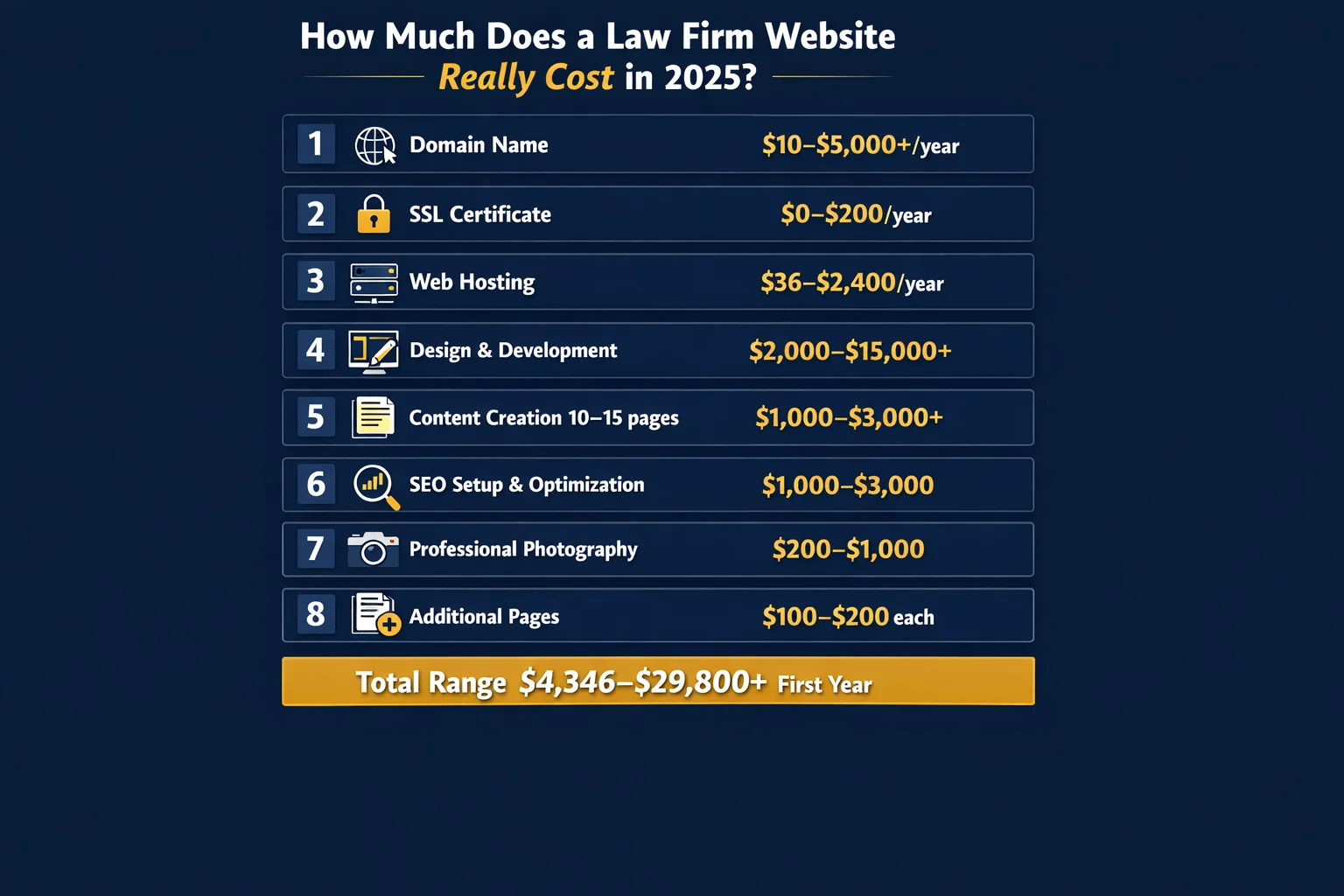
When attorneys ask for a website quote, most agencies respond with a single number. What they rarely provide is the itemized breakdown behind that number — which means hidden costs have a way of surfacing after you've already signed a contract. Here's what you're actually paying for, line by line.
Domain Name: $10–$5,000+
A standard domain registration runs $10–$15 per year — essentially a rounding error in your overall budget. But if you want a premium domain that combines your city and practice area (think "chicagopersonalinjurylawyer.com" or "nycdivorceattorney.com"), you may be looking at $500 to $5,000+ for a domain already held by a third party. These premium domains can carry genuine SEO value, but weigh the cost carefully before committing.
SSL Certificate: Free–$200+/year
Most reputable hosting providers now include a basic SSL certificate at no additional charge. However, Extended Validation (EV) certificates — which display your firm name in the browser bar and signal a higher level of identity verification — can cost $200 or more annually. For firms handling sensitive client intake online, the added trust signal is worth considering.
Web Hosting: $3–$200+/month
Shared hosting plans start as low as $3–$50 per month and are adequate for low-traffic sites. As your firm grows and your site attracts more visitors, managed or dedicated hosting becomes necessary — and that typically runs $50–$200+ per month. Cutting corners on hosting is one of the most common mistakes law firms make; slow load times directly hurt both user experience and search rankings.
Design and Development: $2,000–$15,000+
This is the largest single line item in any website project. The range reflects real differences in scope: a 10-page site with a clean template adaptation sits at the lower end, while a fully custom-designed site with unique layouts, conversion-optimized page structures, and integrated functionality climbs quickly. Budget approximately $100–$200 per additional page beyond your base package — a detail many agencies bury in the fine print.
Content Creation: $1,000–$3,000+
This is where law firms most consistently underinvest, and it's arguably the most consequential mistake. Professional legal copywriting — written by someone who understands both search intent and how to speak to a prospective client in distress — costs $1,000 to $3,000 or more for a complete site. Generic, self-written content doesn't just underperform; it actively undermines your SEO efforts.
SEO Setup and Optimization: $1,000–$3,000
A well-designed site that no one can find is a sunk cost. Initial technical SEO — including site architecture, keyword research, metadata optimization, schema markup, and Google Business Profile alignment — typically adds $1,000 to $3,000 to a project. Many agencies treat this as optional. It isn't.
Photography and Video: $200–$10,000+
Professional headshots for attorneys run $200–$1,000 depending on your market and photographer. Firm overview videos or practice area explainer content ranges from $1,500 to $10,000+. Stock photos are a tempting shortcut, but clients notice — and authenticity consistently outperforms generic imagery in conversion testing.
Ongoing Costs Most Law Firms Forget to Budget For
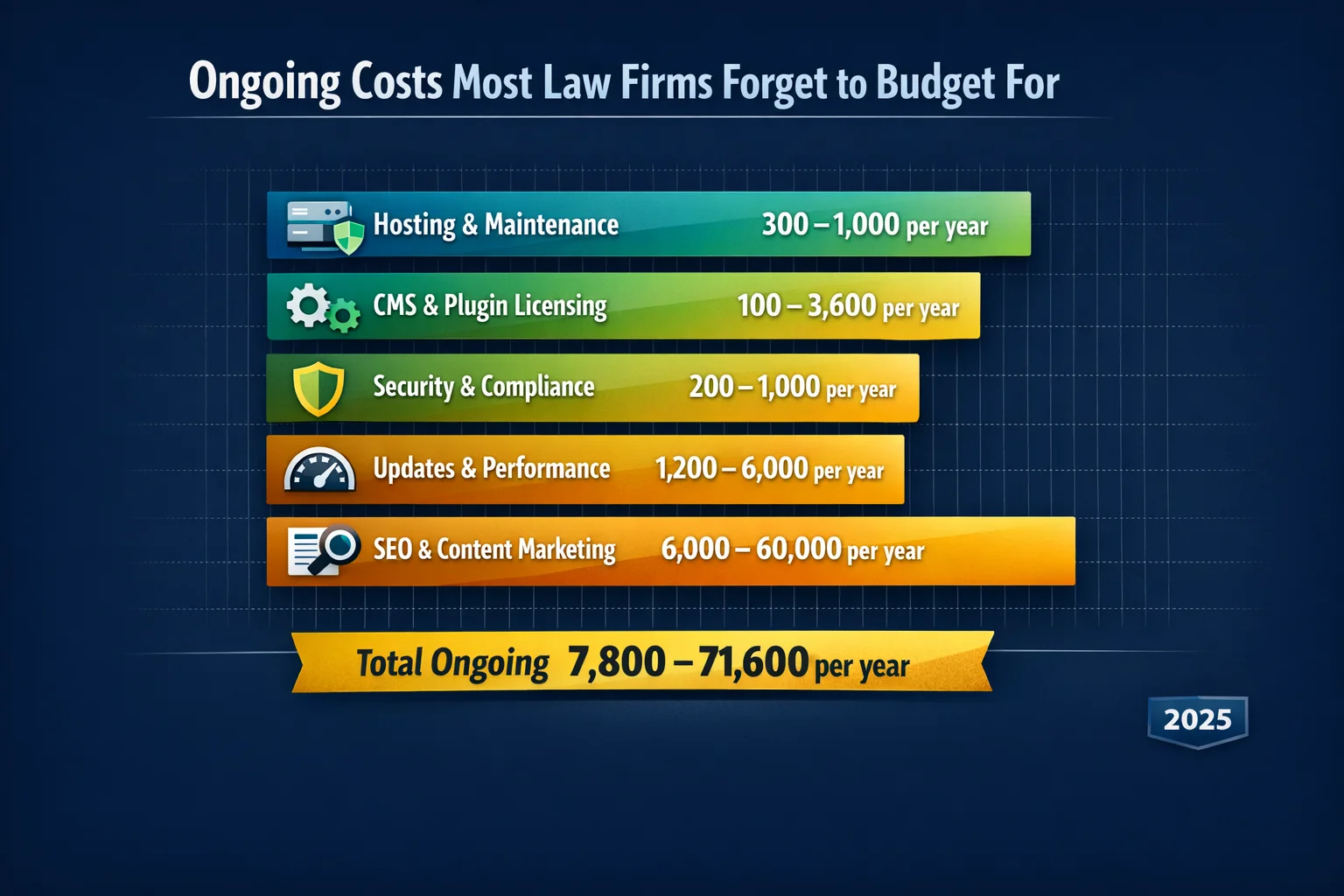
Your website doesn't stop costing money the day it launches — and this is where many law firms get caught off guard. The upfront build cost is just the beginning. Failing to account for recurring expenses doesn't just strain your budget; it can leave your site vulnerable, outdated, and quietly bleeding potential clients.
Hosting and Maintenance: $200–$1,000+/year
Even after your site is live, someone needs to keep the lights on. Hosting fees, software updates, and routine maintenance collectively run a few hundred to over $1,000 annually depending on your setup. More importantly, neglected maintenance creates real security vulnerabilities — an unpatched site is an open door for malware, data breaches, and the kind of reputational damage no law firm can afford.
CMS and Plugin Licensing: $100–$3,600/year
Open-source platforms like WordPress carry no licensing fee, but the plugins that make them functional — security tools, SEO software, form builders, caching systems — typically add $100 to $500 per year. Proprietary platforms often bundle these features but charge $50 to $300 per month for the privilege. Neither model is inherently better; just make sure you know what you're paying before you commit.
Monthly SEO and Content Retainers: $500–$5,000/month
Search rankings aren't a one-time achievement — they require ongoing investment. Monthly SEO retainers and content marketing programs are often necessary to maintain visibility as competitors publish new content and Google's algorithm evolves. This is frequently the largest ongoing expense, and also the one with the clearest return when managed well.
Security and Compliance: $200–$1,000/year
Firewalls, malware scanning, automated backups, and compliance considerations for handling sensitive client data add meaningful cost — but skipping them is a false economy. A single security incident can cost far more to remediate than years of preventive investment.
Total Cost of Ownership: The 3-Year View

Most attorneys evaluate website proposals by looking at one number: the upfront project cost. That single-figure focus is one of the most expensive mistakes you can make.
The true cost of owning a law firm website only becomes clear when you extend the math across three to five years — and the results are often surprising.
Consider two common scenarios. A budget-conscious attorney builds a DIY-adjacent site for $3,000, then pays $200 per month for hosting, maintenance, and basic support. Over three years, that totals $10,200. Meanwhile, a firm that invests $10,000 in a professionally built site with $500 per month in ongoing maintenance and SEO reaches $28,000 over the same period. Neither number is inherently wrong — but both need to be understood before you sign anything.
This is where subscription and retainer-based models deserve serious consideration. All-inclusive monthly plans ranging from $300 to $1,000 per month bundle design, hosting, maintenance, and sometimes SEO into a single predictable payment. For firms that struggle to manage vendor relationships or anticipate variable costs, this structure can deliver better long-term value than a one-time project fee followed by unpredictable ongoing expenses.
The deeper pattern worth noting: firms that invest $8,000–$15,000 upfront frequently spend less over five years than those who build a cheap site, watch it underperform, and rebuild it entirely 18 to 24 months later. Rebuilds aren't just expensive — they reset your SEO progress and cost you time you can't recover.
Finally, before committing to any provider, get clear answers on contract terms: Who owns your design files, content, and domain name if you leave? Are you building on a proprietary platform that makes migration prohibitively expensive? These questions matter as much as the price itself.
How Firm Size and Practice Area Affect Your Budget

Not all law firm websites are created equal — and neither are the budgets behind them. Your firm's size, structure, and practice focus should drive your investment level just as much as aesthetics or feature preferences.
Solo Attorneys: $4,000–$6,000
A solo law firm website typically needs a focused site of five to ten pages: a homepage, an about page, two to four practice area pages, and a contact page. That's enough to establish credibility and compete locally without overbuilding. Budget in the $4,000 to $6,000 range for a professionally designed site that loads fast, ranks in local search, and converts visitors into consultation requests. Going cheaper often means sacrificing the SEO foundation that makes the investment worthwhile in the first place.
Small Firms (2–10 Attorneys): $8,000–$12,000
Once you add multiple attorneys, several practice areas, and the need for individual bio pages, complexity grows quickly. Small firms typically invest $8,000 to $12,000 for a comprehensive site that presents each attorney professionally and clearly communicates the firm's full range of services. This tier also tends to require more sophisticated contact and intake functionality.
Mid-Size to Large Firms: $15,000–$25,000+
Firms with ten or more attorneys, multiple office locations, and complex practice area structures routinely spend $15,000 to $25,000 or more. At this scale, the website functions more like a platform than a brochure — requiring careful information architecture, robust attorney profile systems, and often integration with case management tools.
Practice Area Considerations
Your practice area shapes your priorities as much as your headcount. Personal injury firms typically invest more heavily in conversion optimization — prominent calls-to-action, live chat, and aggressive lead capture. Corporate and intellectual property firms often prioritize thought leadership content and a more polished, understated aesthetic that signals sophistication to business clients.
Multilingual Capabilities: Add $2,000–$5,000+
Firms serving diverse communities should budget meaningfully for multilingual functionality. Translated content, language-switching interfaces, and culturally appropriate design aren't cosmetic additions — they're client acquisition tools that can open entire market segments.
DIY Builders vs. Freelancers vs. Agencies: Which Is Right for You?
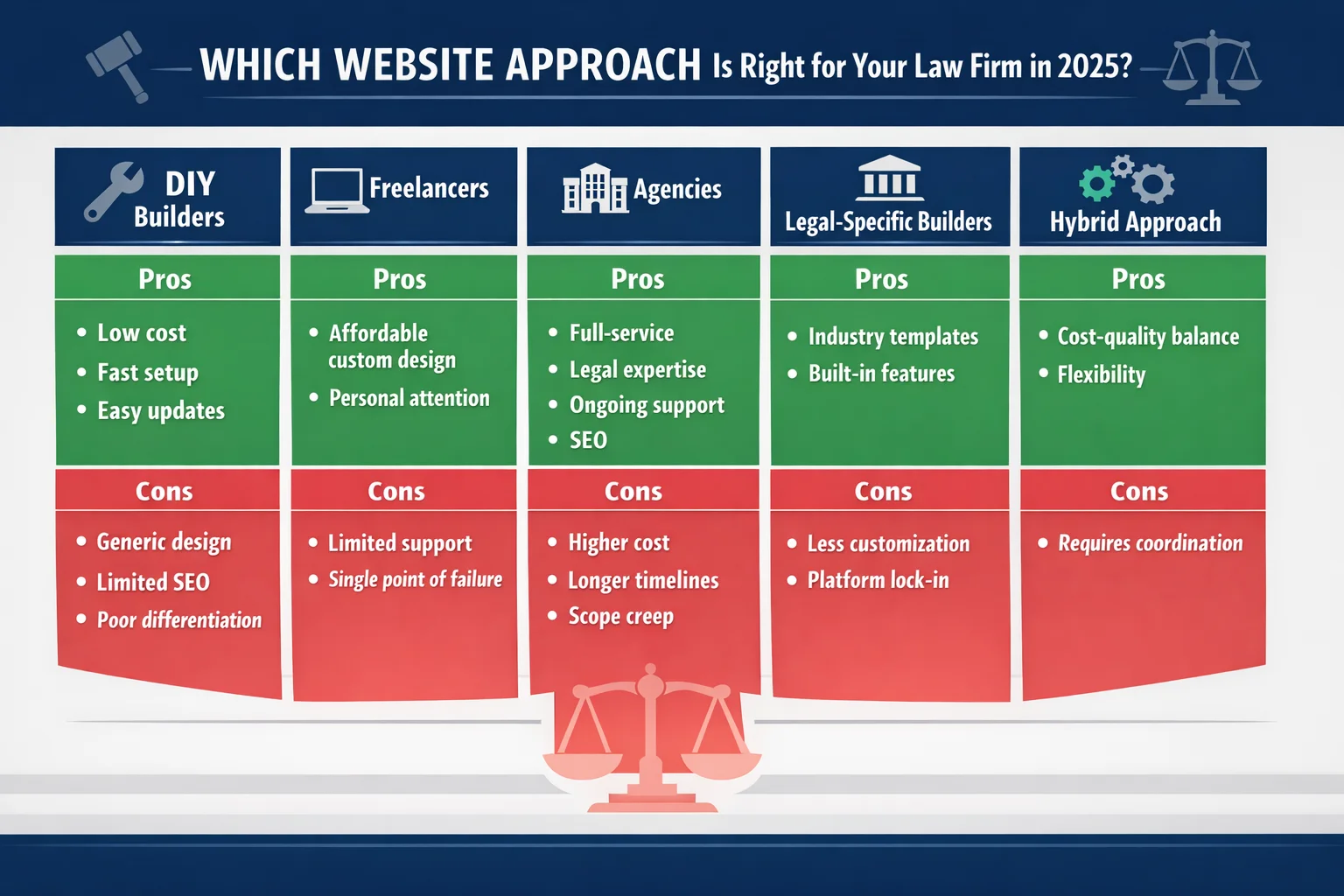
Choosing how to build your law firm website isn't just a budget decision — it's a strategic one. Each path comes with distinct tradeoffs in cost, quality, flexibility, and long-term performance.
DIY Website Builders: Best for Attorneys Just Starting Out
Platforms that let you drag, drop, and publish in a weekend are genuinely useful for one specific scenario: a solo attorney who needs a basic online presence quickly and has minimal budget to work with. At $15 to $100 per month, the barrier to entry is low. The ceiling, however, is equally low. These platforms offer limited customization, generic templates that do nothing to differentiate your firm, and SEO capabilities that rarely compete with professionally built sites in contested local markets. If you're just hanging your shingle and need something live while you build revenue, a DIY builder can serve as a temporary solution — but treat it as exactly that.
Legal-Specific Website Builders: A Step Up, With Caveats
A tier above general DIY platforms, legal-specific website builders offer pre-built templates designed around attorney workflows — practice area pages, bio layouts, consultation request forms. Pricing typically runs $50 to $150 per month. The tradeoff is customization: you're still working within a constrained system, and your site may look similar to dozens of other firms using the same platform.
Freelance Designers: The Middle Ground
Freelancers charging $1,000 to $5,000 or more can produce visually strong work at a reasonable price point. The risk is inconsistency. Many freelancers lack deep legal industry knowledge, may not prioritize SEO architecture, and often can't provide ongoing support once the project closes. Vet carefully and ask specifically about their experience with law firm websites.
Professional Agencies: Comprehensive but Costly
Agencies in the $5,000 to $20,000-plus range bring strategy, design, development, content, and SEO under one roof. For firms serious about growth, this integrated approach often delivers the strongest results — provided the agency has genuine legal industry experience. Ask for case studies and client references before committing.
The Hybrid Approach
For many firms, the smartest path sits between full agency and DIY. Platforms like those offered by Claremont Software combine professionally structured foundations with room for customization, allowing firms to pair a solid technical base with professional content and targeted SEO — delivering strong results without enterprise-level pricing.
Essential Features Worth Paying For (and What to Skip)
Not every feature on a web designer's proposal is worth the line item. Knowing which investments drive real client acquisition — and which ones just look impressive in a demo — can save you thousands without sacrificing performance.
Non-Negotiables: The Foundation Every Firm Needs
Some features aren't optional in 2025. Mobile-responsive design is table stakes — the majority of legal searches now happen on smartphones, and Google penalizes sites that don't perform well on mobile. Fast load times, SSL security, clear calls-to-action, attorney bio pages, practice area pages, and functional contact forms aren't upsells. They're the baseline. If a proposal doesn't include all of these as standard, walk away.
High-ROI Features Worth the Investment
Beyond the basics, certain features consistently pay for themselves. Live chat and AI chatbot integration ($1,500–$5,000+) captures leads outside business hours — critical when a potential client is searching for a DUI attorney at 11pm. Online appointment scheduling and digital client intake forms reduce friction at the exact moment someone decides to hire. Client portals for secure document sharing add operational value that clients notice and appreciate.
Practice management integrations — connecting your website to tools that handle billing, case tracking, and client communication — can justify their $1,000–$3,000 implementation cost quickly through time savings alone.
ADA and WCAG accessibility compliance deserves serious attention. Adding $500–$2,000 to your build, it ensures your site is usable by visitors with disabilities — and increasingly, non-compliant sites face legal exposure of their own.
Features You Can Safely Skip Early On
Complex animations, video backgrounds, custom illustrations, and elaborate interactive elements are the dessert menu of web design — appealing in the moment, expensive, and unlikely to improve your conversion rate. Prioritize performance and clarity over visual spectacle, especially in your first build.
The ROI Equation: When Does Your Website Pay for Itself?

The math here is straightforward — and it's worth doing explicitly. If your firm handles cases with an average value of $5,000 and your website generates just two new clients per month, that's $120,000 in annual revenue flowing from a $10,000–$15,000 investment. Even accounting for ongoing costs, the payback period is measured in weeks, not years.
But that calculation only holds if your website is actually converting visitors into clients — which requires more than a good-looking design.
The Changing Search Landscape
Google's AI Overviews and the rise of zero-click searches are reshaping how law firms capture organic traffic. Potential clients increasingly get answers directly on the search results page without ever visiting your site. This makes optimization for featured snippets, local search visibility, and Google Business Profile integration more important than ever. A website that isn't built with these dynamics in mind will underperform regardless of how much you spent on it.
Measure What Matters
You can't manage what you don't measure. Proper analytics setup — including conversion tracking, call tracking, and form submission monitoring — typically costs $500–$1,500 to implement correctly, but it's the only way to know whether your website is actually earning its keep. Without this infrastructure, you're guessing.
Budget Benchmarks to Know
Industry guidance suggests law firms allocate 7–10% of gross revenue to marketing, with roughly 25–35% of that budget directed toward website and digital presence. These aren't arbitrary numbers — they reflect what consistently growing firms actually spend.
The highest-performing firms don't treat their website as a one-time purchase. They invest continuously in content, SEO, and conversion rate optimization — because that's where the compounding returns live.
Red Flags and Hidden Costs to Watch For
The legal web design industry has its share of predatory practices, and attorneys — who spend their careers reading contracts carefully — sometimes forget to apply that same scrutiny when hiring someone to build their website. Here's what to watch for before you sign anything.
Ownership Terms Are Non-Negotiable
Some agencies retain ownership of your design files, website content, or even your domain name. If you leave, you leave with nothing — forced to rebuild from scratch at full cost. Before engaging any provider, confirm in writing that you own your domain, your content, and all design assets upon final payment. This single clause can save you thousands if the relationship sours.
Proprietary Platform Lock-In
Certain providers build your site on a closed, proprietary CMS that only they can manage. Migrating away means a complete rebuild. Always ask: Can I take this site to another developer if I need to? If the answer is unclear or evasive, treat it as a red flag.
Hidden Costs That Surface After Launch
Get explicit answers on these before signing:
- Revision limits — how many rounds are included, and what's the hourly rate beyond that?
- Stock photo licensing — are images fully licensed, or will you face recurring fees?
- Premium plugin costs — who pays for annual renewals?
- Email setup and post-launch support — is any included, and for how long?
Suspiciously Low Quotes
A "$500–$1,500 custom law firm website" is almost never custom. It's a minimally modified template with no SEO foundation and no strategic thought behind it — a liability dressed as a bargain.
The Simple Rule: Get Everything in Writing
Project scope, timeline, revision count, asset ownership, and all post-launch costs should be documented before work begins. Verbal assurances don't hold up — in law or in web design.
Conclusion
Building a law firm website is one of the most consequential investments you'll make in your practice — and like any serious investment, it deserves serious analysis before you commit. The cost spectrum is wide, running from $15 a month for a basic DIY presence to $40,000 or more for an enterprise-level build, but the right number for your firm isn't found by splitting the difference. It's found by honestly assessing your firm size, practice area, competitive market, and growth goals.
The single most important shift in mindset this guide asks of you: stop evaluating websites by their upfront price and start evaluating them by their three-to-five-year total cost of ownership — including SEO, maintenance, content, and the very real cost of underperformance.
Above all, remember that the goal isn't a beautiful website. It's a website that converts visitors into clients and delivers measurable, trackable ROI.
Start with clear goals. Use the line-item framework in this guide to pressure-test every proposal you receive. And choose a partner — whether that's Claremont Software or another qualified provider — whose expertise and incentives are genuinely aligned with your firm's long-term success.
Frequently Asked Questions
How much should a solo attorney spend on a website in 2025?
A solo attorney should budget between $4,000 and $6,000 for a professionally designed website in 2025. This range typically covers a 5–10 page site with essential features like attorney bio, practice area pages, contact forms, and basic SEO setup. While DIY builders are available for $15–$100/month, they often lack the credibility and search visibility needed to compete in local legal markets. Factor in ongoing costs too — hosting, maintenance, and SEO retainers can add $200–$500/month. Investing in a quality site upfront is almost always more cost-effective than rebuilding a cheap one within two years.
What is the average monthly cost to maintain a law firm website?
The average monthly cost to maintain a law firm website ranges from $100 to $500+ depending on the level of service. Basic maintenance — including hosting, security monitoring, plugin updates, and backups — typically runs $100–$300/month. If you add an SEO or content marketing retainer, costs can rise to $500–$5,000/month. Firms that neglect maintenance risk security vulnerabilities, slow load times, and declining search rankings. Budgeting for ongoing maintenance from day one is essential to protect your initial investment and keep your site performing at its best.
Is a DIY website builder good enough for a law firm?
A DIY website builder can work for a solo attorney who needs a basic online presence quickly and has a very limited budget, but it comes with real trade-offs. Most DIY platforms offer limited customization, weaker SEO capabilities, and templates that don't convey the professional credibility clients expect from a law firm. With 96% of potential clients using search engines to find legal help, a site that doesn't rank or convert is a missed opportunity. For attorneys serious about client acquisition, a professionally designed site — or a legal-specific platform like Claremont Software — will almost always outperform a generic DIY builder.
How much does law firm website SEO cost on top of the design?
SEO costs for a law firm website come in two phases. At launch, initial technical SEO setup, keyword research, and on-page optimization typically adds $1,000–$3,000 to your project cost. Ongoing SEO — including content creation, link building, and performance monitoring — is usually billed as a monthly retainer ranging from $500 to $5,000/month depending on your market competitiveness and goals. Highly competitive practice areas like personal injury in major metros sit at the higher end. Skipping SEO investment is one of the most common and costly mistakes law firms make — a beautiful website that no one finds generates zero ROI.
Should I redesign my existing law firm website or build a new one from scratch?
The right choice depends on the age, performance, and technical foundation of your current site. If your site is more than 3–4 years old, loads slowly, isn't mobile-responsive, or consistently underperforms on lead generation, a full rebuild is often the smarter investment. A redesign makes sense when your core structure and content are solid but the visual design or user experience needs refreshing. Before deciding, audit your current site's SEO equity — if it has strong backlinks and rankings, a careful redesign that preserves that value is preferable to starting from scratch and losing ground in search results.
How long does it take to build a custom law firm website?
A custom law firm website typically takes 6 to 16 weeks to build from kickoff to launch, depending on the size and complexity of the project. A straightforward 5–10 page site for a solo attorney may be completed in 6–8 weeks, while a mid-size firm site with multiple attorney profiles, practice area pages, and integrations can take 10–16 weeks or more. The biggest delays are usually on the client side — gathering content, approving designs, and providing feedback. Having your content, photos, and brand assets ready before the project begins can significantly shorten the timeline.
What features are essential for a law firm website to generate leads?
The highest-impact features for lead generation on a law firm website include: mobile-responsive design (the majority of legal searches happen on mobile), fast load times, SSL security, clear and prominent calls-to-action, a simple contact form, and dedicated practice area pages optimized for local search. Beyond the basics, live chat or AI chatbot integration, online appointment scheduling, and client intake forms can meaningfully increase conversion rates. Attorney bio pages that build trust and social proof are also critical. Features like complex animations or video backgrounds, on the other hand, add cost without improving conversions and can actually slow your site down.
How do I know if my law firm website is providing a good return on investment?
Start by tracking the right metrics: organic search traffic, contact form submissions, call tracking data, and new client acquisition source. Proper analytics setup — including conversion tracking and call tracking — costs $500–$1,500 to implement but is essential for measuring performance accurately. A simple ROI benchmark: if your average case value is $5,000 and your website generates just two new clients per month, that's $120,000 in annual revenue. Industry guidance suggests law firms allocate 7–10% of gross revenue to marketing, with 25–35% of that going toward website and digital presence. If your site isn't generating measurable leads, the issue is usually SEO, content quality, or conversion optimization — not the design itself.