
Nearly half of all prospective legal clients turn to Google when choosing a law firm — yet most attorneys are virtually invisible in the local search results that matter most.
That's not a minor marketing gap. It's a pipeline problem.
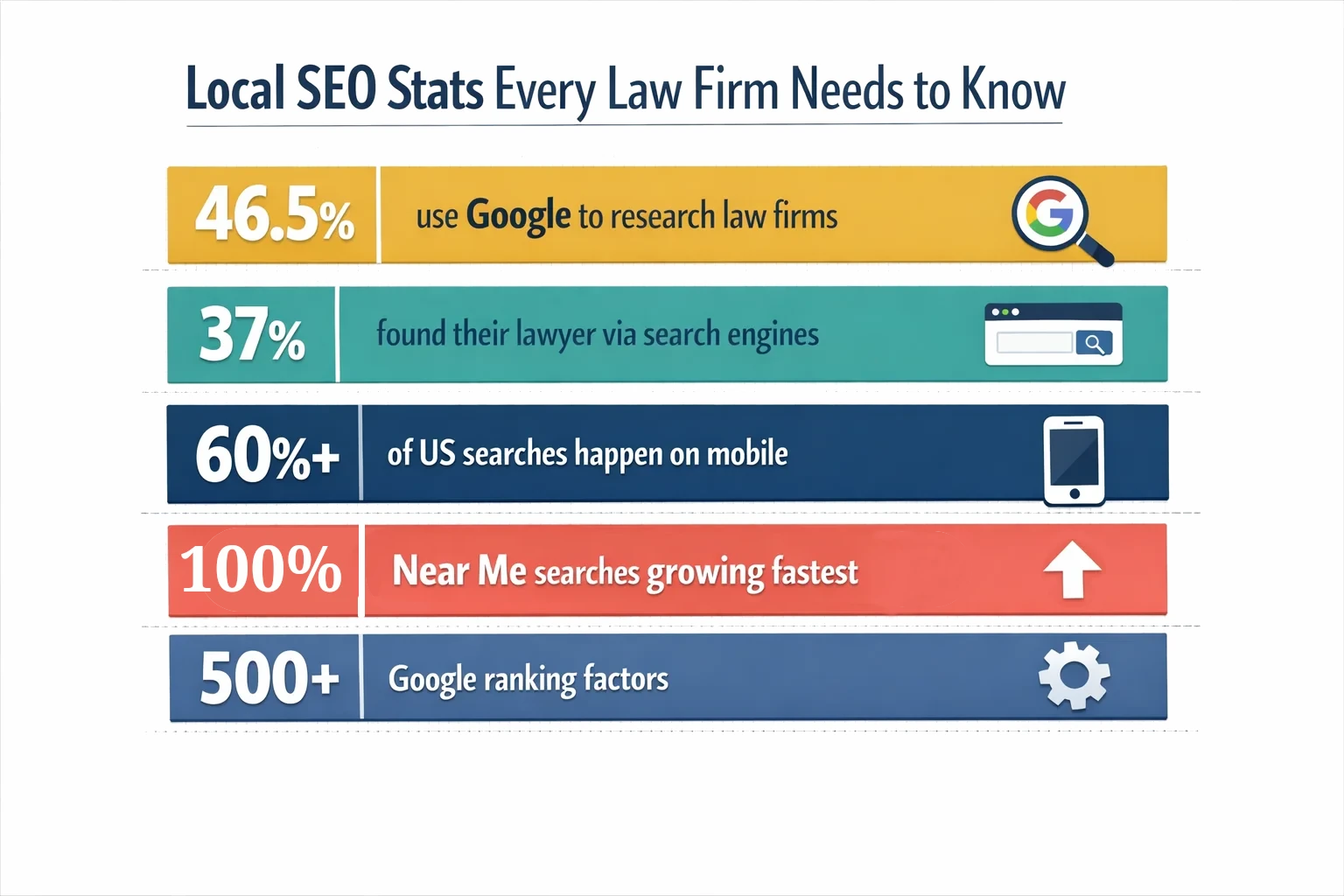
With up to 46.5% of prospective clients using Google to research and select legal representation, your firm's visibility in local search isn't a nice-to-have — it's one of the most consequential factors determining whether your phone rings or your competitor's does. And unlike billboards, print ads, or broadcast spots, local SEO targets people who are actively searching for exactly the legal help you provide, right now, in your city.
The challenge is that local search optimization for law firms isn't simply a matter of having a website. It requires a deliberate, layered strategy — one that spans your Google Business Profile, citation consistency, on-page optimization, review management, technical performance, and ethical compliance with bar advertising rules.
This guide covers all of it. Whether you're starting from scratch or looking to sharpen an existing strategy, you'll find everything you need to dominate your city's search results and turn local visibility into a steady stream of qualified clients.
What Is Local SEO for Law Firms and Why Does It Matter?

Local SEO is the practice of optimizing your law firm's online presence to rank higher in geographically targeted search results — specifically the Google Map Pack, local search listings, and the "near me" queries that prospective clients type into their phones at the exact moment they need legal help.
The distinction from general SEO matters. Traditional SEO aims to build broad visibility across the web. Local SEO is laser-focused on connecting your firm with people in your specific service area who are actively searching for the legal services you provide. That intent-driven targeting is what makes it so powerful.
The numbers back this up. According to the Clio Legal Trends Report, 37% of legal clients found their lawyers through search engines — and "near me" searches are growing faster than almost any other search category. When someone types "divorce attorney near me" or "personal injury lawyer in [your city]," they're not browsing casually. They need help, often urgently, and they're ready to make a call.
Compare that to a billboard or a print ad. Those channels interrupt people who may never need a lawyer. Local SEO puts your firm in front of people who are already looking for exactly what you offer.
There's also a compounding advantage that traditional advertising simply can't match. A paid ad stops generating leads the moment you stop paying. Local SEO strategies — a well-optimized Google Business Profile, consistent citations, strong reviews, quality local content — continue working for months or even years after the initial investment. For law firms evaluating their marketing spend, that long-term return is difficult to ignore.
How Google Determines Local Rankings for Law Firms
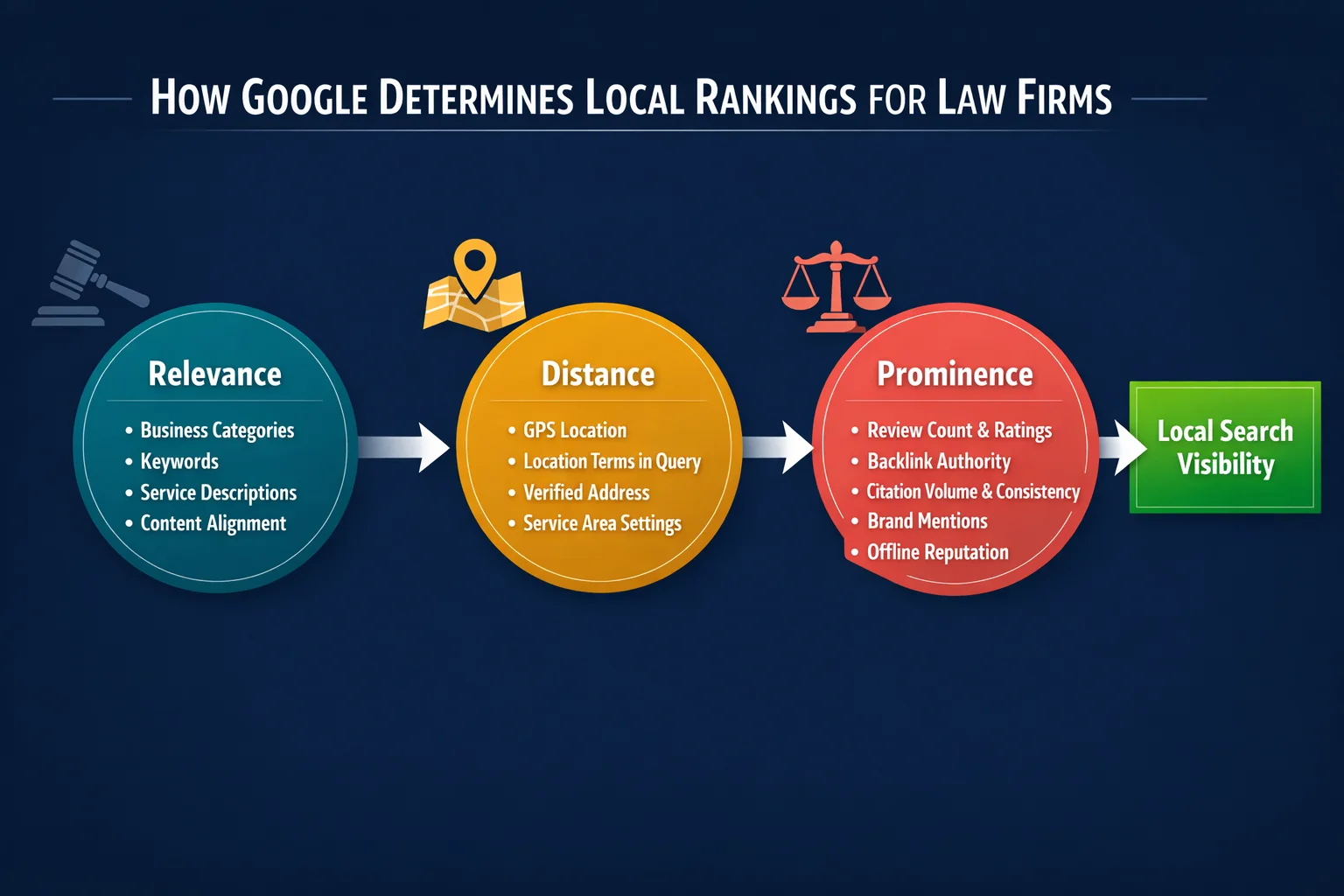
When your firm appears — or fails to appear — in local search results, the outcome isn't random. Google's local ranking algorithm follows a deliberate logic built around three core factors: relevance, distance, and prominence. Understanding how each one works gives you a framework for making strategic decisions rather than guessing at what might move the needle.
Relevance is about alignment. Google evaluates how closely your Google Business Profile, website content, and service descriptions match what a searcher is actually looking for. A firm that has clearly defined its practice areas, used accurate business categories, and built out detailed service descriptions will consistently outrank a competitor with a sparse, vague profile — even if that competitor has been in business longer. The more precisely your online presence reflects the specific legal services someone is searching for, the more relevant Google considers you to be.
Distance is the most straightforward of the three factors. Google uses the searcher's device location or the location mentioned in their query to calculate geographic proximity. You can't manufacture closeness to a searcher who is miles away — but you can ensure your firm's address data is accurate and that your content signals the specific neighborhoods, cities, and counties you actually serve.
Prominence is where law firms have the greatest opportunity to compete. This factor reflects your firm's overall authority and reputation across the web — encompassing your Google review count and quality, the strength of your backlink profile, citation consistency across directories, and your general web presence. A firm that actively builds prominence through reviews, local links, and consistent listings will outperform a less engaged competitor regardless of how long either has been practicing.
Together, these three pillars form the foundation of every local SEO decision your firm should make.
Claiming and Optimizing Your Google Business Profile

Of the three ranking pillars covered in the previous section, prominence is the one you build — but your Google Business Profile (GBP) is the foundation everything else rests on. This free tool from Google directly controls how your firm appears in Google Maps, the local pack, and local search results. If your profile is incomplete, unverified, or neglected, you're essentially handing potential clients to your competitors before the conversation even starts.
Start with verification. Claim your profile if you haven't already, and complete the verification process Google requires. An unverified profile carries significantly less weight in local rankings and limits the features available to you. Once verified, treat every available field as an opportunity — not an afterthought.
Fill in your business name exactly as it appears on your website and physical signage, your precise address, a direct phone number, your website URL, and accurate business hours including any holiday variations. Then go deeper. Add detailed service descriptions for each practice area, select relevant attributes (such as accessibility features or languages spoken), and write a compelling business description that naturally incorporates your primary location and practice areas without reading like a keyword list.
Category selection deserves particular attention. Choose the most specific primary category available for your main practice area — "Personal Injury Attorney" will outperform the generic "Lawyer" category because it signals precise relevance to both Google and searchers. Then add secondary categories for every additional area you practice, whether that's family law, criminal defense, or estate planning.
Photos are another underutilized lever. Profiles with high-quality images consistently receive more clicks and engagement than those without. Upload professional photos of your office exterior and interior, your attorneys, and your team — and refresh them regularly to signal an active, credible presence.
Finally, use the Q&A section and Google Posts strategically. Proactively post and answer the questions prospective clients commonly ask, and publish weekly updates covering legal insights, community involvement, or notable firm news. Consistent activity signals to Google that your profile is current and engaged — which matters more than most attorneys realize.
Mastering NAP Consistency and Local Citations
Think of your Google Business Profile as the front door to your firm's local presence — but NAP consistency is the address on the sign above it. If that address reads differently depending on where someone looks, search engines lose confidence in your firm's legitimacy, and your local rankings suffer as a result.
NAP — Name, Address, and Phone number — or NAPW when your website URL is included, must be absolutely identical across every directory listing, social media profile, legal platform, and website where your firm appears. This isn't a matter of preference or style. It's a technical signal that Google uses to verify your firm is a real, trustworthy local business. Even seemingly trivial discrepancies — "Suite 400" versus "Ste. 400," or "Avenue" versus "Ave." — can fragment your citation signals and dilute the ranking authority you've worked to build.
Start with a citation audit. Before building new listings, identify what already exists and where inconsistencies have crept in. Dedicated local SEO tools can scan hundreds of directories simultaneously, surfacing discrepancies you'd never find manually. Correct existing errors before adding new citations — otherwise you're compounding the problem.
When building new citations, prioritize strategically:
- Legal-specific directories — bar association listings, attorney rating platforms, and legal review sites carry significant authority because they're niche-relevant
- General business directories — established platforms with high domain authority still contribute meaningful citation signals
- Local and regional directories — city-specific business listings reinforce your geographic relevance to Google
The guiding principle here is quality over quantity. A handful of citations from authoritative, relevant legal directories will outperform dozens of listings on obscure, low-traffic sites. Build deliberately, maintain consistently, and your citation profile becomes a durable local ranking asset.
Geo-Specific Keyword Research and On-Page Optimization
With your Google Business Profile verified and your citations locked into consistency, the next layer of local SEO comes down to language — specifically, the exact words your prospective clients type into Google when they need legal help. Getting this right is the difference between a website that attracts qualified local leads and one that ranks for terms nobody actually searches.
Start with location-modified keyword research. Tools like Google Keyword Planner give you real search volume data for geo-specific terms — phrases like "personal injury lawyer [city]," "divorce attorney near [neighborhood]," or "criminal defense lawyer [county]." These aren't guesses; they're the actual queries your potential clients are typing at their most urgent moments. Prioritize terms with meaningful local search volume and realistic competition levels for your firm's current authority.
Once you've identified your target keywords, weave them naturally into your on-page elements:
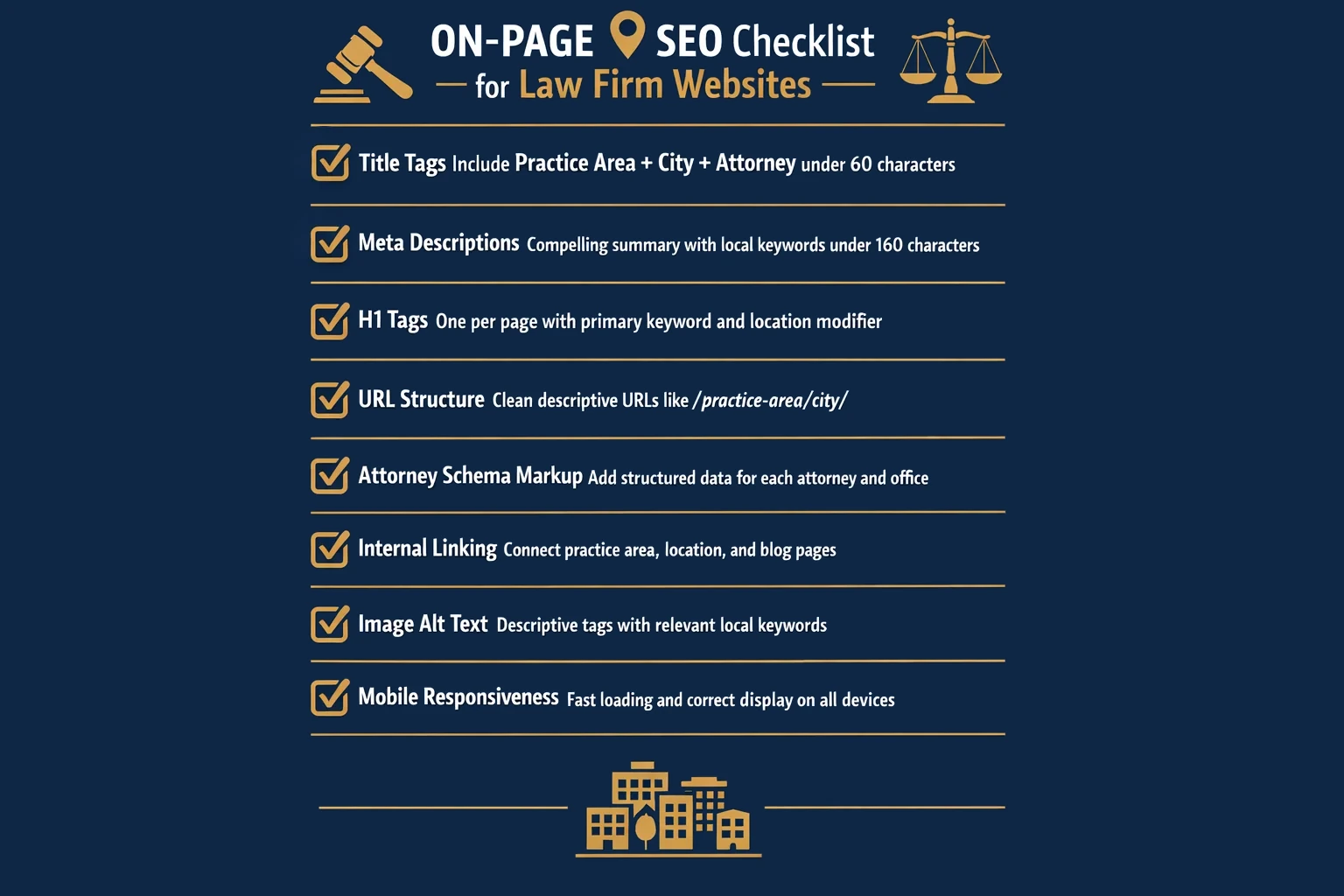
- Title tags — include your primary practice area and city (e.g., "Personal Injury Attorney in [City] | [Firm Name]")
- Meta descriptions — write for the human reader first, but incorporate location and service naturally
- H1 headers — lead with your core keyword phrase without forcing it
- URLs — keep them clean and descriptive (e.g.,
/personal-injury-attorney-chicago/)
The operative word throughout is naturally. Keyword stuffing doesn't just fail to help — it actively signals low-quality content to Google and erodes trust with the readers you're trying to convert.
Dedicated landing pages are non-negotiable for multi-practice and multi-location firms. Each practice area you offer deserves its own page built around that service's specific keyword set. If you serve clients across several cities or counties, create individual location pages for each — but only if you can populate them with genuinely useful, location-specific content. Thin pages that simply swap out a city name provide no value to searchers and no ranking signal to Google.
Attorney schema markup takes your on-page optimization a step further by communicating directly with search engines in structured data they're designed to read. Implementing schema for your firm allows Google to clearly understand your practice areas, office locations, attorney credentials, and client reviews — information that can surface in rich results and strengthen your overall local relevance signals.
Finally, structure your content with Answer Engine Optimization (AEO) in mind. As AI-generated overviews and featured snippets claim more real estate at the top of search results, law firms that format content to directly answer common legal questions — using clear headers, concise definitions, and FAQ-style sections — are far better positioned to capture that visibility. Think about the questions your clients ask before they ever call your office, and answer them plainly on the page.
Building Local Backlinks and Community Authority
Your Google Business Profile and on-page optimization tell search engines what your firm does and where you do it. Local backlinks tell them something equally important: that your community trusts you. In Google's prominence calculation, the quality and relevance of sites linking to yours carries significant weight — and for law firms, the most valuable links come from sources that are both geographically rooted and professionally credible.
Start with the organizations that already exist in your professional ecosystem. Your state and local bar association, local chambers of commerce, civic organizations, and nonprofit groups are natural link sources — and many offer member directory listings or sponsorship acknowledgments that include a link back to your website. These aren't just SEO assets; they're signals that your firm is an active, invested participant in the local community rather than a faceless service provider.
Local media coverage is particularly powerful. Reach out to regional newspapers, legal publications, and community news outlets to offer expert commentary on relevant legal developments. When a local story touches on personal injury, family law, or criminal defense, journalists need credible sources — positioning yourself as that source earns both visibility and authoritative backlinks.
Create content that earns links organically. Practical local resources — guides to your county's court procedures, state-specific legal FAQs, or community resource directories — attract links from other local websites because they provide genuine value. This is link building through usefulness rather than outreach alone.
Beyond written content, consider guest columns in regional business publications and appearances on local podcasts. These opportunities generate contextual backlinks while simultaneously building name recognition among your target audience.
One firm rule: never purchase links or participate in link exchange schemes. These tactics violate Google's guidelines and can trigger manual penalties that are far more damaging — and far harder to recover from — than simply starting from scratch.
Managing Client Reviews and Online Reputation

Your rankings don't exist in a vacuum — they're shaped in part by what real clients say about you online. Positive Google reviews directly influence both relevance and prominence in local search rankings, making review management one of the highest-leverage activities in your entire local SEO strategy. A firm with dozens of detailed, recent five-star reviews signals credibility to both Google's algorithm and the prospective client scrolling through their options at 11pm after an accident.
Build a systematic process for generating reviews. The firms that accumulate strong review profiles don't do it by accident — they ask, consistently and at the right moments. Natural touchpoints include case resolution, successful outcomes, and milestone moments in a client relationship. A brief, personal follow-up message explaining where and how to leave a review removes friction and dramatically increases follow-through. Make it easy, and more clients will do it.
Respond to every review — positive and negative. Responses demonstrate that your firm is engaged and accountable, qualities prospective clients actively look for. Thank satisfied clients genuinely. When a negative review appears, respond calmly and professionally without disclosing any confidential information — a composed, constructive reply often tells prospective clients more about your character than the complaint itself.
On that note: never offer incentives in exchange for review removal, and never violate client confidentiality in a response, regardless of how unfair the criticism feels. Both cross ethical and platform policy lines with serious consequences.
Finally, don't limit your reputation footprint to Google alone. Building reviews across legal-specific directories and broader platforms creates a more authoritative, well-rounded online presence that reinforces your prominence across the entire local search ecosystem.
Mobile Optimization and Technical SEO for Law Firms
Think about when someone actually searches for a lawyer. It's rarely a calm, deliberate moment at a desktop computer. It's a car accident. A served divorce notice. An unexpected arrest. These searches happen on phones, under stress, and they happen fast. Over 60% of all searches in the United States occur on mobile devices — and legal searches are disproportionately urgent, meaning a slow or broken mobile experience doesn't just cost you a ranking, it costs you a client who needed help right now.
Your site must load fast and function flawlessly on smartphones. Google's Core Web Vitals — which measure loading speed, interactivity, and visual stability — are confirmed ranking factors, not optional enhancements. A page that takes four seconds to load on mobile will lose visitors before they ever read your practice areas, regardless of how well-optimized everything else is.
Beyond speed, mobile usability directly affects conversion. Every page on your site should feature a prominent click-to-call button, an easy-to-locate contact form, and navigation that works intuitively on a small screen. If a prospective client has to pinch, zoom, or hunt for your phone number, most won't bother.
On the technical side, a strong local SEO foundation also requires:
- An SSL certificate — HTTPS is a baseline trust and ranking signal
- A properly configured XML sitemap — so search engines can efficiently discover and index every page
- A clean robots.txt file — ensuring crawlers aren't accidentally blocked from important content
- Logical site architecture — with practice area and location pages organized in a clear hierarchy that distributes authority effectively
These aren't glamorous optimizations, but they're the infrastructure everything else depends on.
Ethical Considerations: ABA Compliance in Legal SEO
Local SEO is powerful — but for law firms, it operates within a compliance framework that most industries never have to consider. The ABA Model Rules of Professional Conduct and your state bar's advertising regulations apply to every piece of content you publish online, including your website copy, Google Business Profile descriptions, meta descriptions, and even how you solicit client reviews. Non-compliance isn't just an SEO risk; it can trigger disciplinary action from your state bar.
Watch your language carefully. Claims like "best lawyer in [city]," "top-rated attorney," or any suggestion of guaranteed outcomes are the kind of language that raises red flags under most state advertising rules. Superlatives are difficult to substantiate and frequently prohibited. The same scrutiny applies to your meta descriptions and GBP business description — these are public-facing marketing materials, and regulators treat them as such.
Review solicitation has its own rules. Some jurisdictions impose specific restrictions on when, how, and to whom you can reach out requesting testimonials. Before building your review generation process, verify what your state bar permits. As a general rule, never offer anything of value in exchange for a review, and never coach clients on what to say — both practices violate platform policies and potentially ethics rules simultaneously.
Credentials and accolades must be accurate and permitted. If you list a specialization, award, or certification on your website or directory profiles, confirm that your state bar allows attorneys to advertise that designation. Listing an unapproved specialization — even unintentionally — can constitute a misleading communication under ABA Rule 7.1.
Ethical compliance and effective local SEO aren't in conflict. They simply require the same thing: accuracy, transparency, and professionalism.
Measuring Local SEO Performance and ROI

Without measurement, local SEO is just activity. With it, it becomes a client acquisition system you can actually manage, refine, and justify investing in.
Start with the data sources already available to you. Google Search Console reveals which local queries are driving impressions and clicks to your site, while Google Analytics shows what those visitors do once they arrive. Your Google Business Profile dashboard provides its own layer of intelligence — tracking how many users called your firm directly from the listing, requested directions, or clicked through to your website. These metrics, reviewed together, give you a clear picture of how your local presence is performing at every stage of the funnel.
Call tracking is where local SEO becomes undeniably accountable. By assigning unique tracking numbers to your local SEO efforts, you can attribute incoming client calls to specific campaigns, pages, or listings. This closes the loop between a Map Pack ranking and an actual case intake — which is the number that ultimately matters.
Map Pack rankings themselves deserve close monitoring. Your firm's position for a keyword like "personal injury attorney" can vary meaningfully from one neighborhood to the next within the same city, because Google factors in the searcher's precise location. Tracking rankings across multiple points in your service area gives you a more accurate picture than a single citywide snapshot.
ROI calculation for local SEO is straightforward once you have the data. Compare your monthly investment against the lifetime value of clients acquired through organic local search. In most practice areas, a single retained client generates fees that dwarf months of SEO spend — which means even a conservative conversion rate produces a compelling return.
Finally, schedule quarterly local SEO audits to catch citation drift, identify new keyword opportunities, flag technical issues, and adapt to algorithm changes before they erode rankings you've worked to build.
Conclusion
Local SEO isn't a marketing experiment — it's the most reliable, cost-effective client acquisition channel available to law firms today. Every strategy covered in this guide works toward the same outcome: putting your firm in front of people who are actively searching for legal help in your area, at the exact moment they're ready to make a call.
The path forward is clear. Begin with the highest-impact foundations — a fully optimized Google Business Profile, airtight NAP consistency, and a systematic approach to generating client reviews. Layer in geo-specific content, attorney schema markup, local backlinks, and technical performance. Do all of it within the ethical boundaries your state bar requires.
Then measure, audit, and keep going. The firms that dominate local search results aren't necessarily the largest or the oldest — they're the ones that treat local SEO as an ongoing investment rather than a one-time project.
Start with one section of this guide. Implement it completely. Then move to the next. Consistent, compounding effort is what separates the firms that appear on page one from the ones that don't appear at all.
Frequently Asked Questions
How long does it take for local SEO to produce results for a law firm?
Most law firms begin seeing measurable improvements in local search visibility within 3 to 6 months of implementing a consistent local SEO strategy. However, competitive markets and highly contested practice areas — such as personal injury or criminal defense — may take 6 to 12 months before significant ranking gains appear. The good news is that local SEO results compound over time: strategies you implement today can continue generating leads for months or even years. Unlike paid advertising, which stops delivering the moment you pause spending, local SEO builds lasting authority. Patience and consistency are key — firms that commit to ongoing optimization will outperform competitors who treat it as a one-time project.
How much should a law firm budget for local SEO services?
Local SEO budgets for law firms vary widely depending on market competitiveness, firm size, and the scope of services required. Smaller firms in less competitive markets may see results starting at $500 to $1,500 per month, while firms in major metro areas or high-competition practice areas often invest $2,000 to $5,000 or more per month. It's worth framing this as an ROI calculation rather than a cost: even a single significant case won through organic local search can justify several months of SEO investment. When evaluating your budget, prioritize agencies with demonstrated legal industry experience, as cookie-cutter approaches are far less effective for specialized law firms.
Can I do local SEO for my law firm myself, or do I need to hire an agency?
Many foundational local SEO tasks — such as claiming and optimizing your Google Business Profile, ensuring NAP consistency across directories, and requesting client reviews — can absolutely be handled in-house. If you have the time and willingness to learn, DIY local SEO is a viable starting point. However, more advanced strategies like technical SEO audits, attorney schema markup implementation, local link building, and competitive keyword research typically benefit from professional expertise. For attorneys in competitive markets, hiring an agency with legal SEO experience often delivers a faster and stronger return. A hybrid approach — handling basics yourself while outsourcing technical and strategic work — is also a practical option for smaller firms.
How do I rank in the Google Map Pack for my practice area?
Ranking in the Google Map Pack comes down to optimizing for Google's three local ranking factors: relevance, distance, and prominence. Start by fully completing your Google Business Profile — choose the most specific primary category for your practice area, write a keyword-rich business description, and upload high-quality photos regularly. Ensure your NAP information is consistent across all online directories. Build prominence by actively generating positive client reviews and earning local backlinks from bar associations, community organizations, and local publications. Finally, make sure your website includes geo-specific content and proper attorney schema markup so Google can clearly understand your location and practice areas. Consistent effort across all these signals is what earns and maintains Map Pack placement.
What are the most important local SEO ranking factors for attorneys?
The most impactful local SEO ranking factors for law firms align with Google's three-pillar framework. For relevance: your Google Business Profile categories, service descriptions, and website content must closely match what potential clients are searching for. For prominence: the quantity and quality of your Google reviews, the consistency of your citations across directories, and the strength of your local backlink profile all carry significant weight. For distance: while you can't change your physical location, you can create geo-specific landing pages and service area content to signal relevance across your target geography. Additional high-impact factors include mobile site performance, Core Web Vitals, attorney schema markup, and active engagement with your Google Business Profile through posts and Q&A responses.
How do I handle negative reviews without violating attorney ethics rules?
Handling negative reviews requires a careful balance between reputation management and professional ethics. Never disclose confidential client information in a response — even if the review contains inaccuracies, your duty of confidentiality takes precedence. Instead, respond calmly and professionally, acknowledge the concern in general terms, and invite the reviewer to contact your office directly to resolve the matter. Never offer incentives in exchange for removing or changing a review, as this can violate both platform policies and bar advertising rules. Use negative reviews as an opportunity to demonstrate your firm's professionalism and commitment to client service — prospective clients reading your responses will notice how you handle criticism.
Does my law firm need separate pages for each city we serve?
Yes — if your firm genuinely serves clients across multiple cities or regions, creating dedicated location-specific landing pages is a highly effective local SEO strategy. Each page should include unique, substantive content tailored to that city: local court information, relevant state or county-specific legal considerations, and geo-targeted keywords like 'divorce attorney in [city].' Avoid duplicating the same content across multiple city pages with only the location name swapped out — search engines can identify thin or duplicate content, and it can actually harm your rankings. Well-crafted city pages signal to Google that your firm has real relevance and authority in each service area, helping you appear in local searches beyond your primary office location.
How does voice search and AI affect local SEO for law firms?
Voice search and AI-generated search results are reshaping how potential clients find legal help. Voice queries tend to be longer and more conversational — someone might ask 'Who is the best personal injury lawyer near me?' rather than typing 'personal injury lawyer Chicago.' To optimize for this, structure your website content to directly answer common legal questions in natural language, which also positions your firm for AI-generated overviews and featured snippets through Answer Engine Optimization (AEO). Maintaining a fully optimized Google Business Profile is especially critical, as voice assistants frequently pull local business information directly from it. Firms that invest in clear, question-and-answer formatted content and strong local signals will be best positioned as AI continues to influence search behavior.