
Your law firm's website is the single point where every marketing channel converges — search engines, AI chatbots, social media, legal directories, and word-of-mouth referrals all funnel potential clients to the same digital front door. What they find when they arrive will determine whether they call your firm or keep scrolling.
Yet most law firms dramatically underinvest in website content, treating their site like a static brochure rather than the 24/7 client acquisition engine it could be. In an era where generative AI tools are actively recommending attorneys to users and mobile browsing has become the default, thin or outdated content isn't just a missed opportunity — it's a competitive liability.
This guide walks through every essential page of a law firm website, from the homepage to the blog, with specific content frameworks, word count targets, and practical best practices. Whether you're building a new site from scratch or overhauling an existing one, you'll find a clear, page-by-page roadmap for creating content that establishes credibility, attracts qualified leads, and positions your firm for visibility in both traditional search and AI-driven discovery.
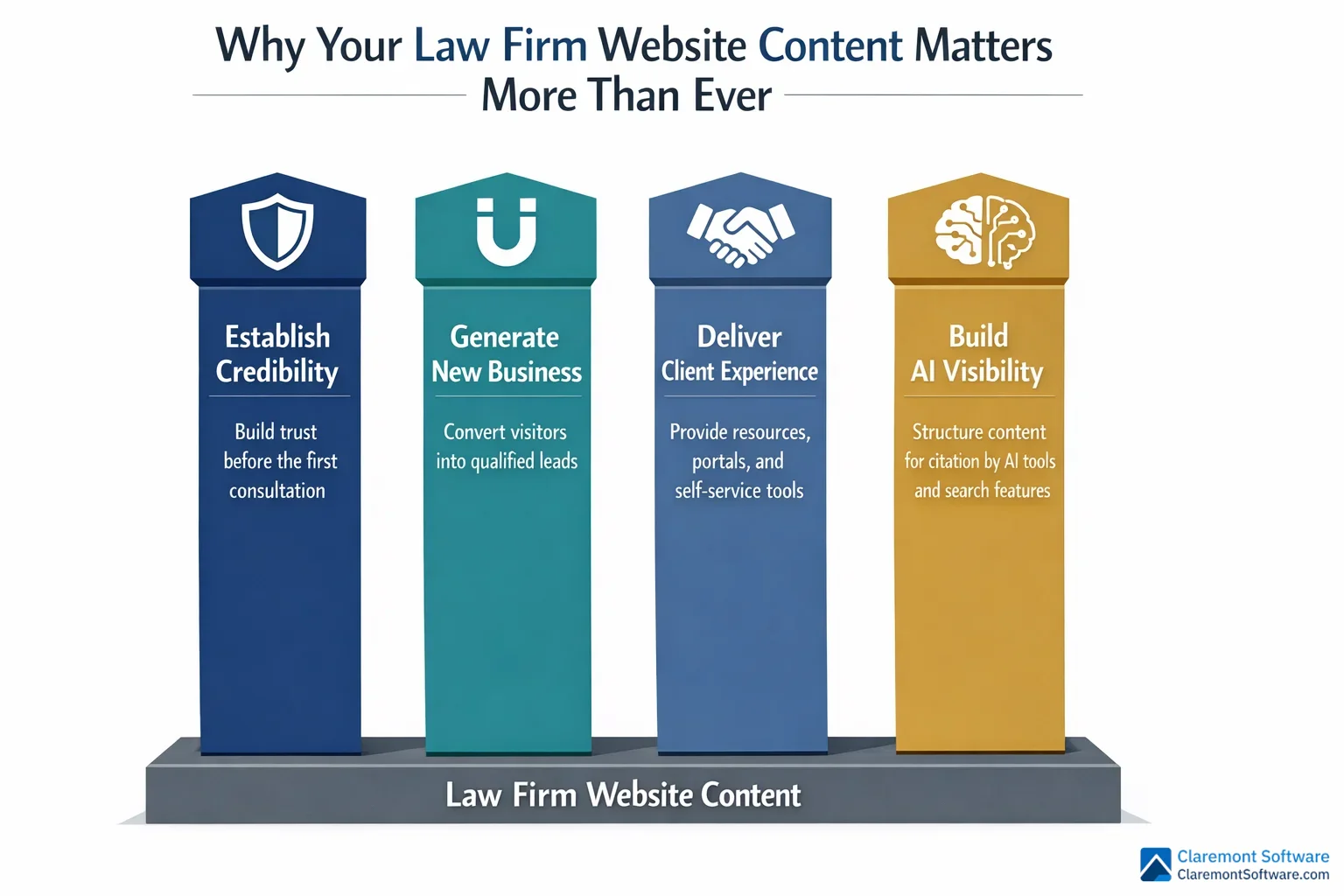
Why Your Law Firm Website Content Matters More Than Ever
The legal industry has never been more competitive — and the way potential clients find attorneys is changing faster than most firms realize.
More than half of the world's internet users now access the web via mobile phones. That single statistic should reshape how you think about every sentence on your website. Dense paragraphs, walls of legal text, and cluttered navigation don't just frustrate mobile visitors — they drive them directly to a competitor. Your content must be scannable, concise, and structured for a five-inch screen first.
Then there's the AI factor. Generative AI tools are now recommending attorneys directly to users, answering questions like "who is the best divorce lawyer near me?" without sending users to a search results page at all. Google's AI Overviews create zero-click experiences where your content gets cited — or ignored — before a potential client ever visits your site. Firms that structure their content for AI discovery today will have a significant advantage as this shift accelerates.
A stagnant website compounds both problems. Outdated content signals neglect to search engines and to the humans reading it. Firms that invest in fresh, well-organized content now will be best positioned as AI continues reshaping how people find legal services.
Perhaps most importantly, law firm website content requires an entirely different skillset than legal writing. Contracts and briefs are written for precision and legal defensibility. Website content must be written for a frightened person Googling their problem at midnight — client-centered, jargon-free, and designed to move someone from uncertainty to action.
Homepage: Your Digital First Impression

Think of your homepage as a firm handshake — it communicates competence, confidence, and character in the first few seconds before a potential client reads a single word of body copy.
Search engines weight your homepage more heavily than any other page on your site, which means it deserves your most substantial, carefully crafted content. This is not the place for a sparse welcome message and a stock photo of a gavel. Your homepage needs to work hard — for both the humans landing on it and the algorithms deciding whether to surface it.
Above the fold — the portion of the page visible before scrolling — must accomplish three things immediately:
- A clear headline that communicates who you help and how ("Protecting Chicago Families Through Every Stage of Divorce")
- A primary call to action that removes friction ("Schedule Your Free Consultation" or a prominently displayed phone number)
- A trust signal that establishes credibility at a glance — years in practice, total cases handled, a notable award, or a recognizable client outcome
Once a visitor scrolls, the homepage should deliver a brief firm overview, direct links to your core practice areas, and at least one testimonial snippet that reinforces the trust signal established above the fold. Close with a secondary CTA before the footer — visitors who reach the bottom of your page are highly engaged and deserve a second invitation to act.
Visual hierarchy is not a design luxury — it's a conversion tool. Short paragraphs, strategic bullet points, and deliberate whitespace guide the eye toward the moments that matter. Dense blocks of text do the opposite.
Finally, your contact information — phone number at minimum — should live in the header or sticky navigation so it's visible on every page, on every device, at every scroll depth. Never make a motivated client hunt for a way to reach you.
Attorney Bio and Profile Pages

After your homepage, attorney profile pages are the most visited destination on your law firm's website. Yet most firms treat them as an afterthought — a name, a headshot, and a bulleted list of law schools. That's a missed opportunity of the highest order.
Potential clients don't hire law firms. They hire people. Before someone picks up the phone, they want to look the attorney in the eye — even if that eye contact happens through a screen. Your bio pages are where that connection either forms or fails.
The goal is not a digital résumé. A full-length CV signals competence but rarely inspires trust. Instead, aim for an engaging profile of 400–600 words that weaves credentials into a narrative — one that answers the question every prospective client is silently asking: Is this the right person to handle something this important in my life?
Every attorney bio should include:
- A professional headshot — warm, approachable, and current (not a decade-old photo)
- Practice area focus — what this attorney actually handles day-to-day
- Notable results or representative experience — specific enough to be meaningful, general enough to protect confidentiality
- Education and bar admissions — the credentialing baseline clients expect
- A personal element — community involvement, a hobby, or a brief quote about why they practice law
That last item matters more than most attorneys are comfortable admitting. A sentence about coaching youth soccer or volunteering at a legal aid clinic humanizes a profile in a way that a list of honors never can.
Write in third person for professionalism, but resist the urge to slip into stiff, formal language. "Sarah has spent fifteen years fighting for families navigating the most difficult moments of their lives" lands differently than "Ms. Johnson is an experienced family law practitioner." Both are professional. Only one is compelling.
Finally, every bio page should close with a direct, attorney-specific call to action — "Schedule a consultation with [Attorney Name]" rather than a generic contact link. Reducing that friction by even one click meaningfully increases the likelihood that a motivated visitor becomes a client.
Practice Area Pages: One Page Per Service
If your homepage is the firm handshake and your attorney bios are the face-to-face introduction, your practice area pages are where potential clients decide whether you can actually solve their problem. These pages carry enormous SEO weight and conversion responsibility — and they deserve to be built accordingly.
The cardinal rule: one practice area, one page. Never consolidate multiple services onto a single page to save time or simplify your site structure. A page titled "Family Law, Estate Planning, and Business Contracts" tells search engines nothing useful and tells potential clients even less. Each service your firm handles — divorce, child custody, DUI defense, slip-and-fall, trademark registration — earns its own dedicated, fully developed page.
Each practice area page should be built around one or two focus keywords with related terms woven naturally throughout. Think about how a real person describes their problem at midnight, panicked and searching for help. They're not typing "dissolution of marriage proceedings" — they're typing "how to file for divorce in Texas." Write for that person.
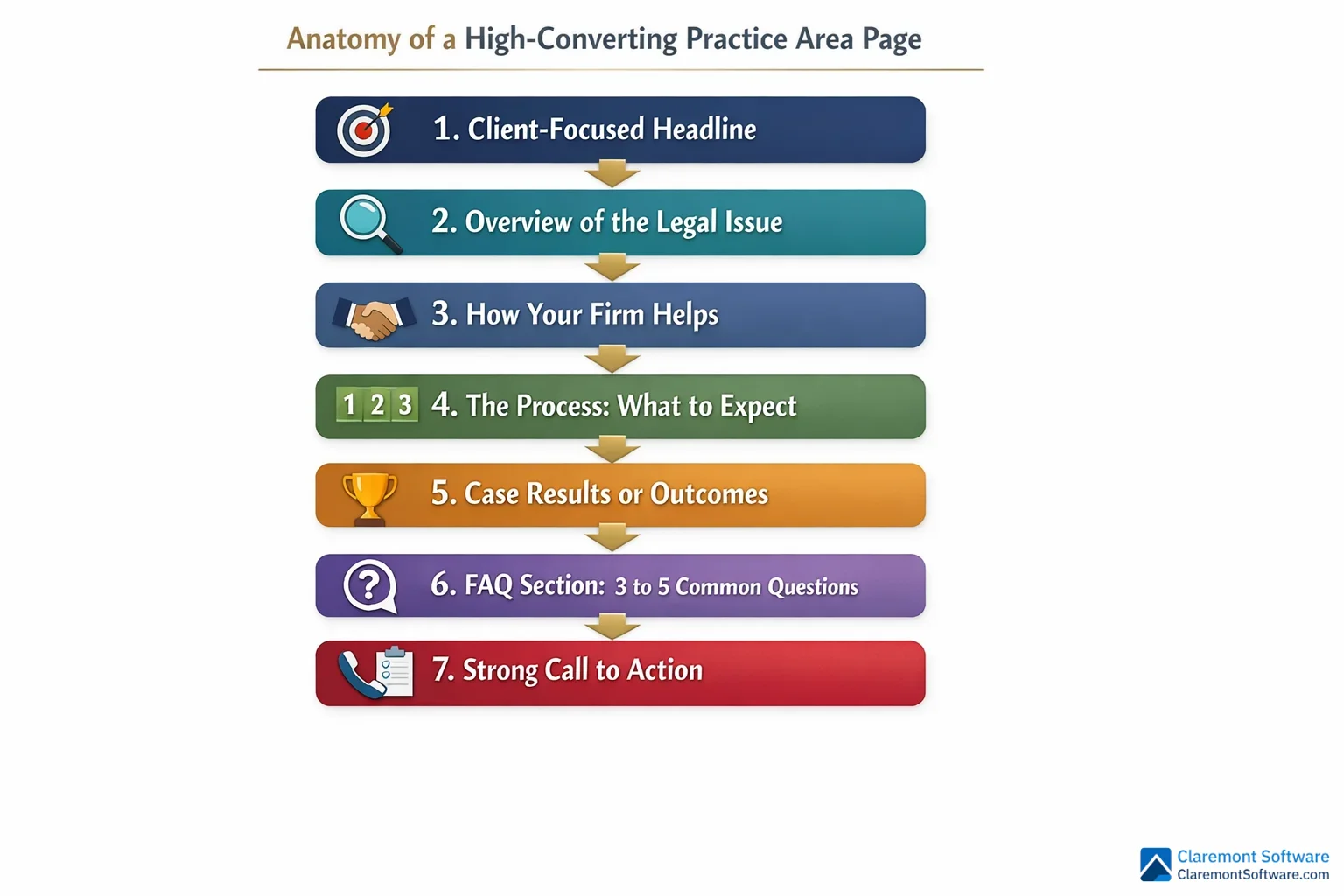
Structure every practice area page with the same essential framework:
- A client-focused headline that speaks to the problem, not the legal category
- An overview of the legal issue in plain, accessible language
- How your firm specifically helps — not generic capabilities, but your actual approach
- The process clients can expect — what happens after they call, step by step
- Relevant results or representative outcomes (with appropriate ethical disclaimers)
- A strong, specific call to action to close
On length: complexity should drive word count. Consumer-facing areas like personal injury or criminal defense often perform well at 800–1,000 words, while more intricate practice areas like corporate transactions or regulatory compliance may warrant 1,200 words or more to adequately demonstrate expertise and capture the full range of related search queries.
The goal of every practice area page is the same: make a frightened or overwhelmed person feel understood, capable of moving forward, and confident that your firm is the right guide for the journey.
About Us Page: Your Firm's Story and Values
Most visitors who land on your About Us page have already done some preliminary vetting. They've skimmed your homepage, maybe browsed a practice area page. Now they're asking a different question — not can this firm help me, but do I want these people in my corner?
That distinction should shape every word on this page.
Lead with your mission and your "why." Before founding history or accolades, tell visitors what drives the firm. Why does it exist? Who does it exist to serve? A sentence like "We started this firm because we watched too many families navigate the legal system without anyone truly in their corner" communicates values instantly — and values are what clients are really evaluating here.
From there, weave in the firm's founding story, core values, and community involvement. These elements work together to paint a picture of a firm with roots, principles, and a genuine stake in the community it serves. If your attorneys sit on bar association committees, speak at legal conferences, or volunteer with local nonprofits, this is the right place to say so — not as a brag, but as evidence of engagement.
Avoid the trap of generic corporate language. Phrases like "client-centered approach" and "commitment to excellence" appear on thousands of law firm websites and register as noise. Replace them with specifics: the neighborhoods you serve, the types of clients you champion, the outcomes you care most about achieving.
Keep the page concise — 400 to 600 words — but pair the narrative with a team photo or office imagery. A single authentic photograph does more to humanize your firm than three paragraphs of polished copy ever could.
Client Testimonials, Reviews, and Case Results
Potential clients don't just take your word for it — they want proof that you've helped people like them. That's exactly what a well-built social proof strategy delivers, and it's one of the most persuasive elements your law firm website can contain.
Third-party reviews carry weight that self-published content simply cannot match. When a potential client sees star ratings, review counts, and links to external review profiles, they know those words came from real people — not your marketing team. Embed or prominently reference reviews from platforms like Google Business and legal directories throughout your site, particularly on your homepage and practice area pages where visitors are actively evaluating whether to reach out.
Beyond those touchpoints, create a dedicated testimonials page that aggregates your strongest client feedback in one place. Then distribute social proof strategically across attorney bios, practice area pages, and anywhere else a visitor might hesitate before converting. Think of testimonials less as a single destination and more as a thread woven through the entire site.
Where your state bar rules permit, video testimonials are worth the investment. A client speaking directly to the camera — describing their situation, their fears, and how your firm helped — is exponentially more persuasive than a paragraph of text. Client photos paired with written testimonials offer a meaningful middle ground when video isn't feasible.
For case results pages, always include the ethical disclaimers your jurisdiction requires. Language noting that past results do not guarantee future outcomes isn't just a legal formality — it's also a trust signal that demonstrates your firm operates with transparency and integrity.
Social proof, handled well, doesn't feel like marketing. It feels like reassurance.
Blog and Content Marketing: Your SEO Growth Engine

A stagnant website is a forgotten website. An active blog changes that equation entirely — it signals to search engines that your firm is alive and engaged, gives AI tools fresh content to index and cite, and positions your attorneys as credible voices in their practice areas.
The catch? Consistency matters more than volume. Publishing two to four posts per month on a reliable schedule outperforms sporadic bursts of content every time. Search engines reward regularity, and so do readers who return expecting new material.
The most effective blog content isn't written to impress other lawyers — it's written to answer the questions real clients are typing into search bars at midnight. Think process explainers ("What happens after I file a personal injury claim?"), common legal misconceptions, recent legislative changes that affect your clients, and FAQ-style posts that address the fears people bring to their first consultation. This type of content doesn't just rank — it builds trust before a potential client ever picks up the phone.
Each post should be built with purpose: one target keyword, natural integration of related terms, internal links to relevant practice area pages and attorney bios, and a clear call to action at the close. A post that educates but doesn't invite the next step is a missed opportunity.
One practical consideration worth raising: the economics of outsourcing content make a compelling case. The average hourly rate for an attorney runs roughly twice that of a professional legal content writer — meaning delegation isn't just a time-saver, it's often a higher-quality, lower-cost solution that frees your attorneys to do what only they can do.
Contact Page and CTA Strategy Across Your Site
Every page on your law firm website is a potential entry point — and every entry point needs a clear path to conversion. That path starts with making contact effortless.
Your phone number and contact information should appear on every single page — in the header, in the footer, and within the body content of high-intent pages like practice areas and attorney bios. A potential client who has to hunt for your phone number will simply stop hunting. Visibility isn't a design preference here; it's a conversion requirement.
Your dedicated contact page should remove every possible barrier by offering multiple ways to reach you: a clickable phone number, an email address, a contact form, your office address with an embedded map, and a live chat widget if your firm has the capacity to staff it. Different clients prefer different channels — give them options.
The language on your calls to action matters more than most firms realize. Specific, action-oriented CTAs consistently outperform generic ones. "Schedule Your Free Case Review" tells a visitor exactly what they're getting and what to do next. "Contact Us" tells them almost nothing. Place these CTAs at natural decision points throughout every page — not just at the bottom, but wherever a reader might pause and consider reaching out.
Consider building an online intake form that collects basic case details before the first call. This qualifies leads upfront, reduces back-and-forth, and signals to prospective clients that your firm is organized and professional.
For firms operating across multiple locations, each office deserves its own dedicated location page — with unique content, locally relevant keywords, and attorney listings specific to that office. Duplicate pages with swapped city names won't rank; genuinely localized content will.
SEO and AI Visibility: Structuring Content for Discovery

Getting your content in front of the right people requires more than good writing — it requires deliberate technical structure that both search engines and AI tools can interpret and act on.
On-page SEO fundamentals remain non-negotiable. Every page on your site should have a unique, keyword-optimized meta title and description, header tags that follow a logical hierarchy (H1 for the page title, H2s for major sections, H3s beneath those), and descriptive alt text on every image. These aren't optional refinements — they're the baseline infrastructure that makes your content discoverable.
Beyond the basics, schema markup is one of the highest-leverage investments a law firm can make right now. By adding structured data types like LocalBusiness, Attorney, LegalService, and FAQPage to your site's code, you give search engines and generative AI tools an explicit, machine-readable map of who you are and what you do. This significantly increases your chances of being cited in AI Overviews and surfaced by tools like ChatGPT or Gemini when users ask for attorney recommendations.
Structure your content to answer questions directly. AI tools favor content that provides clear, concise answers in a predictable format — a question posed, then answered in the next one to two sentences. FAQ sections, numbered process steps, and definition-style explanations all perform well in this environment.
Internal linking deserves the same strategic attention. Connect practice area pages to related blog posts, link attorney bios to their relevant practice areas, and route FAQ content back to service pages. This architecture distributes authority across your site and guides both readers and crawlers through your content logically.
Finally, readability targets matter for legal content specifically. Aim for an 8th-grade reading level, keep sentences under 20 words on average, and limit paragraphs to two or three sentences. Accessible content converts better — and AI tools index it more effectively.
Content Prioritization: Which Pages to Build First
Not every page on your law firm website carries equal strategic weight, and trying to build everything at once is a reliable path to launching with thin, underperforming content across the board. Prioritize depth over breadth, especially early on.
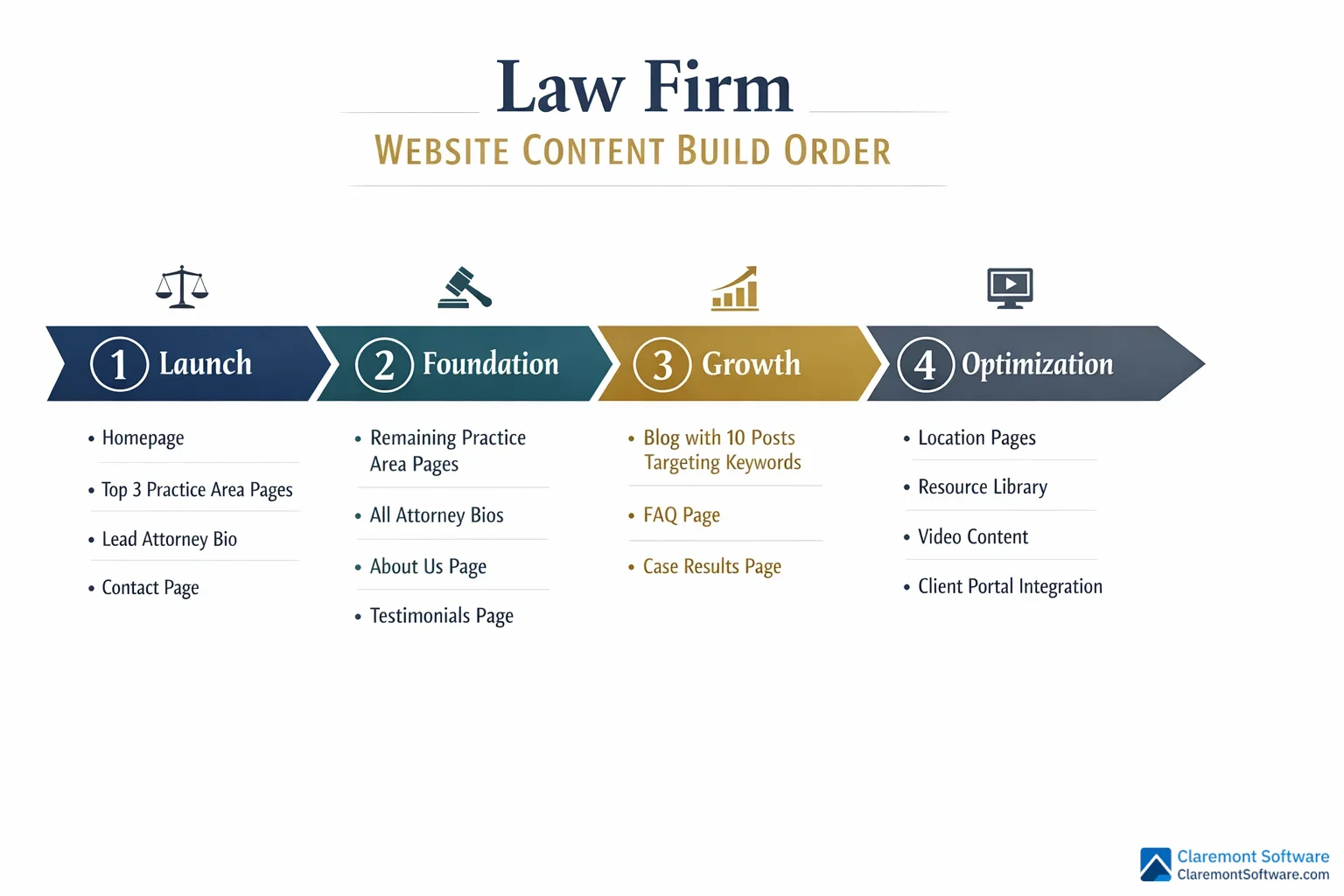
Build in this order: homepage first, then your top three practice area pages, then attorney bios, then your contact page. These eight to ten pages form the functional core of your site — the pages that drive the most traffic, handle the most conversions, and establish credibility with both visitors and search engines. Once that foundation is solid, expand into additional practice areas, blog content, case results, and resource pages.
For solo practitioners and small firms, this sequenced approach is especially important. A lean site with ten well-crafted pages will consistently outperform a sprawling site with thirty underdeveloped ones. For specific patterns that work, see our solo law firm website design guide.
Once your core pages are live, build a content refresh schedule to keep them current:
- Core pages (homepage, practice areas, contact): review quarterly
- Attorney bios: update whenever credentials, results, or roles change
- Blog posts: audit annually for accuracy and keyword relevance
Finally, measure what matters. Track bounce rate and time on page for your homepage, organic traffic and form submissions for practice area pages, and keyword rankings and internal link clicks for blog content. These KPIs tell you where your content is working — and where it needs attention.
Conclusion
Your law firm website is either working for you around the clock or quietly costing you clients. There is no middle ground.
The firms that will dominate both traditional search and AI-driven discovery in the years ahead share one thing in common: they treat their website as a client acquisition system, not a digital brochure. Every page is built with purpose — written for the person on the other side of the screen, structured for the algorithms deciding what to surface, and designed to make the next step effortless.
Start where the impact is highest. Build your homepage, core practice area pages, attorney bios, and contact page with the depth and intentionality they deserve. Then expand methodically — blog content, case results, resource libraries — compounding your visibility with every addition.
The content you publish today becomes the foundation your firm's online presence is built on tomorrow. As AI continues reshaping how people find legal help, that foundation will matter more, not less.
If you're ready to build a law firm website that actually converts, Claremont Software can help you get there.
Frequently Asked Questions
How many pages should a law firm website have?
There is no magic number, but a functional law firm website should have at minimum 8–10 essential pages: a homepage, 3–5 dedicated practice area pages, individual attorney bio pages, an About Us page, a contact page, and a blog or resources section. Solo practitioners and small firms should prioritize depth over breadth — it's far better to launch with 10 well-written, SEO-optimized pages than 30 thin, underdeveloped ones. As your firm grows, expand by adding more practice area pages, location pages, case results pages, and blog content to build authority over time.
How long should law firm website content be?
Content length should match the complexity of the topic and the page's purpose. Attorney bios perform best at 400–600 words. Practice area pages typically need 800–1,000 words for consumer-facing areas like personal injury, while complex areas like corporate law may warrant 1,200+ words. Your homepage should include substantial content since search engines weight it heavily. Blog posts should be long enough to fully answer the target question — usually 800–1,500 words. Across all pages, prioritize clarity and scannability: short paragraphs, bullet points, and plain language at roughly an 8th-grade reading level.
Should lawyers write their own website content or outsource it?
In most cases, outsourcing to a professional legal content writer is the smarter choice — both financially and strategically. The average hourly rate of a lawyer is roughly twice that of a skilled legal content writer, meaning every hour a lawyer spends writing website copy is an expensive use of their time. Beyond cost, legal writing and marketing copywriting require very different skills. Website content must be client-centered, jargon-free, and conversion-focused — a style that doesn't come naturally to most attorneys trained in precise legal drafting. Lawyers should provide input, review for accuracy, and approve final content, but leave the writing to specialists.
How often should law firm website content be updated?
A consistent content refresh schedule is essential — a stagnant website signals neglect to both search engines and potential clients. As a general rule, review and update your core pages (homepage, practice areas, attorney bios) at least quarterly. Update attorney bios whenever credentials, bar admissions, or notable results change. Blog posts should be audited annually and refreshed if the information is outdated. Publishing new blog content at a minimum of 2–4 times per month keeps your site active, supports SEO rankings, and gives AI tools fresh material to index and cite.
What is the most important page on a law firm website?
The homepage is the single most important page on a law firm website. It's where every marketing channel — search engines, social media, legal directories, referrals, and AI tools — ultimately sends potential clients. Search engines also weight the homepage more heavily than any other page on the site. That said, attorney bio pages are the most frequently visited pages after the homepage, making them a close second in terms of investment priority. Think of the homepage as the front door and attorney bios as the handshake — both need to make a strong first impression.
How do I optimize my law firm website for AI search tools like ChatGPT and Google AI Overviews?
To be visible in AI-driven search results, your content needs to be structured so that AI tools can easily read, understand, and cite it. Start by implementing schema markup — specifically LocalBusiness, Attorney, LegalService, and FAQPage schemas — so search engines and AI crawlers can interpret your content accurately. Write content that directly and concisely answers common client questions, since AI Overviews favor clear, structured responses. Use hierarchical header tags, short paragraphs, and FAQ-style formatting throughout your pages. Build a strong internal linking strategy and keep content regularly updated, as AI tools prioritize fresh, authoritative sources.
What should a law firm homepage include above the fold?
Above the fold — the portion of the page visible before a visitor scrolls — is prime real estate that must immediately communicate who you are, who you help, and what to do next. Every law firm homepage should include three core elements above the fold: a clear, client-focused headline that states who you help and how (not just your firm name), a prominent primary call to action such as 'Schedule a Free Consultation' or 'Call Now,' and at least one trust signal such as years of experience, notable case results, or a recognizable award or rating. Contact information should also be visible in the header or sticky navigation.
Do law firm websites need a blog to rank in search engines?
A blog isn't strictly required to rank, but it is one of the most powerful tools available for growing your law firm's organic search visibility over time. An active blog allows your firm to target a wide range of long-tail keywords, answer the specific questions potential clients are searching for, and build topical authority in your practice areas. It also provides fresh content for search engines and AI tools to index and cite. Firms that publish consistently — at least 2–4 posts per month — compound their SEO advantage over time, while firms with static websites gradually lose ground to competitors who are actively publishing.