The best lawyer websites win on trust, not decoration: specific case results instead of vague claims, real attorney photography, fast mobile-first pages, and a clear next step on every screen. Costs range from a few hundred dollars on template builders to $5,000–$30,000+ for specialist legal design agencies. This guide names 25 sites that get it right and the exact features behind them.

Somewhere between the Google search and the phone call, every potential client lands on your website and decides whether you are the lawyer for the job. Most law firm websites lose that decision in the first few seconds.
We reviewed 25 live attorney and law firm websites, from solo practices to international firms, and scored each on five categories: first impression, trust signals, content quality, technical performance, and conversion optimization. Every pattern in this guide comes from the sites that scored at the top, and each is something your firm can study and apply.
This guide covers the full picture: all 25 sites with what each one does well, the patterns behind them, the elements every legal website needs, what a law firm website costs, the mistakes that drain leads, and a scorecard for grading your own site. Solo practitioners should also see our dedicated roundup of the best solo law firm websites, which goes deeper on small firm strategy.
How We Evaluated the Best Lawyer Websites
Not all law firm websites are created equal, and neither are the methods used to evaluate them. We scored every site on the same five categories you'll find in the scorecard near the end of this guide: first impression, trust signals, content quality, technical performance, and conversion optimization.
One distinction guided every score: functionality, branding, marketing effectiveness, and technical execution are no longer differentiators. They're table stakes. A site that loads quickly, looks professional, and lists practice areas clearly deserves no special recognition in today's market. That's the minimum. Great websites must clear this bar and then go considerably further.
Every site we reviewed was assessed through the lens of visitor intent, the real-world questions a potential client brings to a law firm's website. Can they quickly find answers to their most pressing questions? Does the site make them feel understood and reassured? Is contacting the firm as frictionless as possible, or does it require hunting through menus and filling out clunky forms?
We also weighted innovation heavily. The sites that impressed us engaged visitors through tools and resources that delivered immediate value. A site that helps a visitor estimate costs, evaluate their case, or schedule a consultation is doing far more work than one that simply describes what the firm offers.
What Separates Good Law Firm Websites From Great Ones
There's a meaningful difference between a law firm website that works and one that wins, and that gap is wider than most attorneys realize.
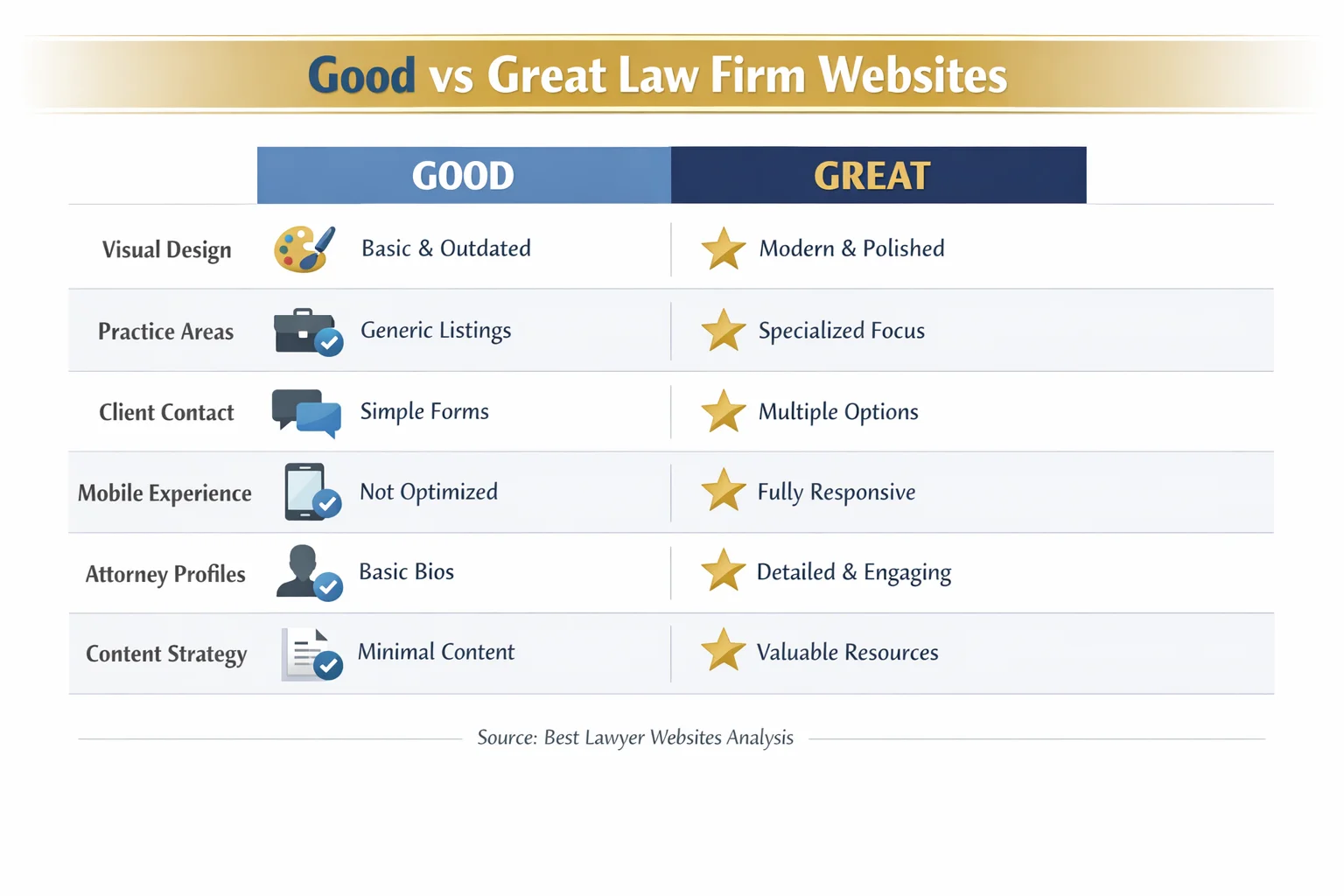
A good law firm website covers the fundamentals: clean, professional design; mobile responsiveness; clearly organized practice area pages; attorney bios; and basic contact information. These elements matter, and firms that neglect them are at a serious disadvantage. In today's market, nailing the fundamentals earns you a seat at the table, nothing more. Visitors have seen hundreds of professional websites. A clean layout and a contact form no longer inspire confidence on their own.
Great law firm websites do something fundamentally different: they treat the site as a 24/7 intake team member, not a static brochure. They anticipate the questions a frightened, overwhelmed, or time-pressed potential client is likely to ask, and they answer those questions before the visitor even thinks to ask them. They have a distinct personality that reflects the firm's values and the people behind it.
One of the clearest signals of a mediocre legal website is the combination of cookie-cutter templates and generic stock photography. Today's clients are digitally sophisticated. They can spot a staged courtroom handshake photo or a recycled template layout instantly, and it erodes trust before a single word of copy is read.
The bar is also rising fast. Law firm websites across the board are improving year over year, which means standing still is effectively moving backward. What impressed clients three years ago is now expected. What impresses them today requires intention, creativity, and a genuine commitment to putting their needs first.
The Hero Section That Sells Before You Scroll
The moment a visitor lands on your site, the clock starts. A visitor decides within seconds whether to stay, which makes your hero section your opening argument.
The best-performing hero sections do three things simultaneously, all above the fold: they state a clear, specific value proposition (not "experienced attorneys," something that actually differentiates), pair it with an emotionally compelling image or video, and present a single, unmissable call-to-action. Remove any one of those three elements and conversion rates drop.
Some of the most memorable examples in this guide take genuine creative risks. One environmental law firm greets visitors with the image of a rhinoceros balanced on a tightrope, an arresting visual that communicates the firm's niche and its stakes before a single word is read. That kind of creative courage is rare in legal marketing, and it pays off in memorability.
Firms serving specific communities (tribal nations, veterans, immigrant families) use their hero sections to signal belonging. Culturally resonant imagery and language that speaks directly to a community's experience communicates something no credential can: we understand you.
Perhaps the highest-impact tactical lesson here is the embedded intake form. Hero sections that place a "Free Case Evaluation" form or scheduling widget directly in the fold, with no extra click required, consistently outperform those that route visitors to a separate contact page. Every additional step is an exit opportunity.
Interactive Tools That Do the Selling for You
The most powerful sales tool on your website is the moment a visitor stops reading and starts doing.
Interactive tools create that moment. The firms that have built them into their websites are running a fundamentally different kind of intake operation.
Consider a veterans-focused disability law firm that replaced its standard "contact us" page with a personalized benefit calculator. Visitors input their service history and disability rating, and the tool returns an estimated monthly benefit figure, a number that's immediately meaningful and personal. That single feature transforms a passive browsing session into an engaged, emotionally invested interaction. By the time the visitor reaches the consultation booking prompt, they're not a cold lead. They're someone who already knows what's at stake.
A fintech-focused legal practice takes a different approach, offering an online company registration workflow directly through the site. What would otherwise require multiple attorney touchpoints becomes a guided self-service process. That removes much of the friction that causes prospective clients to abandon the journey entirely.
A criminal defense firm goes further still, deploying proprietary software that helps visitors assess their eligibility for record clearing, paired with transparent flat-fee pricing and interest-free monthly payment options displayed upfront.
The pattern across all three: interactive tools give first, then ask. They deliver genuine value before requesting contact information, which is precisely why they convert so well.
Client Trust Signals That Actually Move the Needle
Every attorney claims to deliver results. The firms that actually convert skeptical visitors into paying clients are the ones that prove it, and they do so strategically rather than on a single testimonials page buried three clicks deep.
Client testimonials and case studies are the most powerful trust signals available to a law firm website, but their impact depends almost entirely on placement and presentation. The best legal websites treat social proof as a thread woven through the entire user journey: the hero section, alongside practice area descriptions, near contact forms, and at every other moment where a visitor's confidence might waver. Reserving testimonials for a dedicated page that most visitors never find is one of the most common and costly mistakes in legal web design.
Specificity is what separates persuasive social proof from forgettable noise. A testimonial that says "great lawyer, highly recommend" does almost nothing. A testimonial that describes a specific fear, a specific outcome, and a specific feeling of relief does a great deal. The same principle applies to case results. A "$2.3 million settlement for a construction accident victim" is far more compelling than "we've recovered millions for our clients."
Third-party validation adds another credibility layer that self-reported claims simply can't replicate. Bar association memberships, peer-reviewed awards, media mentions, and recognizable "as seen in" logos signal that outside authorities have independently vetted the firm's reputation.
Video testimonials deserve particular attention. For practice areas involving personal or high-stakes legal matters (family law, criminal defense, personal injury), a real client speaking directly to camera creates a level of trust that text alone cannot achieve. Visitors see authenticity, hear emotion, and connect in ways that written words rarely produce.
Design Patterns by Practice Area: One Size Does Not Fit All
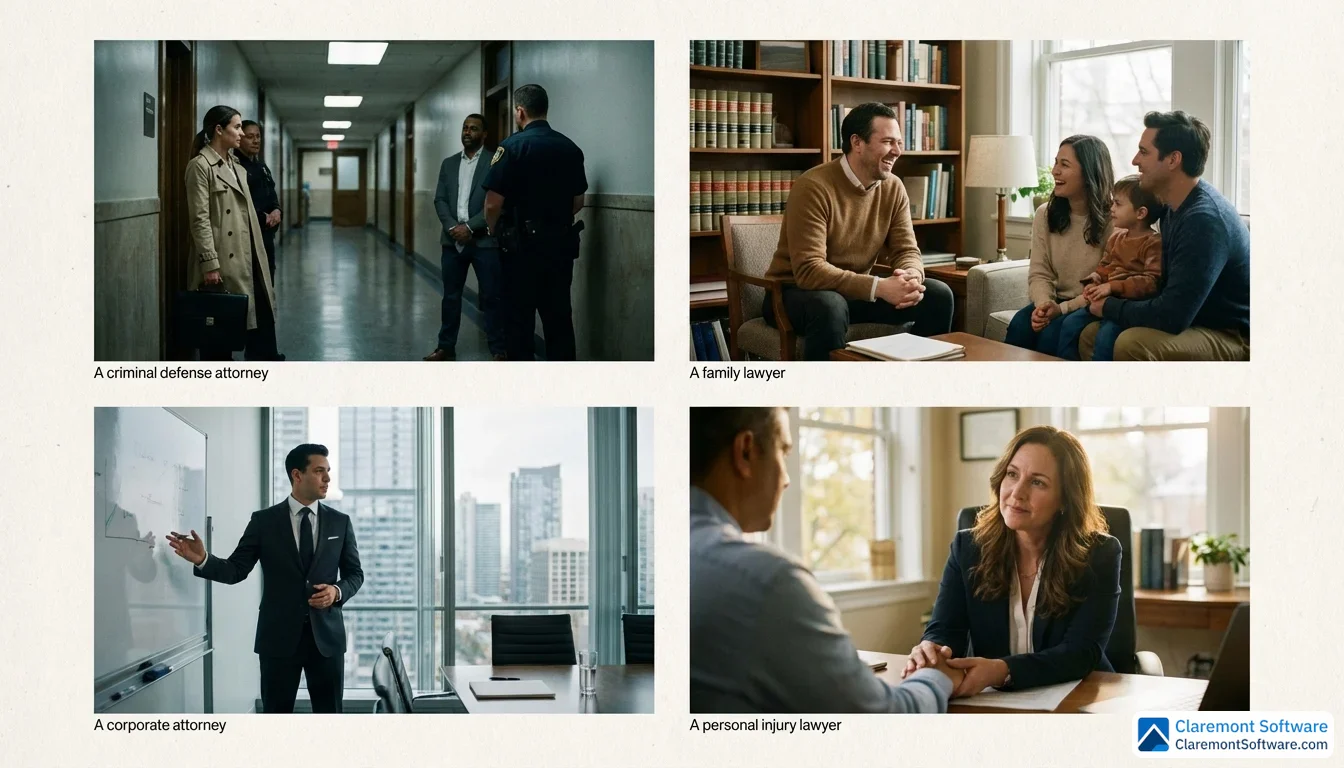
A law firm's website is not a one-size-fits-all product, and the firms that treat it like one are leaving serious opportunity on the table. The design choices, messaging tone, and conversion strategies that work brilliantly for a personal injury practice can actively undermine a corporate law firm's credibility, and vice versa. The best legal websites are built with a clear understanding of who the visitor is, what emotional state they're arriving in, and what they need to feel confident enough to make contact. The same goes for the best law firm landing pages: design and message matched to the client each page serves. Here is how that plays out by practice area.
Personal injury websites perform best when they lead with empathy and back it up with evidence. Visitors are often frightened and uncertain, so bold messaging that acknowledges their situation, paired with prominent case results and clear urgency-driven calls to action, meets them where they are. This is not the place for understated design.
Family law and immigration websites call for a warmer, more reassuring visual language. Softer color palettes, approachable photography, and copy that prioritizes emotional safety over legal jargon help visitors feel understood rather than processed. For immigration practices especially, multilingual options are often the difference between a visitor staying or leaving.
Criminal defense websites operate under a different kind of urgency. Someone searching for a criminal defense attorney at 11 p.m. on a Saturday needs to know immediately that help is available. Prominent 24/7 contact options, fast-loading mobile pages, and direct, no-nonsense messaging are non-negotiable.
Corporate and business law websites should project sophistication and intellectual authority. Thought leadership content, industry-specific expertise, and polished design signal that the firm understands the world their clients operate in.
Solo and small firm websites have a genuine competitive advantage that larger firms can't easily replicate: authenticity. Leaning into personal branding, niche expertise, and real storytelling can make a one-attorney practice feel more trustworthy than a faceless 200-lawyer operation.
The Technical Foundation: Speed, SEO, and Accessibility
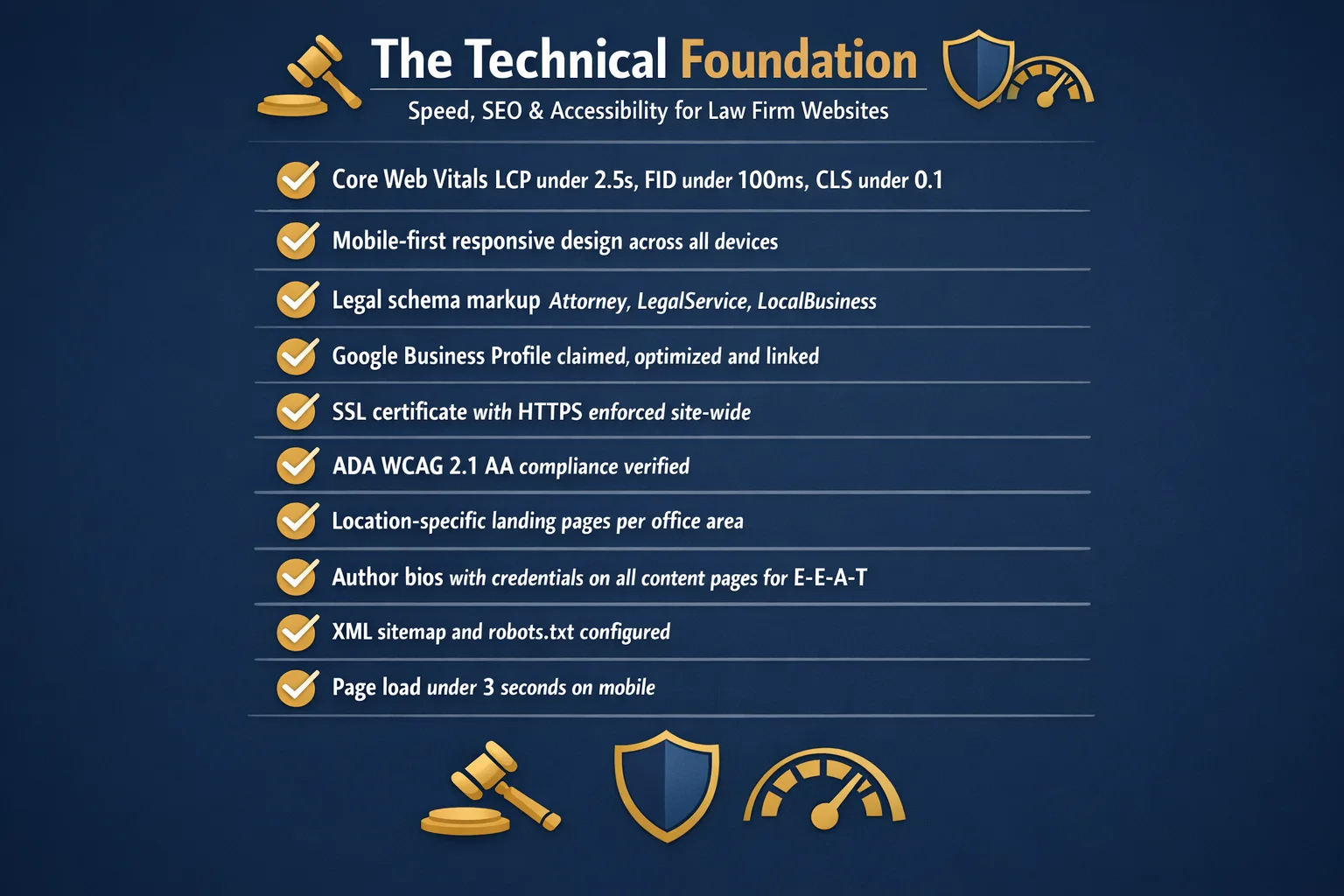
A beautifully designed law firm website means nothing if it takes six seconds to load, doesn't show up in local search results, or turns away visitors with disabilities. The technical foundation beneath your site is what determines whether all that investment in design and content actually reaches the people it's meant to serve.
Page speed is a client retention issue. Google's Core Web Vitals measure how quickly your pages load, how stable they are as they render, and how responsive they feel to user input. Poor scores hurt your search rankings and, more immediately, cost you visitors. A potential client who just experienced a car accident or received a frightening legal notice will not wait for a slow page to load. They'll hit the back button and call your competitor.
Local SEO is equally critical for the vast majority of law firms targeting clients in specific geographic markets. This means fully optimizing your Google Business Profile, building location-specific landing pages for every market you serve, and implementing legal schema markup, the structured data that helps search engines understand your practice areas, attorney credentials, and office locations. These are baseline requirements for visibility.
Accessibility is where many law firms face an uncomfortable irony. Websites that fail to meet ADA and WCAG compliance standards, through missing alt text, poor color contrast, or keyboard navigation issues, expose the firm to the very kind of legal liability they help clients avoid. Beyond the legal risk, accessibility is simply the right standard to hold yourself to.
Google's E-E-A-T framework (Experience, Expertise, Authoritativeness, Trustworthiness) carries particular weight for legal content, which Google classifies as a "Your Money or Your Life" topic. Detailed attorney bios with credentials, bar admissions, and published work are signals that influence how your content ranks.
Finally, SSL certificates, encrypted contact forms, and clearly posted privacy policies are non-negotiable for any site where visitors share sensitive personal information. Clients need to trust your website before they'll trust you with their case.
Law Firm Website Examples: What the Best Get Right in 2026
Here are the 25 sites, grouped by the kind of firm that built them. Each was live when this guide was written, each was scored on the same five categories used throughout (first impression, trust signals, content quality, technical performance, and conversion optimization), and every feature described below is something you can go and see for yourself.
The list spans solo practitioners, boutiques, mid-size regional practices, and global firms, because the useful ideas travel in both directions. A four-attorney estate planning firm in Boise handles progressive disclosure in a way a thousand-lawyer firm could copy, and a global firm's discipline about naming its content is free for a solo to take.
Practice areas represented include personal injury, family law, immigration, criminal defense, estate planning, bankruptcy, employment, intellectual property, tribal law, trademark, student loan resolution, and corporate transactional work. After the 25 sites, the rest of this section breaks down the patterns they share.
Large Firms: Content Architecture at Scale
Big firms have more content than anyone else and the hardest job organizing it. These five earn their place on how they structure and name what they publish.
Skadden publishes its insights as dated serial editions rather than as an undated blog, and it gives its governance newsletter a title, The Informed Board, so readers can ask for it by name. Podcast series are grouped by topic, including antitrust, tax, and technology, instead of by publication date. Steal the naming habit: a resource with a title becomes something a client remembers and requests.
Baker McKenzie runs two parallel expertise menus, one for Sectors and one for Practices, so a visitor who arrives thinking about their industry and a visitor who arrives thinking about their legal problem both land in the right place. The primary navigation opens into four geographic mega-regions, each expanding to country-level links. Most firms impose one taxonomy on everyone; offering two costs nothing but a second menu.
Cooley builds named resource hubs for specific audiences: Cooley Go for founders, IPO GO for companies approaching a listing, and a Public Company Resource Hub for those past it. Video plays inside the homepage hero, and invoice payment sits in the primary navigation alongside practice areas. A hub aimed at one audience will out-earn a general resources page aimed at everyone.
Sidley Austin rotates deal tiles carrying their dollar values through the hero, so the firm's scale registers before any copy is read. It also maintains the Sidley AI Monitor as a standalone hub rather than filing AI commentary under general insights, and the navigation runs in English, Japanese, and Chinese. Giving your best-performing topic its own destination is cheaper than a redesign.
Husch Blackwell puts a general counsel's pull-quote on the homepage praising the firm's affordable hourly rates and more personalized interaction, which is an unusual note for a large firm to lead with. Its People navigation treats attorney search, pro bono work, and alumni as peers instead of burying the human material under About. Scale does not require sounding institutional.
Personal Injury Firms: Conversion Mechanics You Can Copy
Personal injury is the most competitive corner of legal marketing, so its best sites are the most thoroughly tested. The mechanics below transfer to any practice area where visitors arrive stressed and ready to act.
Dolman Law Group pairs a sticky click-to-call header with an attorney-on-camera introduction from Matthew Dolman that offers a transcript alongside the video, so the content works whether a visitor watches it, reads it, or hears it through a screen reader. Case results and video client testimonials sit on the homepage rather than on a buried results page. Publishing a transcript with every video is a small build that widens who your content reaches.
Staver Accident Injury Lawyers runs an English and Spanish toggle plus an accessibility widget with text-size, grayscale, and contrast controls, then walks visitors through a numbered guide to what happens at each stage of a case. A frightened visitor who can see the steps ahead is far likelier to make the call. That numbered process guide is the single most copyable element on the site.
Romanucci & Blandin offers a language selector that includes Polish alongside Spanish, matched to the Chicago-area communities the firm actually serves rather than to a generic translation plugin. An attorney-on-camera brand video titled What Separates Us does the differentiation work most firms leave to a paragraph of copy. Choose your second language from your client roster, not from a list of the world's most spoken languages.
Page Law combines a live chat widget with a sticky click-to-call bar carrying the vanity number 1-800-CAR-CRASH, giving visitors several ways to start a conversation without leaving the page. The firm also publishes free downloadable case guides, which capture contact details in exchange for something the visitor actually wants. A memorable number and a useful download both outlast any redesign.
Jacob D. Fuchsberg Law Firm answers its FAQ in video, presenting each question as a thumbnail so a visitor can pick the one matching their situation instead of scrolling a wall of text. A settlements carousel and an English and Spanish toggle sit alongside it. Turning your five most-asked intake questions into short videos is a one-afternoon project with a long shelf life.
Solo and Small Firms Punching Above Their Budget
These six sites were built by firms with between one and five attorneys. Each wins on a decision that costs nothing: a sharper niche, a clearer voice, or a promise the competition will not make.
Stanley Tate practices student loan debt resolution and nothing else, and the site sounds like one person talking. The tagline reads NO B.S. NO LIES, and the FAQ answers are written in the first person with personal asides. The site states an approximate flat fee of around three thousand dollars with installments available. Naming a number, even an approximate one, separates you from every competitor whose answer is that it depends.
Indie Law leads with the line that trademarks are all it does, and backs that focus with a branded process it calls the RAD Method. The site uses a custom line-drawn icon set in place of stock legal photography and publishes a guarantee that a rejected trademark means the next one is on the firm. Naming your process turns an ordinary service into something a client can describe to a friend.
Native Law is a solo practice covering tribal law, water rights, and tribal economic development, led by an enrolled Lummi Nation member. The site states its tribal-member-owned and woman-owned positioning directly and carries tribal-inspired imagery through the logo and page design, so the firm's standing is legible before a visitor opens a bio. When your background is the reason a client should choose you, put it above the fold.
Bend Law Group counsels startups and small businesses, and its case studies name real clients including eTip, Perfect Keto, and Omakase Restaurant Group instead of describing an anonymous technology company. Its claim of more than 200 five-star reviews links out to the Google and Yelp profiles behind it. A named client and a verifiable link are worth more than a page of adjectives.
Stilley Law positions itself explicitly against plea-deal mills and supports the claim with named case results, including not-guilty verdicts and acquittals, plus more than twenty testimonials that cite specific dismissals. Three attorneys in Joplin, Missouri, are making a sharper argument than most hundred-lawyer firms manage. Choosing an opponent to define yourself against is free, and it makes every other page easier to write.
Oliver Law is a solo estate planning, elder law, and tax practice serving McLean, Virginia, and Bethesda, Maryland, and it frames its high-net-worth niche explicitly rather than claiming to serve everyone. The homepage visualizes the engagement as three steps, an accordion FAQ keeps the page short, and a client portal link sits in the navigation. A solo practice with a portal in the nav reads as more established than a mid-size firm without one.
Family, Immigration, and Estate Planning: Sites Built for Anxious Visitors
Visitors to these practice areas arrive worried and often embarrassed. The five sites below lower the emotional cost of the first step, which is the only conversion problem that matters here.
Modern Family Law publishes interactive calculators for divorce costs, child support, asset division, maintenance, and parenting time, the deepest set of self-service tools among the sites reviewed for this guide. It also names its reduced-retainer program SimpleStart, which turns a low-cost entry point into a product rather than a discount. Give an anxious visitor a number before you ask for their phone number.
Bloom Family Law opens with the words Breathe. Release. Reclaim., addressing the visitor's emotional state before it mentions divorce at all. Its contact form asks for county alongside the usual name, email, and phone, so every lead arrives pre-qualified by jurisdiction. Adding one routing field to your form saves a phone call on every enquiry.
SimVisa organizes navigation by visa type, breaking employment-based paths out to EB-1, EB-2, EB-5, H-1B, L-1, O-1, and TN so visitors can search the way they actually think. A Take a Quiz eligibility tool and a secure client portal for document upload handle the two hardest parts of immigration intake. Structure navigation around the visitor's vocabulary, not your practice-group chart.
Exceed Legal, a four-attorney Boise boutique, leads with a metrics bar counting assisted clients, closed transactions, and combined years of licensure, then uses expandable per-practice menus so the homepage stays short while still covering estate planning, business law, and real estate. Progressive disclosure lets a small firm look thorough without looking cluttered.
Tejes Law offers downloadable questionnaires for bankruptcy, student loans, estate planning, and long-term planning, letting a visitor begin the work privately before they are ready to speak to anyone. The site also states its office hours and names the seven Central Florida counties it serves. For a practice area people are embarrassed to call about, a private first step is the whole conversion strategy.
Criminal Defense, Employment, IP, and Business Boutiques
The last four sites solve a shared problem: matching a visitor to the right page when the visitor does not know the legal name for what they need.
Cowboy Country Law runs a persistent header call bar and organizes navigation by charge, giving DUI, drug charges, domestic violence, homicide, assault, theft, and sexual assault each a dedicated page. Its Western branding is tied to the Wyoming market it serves rather than borrowed from a template. Someone arrested last night searches for the charge, so the charge should be the navigation.
Lipsky Lowe segments its practice navigation by claim type crossed with more than eight New York and New Jersey sub-markets, which produces pages matching how employees actually search. A case-result carousel carries dollar figures, and the phone line is staffed around the clock. Crossing practice area with geography is the most reliable way to build pages that rank and still read naturally.
Rosenbaum IP puts five named client-company logos on the homepage and states a quantified track record in market value protected, a harder claim than the usual decades of combined experience. Four practice-area cards reveal their descriptions on hover, keeping the page calm until a visitor signals interest. Client logos, where your engagements permit them, outperform any badge you can buy.
Buhler Duggal & Henry quantifies its transactional experience by client count and aggregate deal value since 2010, then segments the site by client type: startups, middle-market companies, private equity and venture funds, and international institutional investors. A visitor identifies themselves in one click. Sorting by who the client is, rather than by what the law is called, is the transactional equivalent of organizing by charge.
Three habits recur across all 25 sites, and none of them requires a large budget. The first is naming. A titled newsletter, a named process, or a named program gets remembered and asked for by name, while a page called Resources does not. The second is routing: organizing by charge, by visa type, by claim type, or by client type puts a visitor one click from the page that matches their situation, and it works because it uses their vocabulary instead of yours. The third is offering a private first step, whether that is a calculator, an eligibility quiz, or a downloadable questionnaire, so someone can begin before they feel ready to speak to a lawyer. Each of those is a decision rather than a line item, which is why a four-attorney firm and a global firm can both execute them well.
Client Portals and Payment Integration That Build Trust
The pattern behind interactive tools (give value first, then ask) extends naturally into what happens after a visitor decides they're interested. Client portals and payment integration have quietly become some of the most persuasive conversion assets on a law firm's website.
Leading firms now surface their secure client portals directly on their websites, not buried in a separate app or mentioned only in the engagement letter. Visitors can see, before they ever sign anything, that this firm offers encrypted document sharing, real-time case updates, and direct communication channels. That visibility matters. It signals professionalism and technological competence at exactly the moment a prospective client is deciding whether to trust you with their most sensitive problems.
The same logic applies to online payment integration. When billing is frictionless, accessible through the same site where a client first found you instead of hidden behind a separate login they'll inevitably forget, it positions the firm as genuinely client-centric rather than operationally convenient for itself.
Perhaps the most significant shift, though, is the rise of transparent pricing pages. Once considered professionally taboo, flat-fee disclosures, payment plan structures, and cost estimators are now a competitive advantage. Visitors who find pricing information readily available are more likely to book, not less, because transparency eliminates the anxiety of the unknown.
Collectively, these features do double duty: they improve the experience for existing clients and convert undecided visitors by demonstrating, before a single conversation, that this firm operates with openness and respect for the client's time and money.
Branding That Breaks the Mold: Visual Identity Lessons from Top Sites
Walk into any law firm's office built before 2010 and you'll likely find the same visual vocabulary: navy walls, framed diplomas, mahogany furniture, and somewhere, inevitably, a set of brass scales. That aesthetic communicated authority for decades. On a website in 2026, it communicates something else entirely: that you haven't been paying attention.
The best law firm websites have abandoned that inherited visual language in favor of something far more intentional. Bold, unexpected color palettes (deep forest greens, warm terracottas, high-contrast blacks) replace the default navy-and-gold combination that makes every firm look interchangeable. Custom illustrations and cinematic photography replace stock images of gavels and handshakes that visitors have learned to mentally filter out.
Niche-focused firms are particularly effective at using visual storytelling as instant positioning. An environmental practice that leads with sweeping nature photography communicates its mission before a single word is read. An immigration firm that features diverse, real-community imagery signals cultural fluency that no tagline could replicate as efficiently. Family law practices that use warm, human photography instead of formal courtroom imagery immediately lower a visitor's emotional guard at a moment when they're likely already stressed.
Typography is doing more work than most firms realize. The shift toward modern sans-serif fonts and generous whitespace projects clarity and confidence, qualities clients want in an attorney, rather than the stuffiness that dense serif text in narrow columns tends to evoke.
The strongest visual identities do not live only on the homepage. They carry through every page consistently: attorney bios, blog posts, practice area pages. That coherence accumulates into trust.
Solo and Small Firm Websites That Compete with Big Law
There's a persistent myth in legal marketing that a polished, high-converting website requires a six-figure budget and a team of enterprise developers. The best solo and small firm sites in 2026 are quietly dismantling that assumption.
Platforms and templates built specifically for attorneys have matured dramatically, giving solo practitioners access to design quality that would have required custom agency work just a few years ago. The result: small firms are showing up online with the same visual polish as firms ten times their size, without the overhead.
The smartest small firm sites do not try to look like big firms. They lean into what large practices genuinely cannot offer: direct attorney access and deep community roots. Where a 500-attorney firm's homepage inevitably feels institutional, a solo practitioner's site can feel like a conversation. That intimacy is a feature, and the best small firm sites frame it exactly that way.
That's the philosophy behind our own small law firm website design work: lean into direct attorney access and community roots instead of imitating institutional polish.
Emotional connection is where small firms consistently outperform. Authentic client testimonials, honest attorney story pages, and case results (where bar rules permit) create the kind of human resonance that no corporate brand guidelines document can manufacture.
The single most effective equalizer, though, is investing in one standout interactive feature: a consultation cost estimator, a case eligibility quiz, or a self-service scheduling tool. A visitor who engages with a well-built calculator doesn't know or care how many attorneys are on your payroll. They know you gave them something useful. That's what gets them to book.
Large Firm Websites That Still Feel Personal
Scale changes everything, and not always for the better. A firm with 2,200 attorneys practicing across 250 areas of law has an extraordinary story to tell. It also has an extraordinary opportunity to overwhelm, confuse, and ultimately lose the visitor who arrived looking for a straightforward answer to a specific legal problem. This is the corporate maze effect, and it's the defining challenge of large firm web design in 2026.
The firms navigating it best have invested heavily in intelligent navigation architecture. Rather than forcing visitors to scroll through exhaustive dropdown menus, top large firm sites deploy practice area filtering, attorney search tools sortable by specialty and geography, and personalized content recommendations that surface relevant resources based on browsing behavior. The goal is simple: get every visitor to the right attorney, in the right practice area, in as few clicks as possible.
Thought leadership content has become another powerful equalizer, and a dual-purpose one. White papers, industry reports, and on-demand webinars drive organic search traffic while simultaneously demonstrating the depth of expertise that justifies a large firm's premium positioning. Visitors who consume this content before reaching out arrive pre-qualified and pre-convinced.
The subtler achievement of the best large firm sites, though, is preserving humanity at scale. Attorney video introductions, team culture pages, and community involvement spotlights remind visitors that behind the rankings, the global offices, and the Chambers USA accolades are actual people who care about outcomes. Institutional credibility earns the click. Human connection earns the call.
Essential Elements Every Law Firm Website Must Have
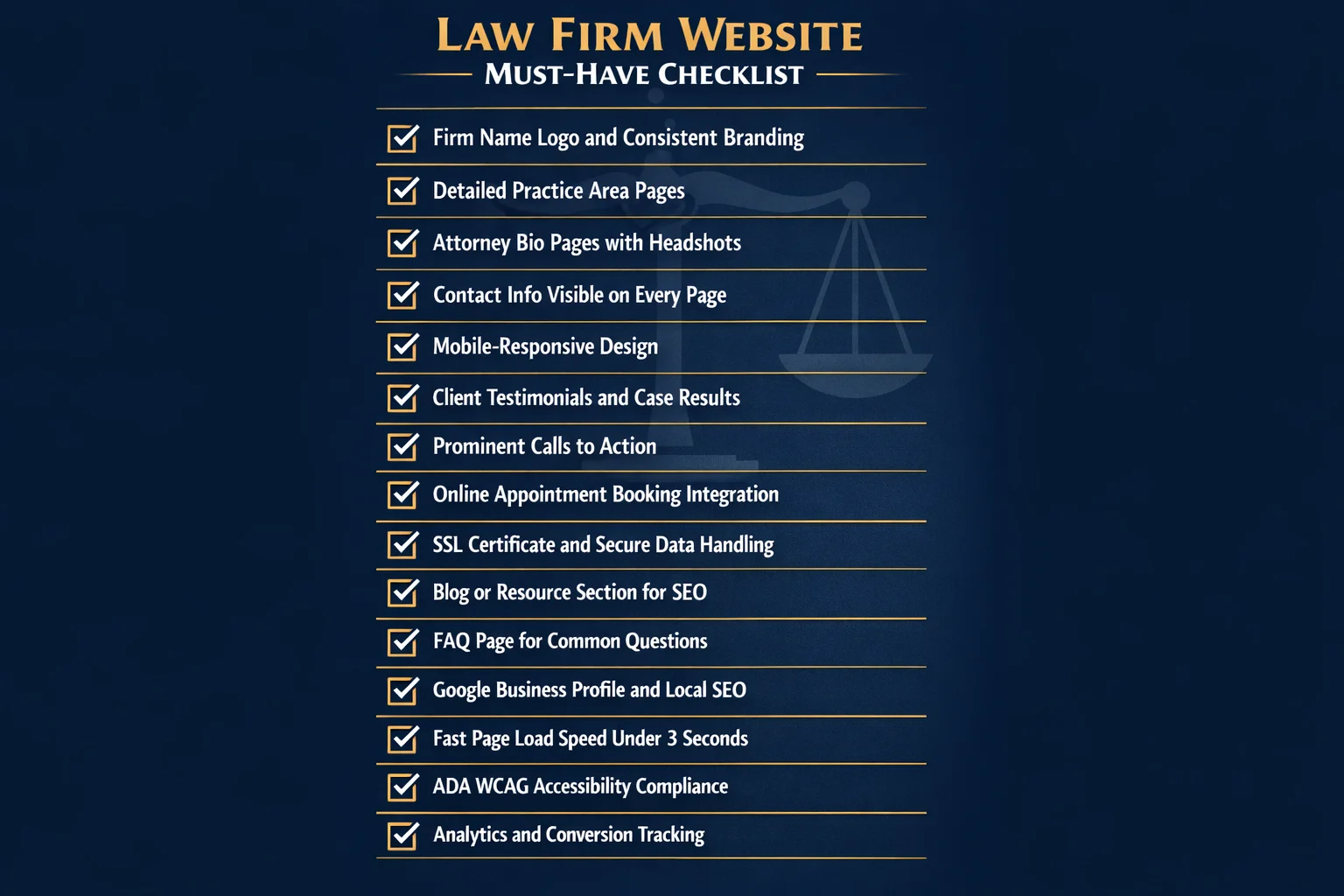
Before borrowing design ideas from the examples above, it's worth stepping back to confirm your own site covers the fundamentals. Even the most creative homepage concept won't convert visitors if the basics are missing.
The non-negotiable baseline includes your firm name and logo, a clearly organized list of practice areas, attorney bios with professional headshots, contact information visible on every page, an office location with an embedded map, and a design that works flawlessly on mobile, where the majority of legal searches now originate.
Trust builders move visitors from curious to confident. These include client testimonials, notable case results, awards and recognitions, bar association memberships, and any media appearances or press mentions. Placed throughout the site instead of buried on a single "About" page, these elements do continuous conversion work.
Conversion elements ensure visitors know exactly what to do next. Prominent calls-to-action (call, email, or schedule), online appointment booking, live chat, and streamlined intake forms all reduce friction at the critical moment when a visitor is ready to reach out. Every page should offer a clear next step.
Enhanced features separate good sites from great ones: FAQ pages, a legal blog, educational videos, downloadable resources, and transparent fee information all add value while building authority.
Website copy does the selling on every one of these pages. Strong law firm website copy speaks to the client's problem in plain language and answers the questions they arrived with. End each page with a clear next step, and if a paragraph reads like it was written for another attorney, rewrite it for the client.
Technical essentials underpin everything else: an SSL certificate, fast page load speeds, schema markup for local SEO, ADA-accessible design, and analytics tracking to measure what's actually working.
Think of these layers as a pyramid: get the foundation right before optimizing the top.
How Much Does a Law Firm Website Cost?

Budget shapes every website decision, but it doesn't have to determine the outcome. Here's what you can realistically expect to spend at each tier.
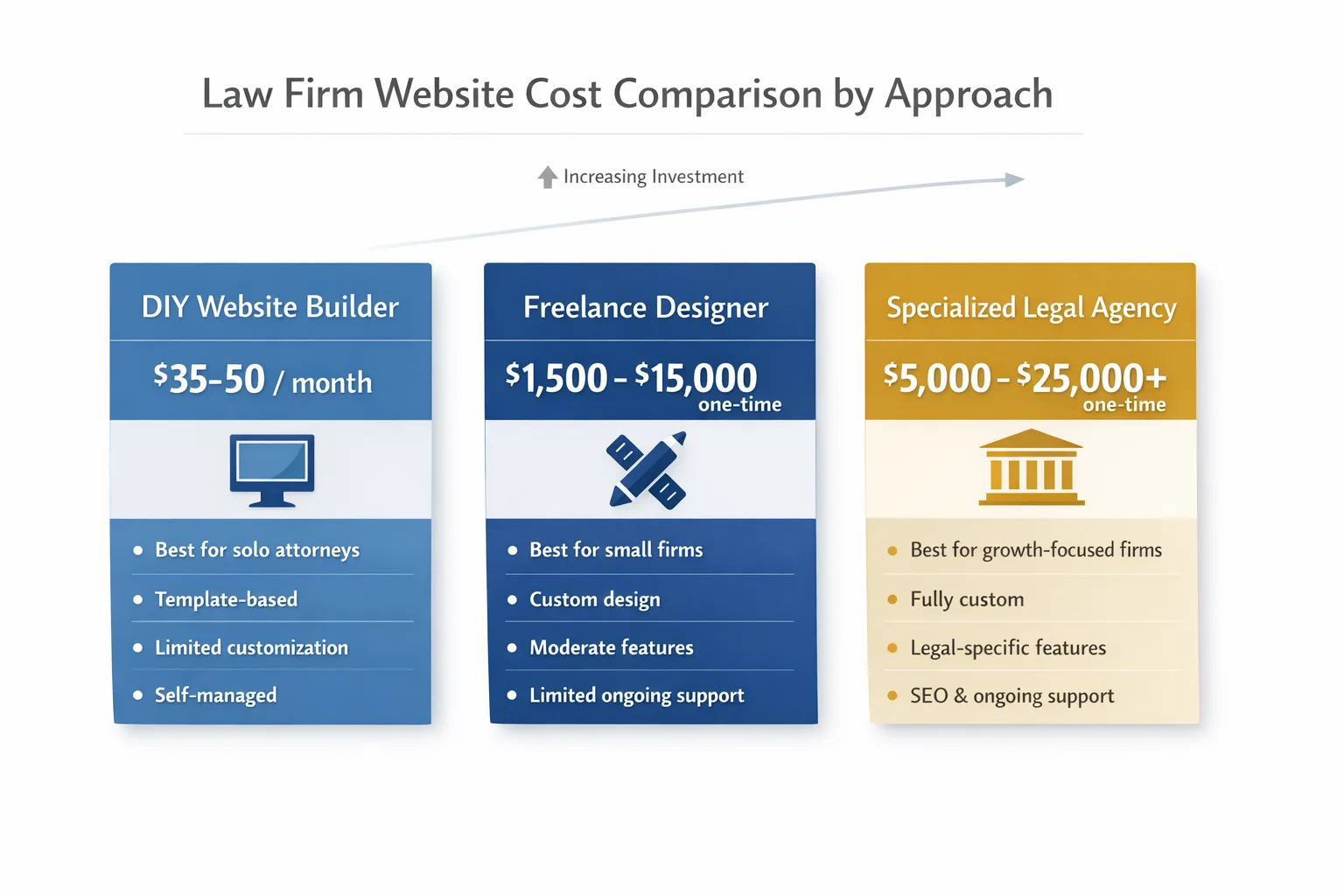
DIY with website builders (Squarespace, Wix, and similar platforms) runs approximately $35–$50 per month. For solo attorneys who need a polished, professional presence without a large upfront investment, this is a legitimate starting point, not a compromise. Modern templates are clean, mobile-responsive, and surprisingly capable when paired with focused messaging and a professional headshot.
Freelance designers occupy the middle ground, typically charging $1,500–$5,000 for straightforward builds and $5,000–$15,000+ for more complex, custom work. This tier suits small firms that want a distinctive look without committing to a full agency relationship.
Specialized legal website agencies start around $5,000 and can exceed $30,000 for fully custom designs with legal-specific functionality, built-in SEO strategy, and ongoing support. For firms serious about using their website as a primary growth engine, this investment frequently pays for itself.
Claremont Software works in this specialized tier. See our law firm website design services for what a legal-specific build includes.
Several factors push costs upward regardless of tier: the number of pages, custom functionality like intake forms or interactive calculators, professional copywriting, SEO configuration, and ongoing maintenance.
The more important number, though, is the cost of a cheap website: lost leads who bounce to a competitor, suppressed search rankings, and a first impression that quietly undermines every other marketing dollar you spend. A website that fails to convert is costing you clients.
DIY Website Builders vs. Custom Design: Choosing the Right Path
The decision between a DIY website builder and a custom-designed site is one of the most consequential choices a law firm makes, and the right answer isn't the same for every practice.
Template-based platforms and legal website builders offer a genuinely viable starting point for solo attorneys and small firms. Costs typically range from a few hundred to a few thousand dollars, and modern builders have improved dramatically in recent years. For a newly launched practice or a firm in a low-competition market, a well-configured template can cover the fundamentals without draining a limited marketing budget.
Custom design agencies specializing in legal websites operate at a different level and a different price point. Expect to invest anywhere from $5,000 to $30,000 or more depending on scope, functionality, and the agency's track record. What you're buying is a site architected around your specific practice area, client base, and competitive landscape. For firms in high-stakes markets where the website is a primary driver of client acquisition, that investment typically pays for itself.
If you're leaning toward the custom route, that's exactly the work our law firm web design team does: sites architected for a specific practice area and market, then paired with law firm SEO so the design actually gets found.
The honest framework for choosing: consider your firm size, your budget, how competitive your local market is, and how much differentiation your website actually needs to do. A niche estate planning practice in a mid-sized city has different requirements than a personal injury firm competing in a major metro.
Regardless of which path you choose, the platform underneath your site matters enormously. It must support strong SEO optimization, fast load times, and content updates you can make without calling a developer every time. WordPress and Webflow remain popular choices for good reason.
Claremont Software offers tools designed to help firms bridge this gap, with professional-grade functionality and customization but without the cost and complexity of a full custom build.
Common Attorney Website Mistakes (And How to Fix Them)
Even the most technically polished attorney website can fail if it's built around the wrong priorities. These are the mistakes that quietly drain leads from otherwise capable firms, and the fixes that reverse the damage.
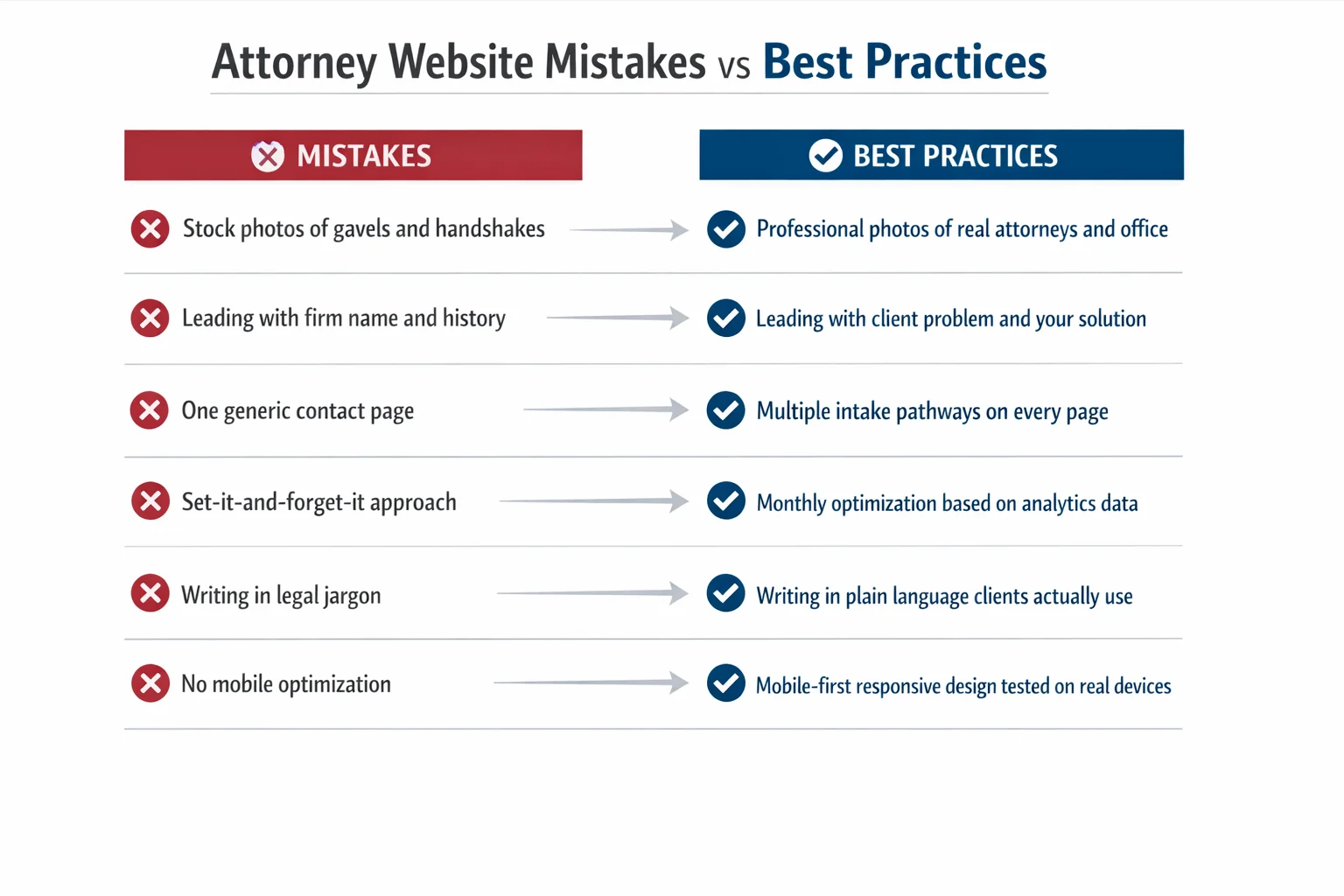
Stock photography is the fastest way to signal inauthenticity. Visitors have seen the same gavel-on-mahogany and handshake-in-a-boardroom images thousands of times. They register as placeholders, not people, and trust requires people. Real photos of your attorneys, your office, and your team communicate something no stock library can: that an actual human being will answer when they call. If a professional photoshoot feels out of reach, even candid, well-lit smartphone photos of your genuine workspace outperform generic imagery.
Designing for ego instead of the client is the second most common failure. Firms that lead with their founding year, their partners' credentials, and their trophy case are answering questions nobody asked. The visitor arrived with a problem (a car accident, a custody dispute, a criminal charge), and they need to know immediately whether you can solve it. Every element of your homepage should answer that question before it celebrates your firm's history.
SEO neglect compounds quietly over time. Missing title tags, no local keyword strategy, thin practice area pages, and zero content plan don't create an immediate crisis. They create a slow, invisible one where competitors steadily capture the searches you should be winning.
Ethical compliance is not optional. Required disclaimers, state bar advertising disclosures, and carefully worded outcome language carry real professional consequences when you get them wrong.
Finally, treating your website as a finished product rather than a living asset is perhaps the costliest mistake of all. Analytics, user behavior data, and conversion metrics tell you exactly where visitors are dropping off. Ignoring that information means repeating the same mistakes indefinitely.
Your Attorney Website Scorecard: A Self-Assessment Framework
Everything covered in this article comes down to one practical question: how does your website actually stack up right now?
Use this five-category scorecard, the same one we scored the featured sites on, to find out. Score each area honestly, not how you want your site to perform but how a first-time visitor with a real legal problem would experience it.
First Impression (Hero Section & Branding) Does your headline address the visitor's problem, or does it lead with your firm name? Is there a single, prominent call to action above the fold? Are you using real photos of your attorneys, or stock imagery? A strong first impression scores yes on all three.
Trust Signals Do you have client testimonials displayed near your CTAs? Are credentials, awards, and bar memberships visible without digging? Do you include case results or client stories where ethically permitted?
Content Quality Does each practice area have its own dedicated page targeting a specific client question? Is your language written for clients, not colleagues? Is your blog or resource section current?
Technical Performance Does your site load in under three seconds on mobile? Does it pass a basic accessibility check? Is your local SEO structured correctly?
Conversion Optimization Do you offer multiple intake pathways? Is there a persistent CTA throughout the site? Can visitors book a consultation without making a phone call?
Once you've scored your site, open the top three attorney websites ranking in your local market and practice area. Compare them against the same checklist. The gaps you find are your roadmap.
When to DIY vs. hire a professional: quick wins like updating photos, adding testimonials, and fixing mobile display issues are manageable in-house. If your gaps cluster around technical performance or conversion architecture, partnering with a specialized firm like Claremont Software will accelerate results faster than trial and error.
Prioritize those quick wins in the first 30 days. Save the full redesign and content overhaul for days 60 through 90, after you've validated what's working.
Design Trends and Inspiration Shaping Law Firm Websites in 2026

The legal industry's visual language is changing fast, and the firms leading that charge are a rich source of web design inspiration for everyone else.
Dark mode aesthetics have moved well beyond tech startups and into the legal space, with forward-thinking firms using deep charcoal, near-black, and rich jewel-tone backgrounds to project sophistication and authority. Far from feeling cold or inaccessible, these palettes, when paired with warm typography and strategic accent colors, communicate exactly the kind of quiet confidence that high-value clients find reassuring.
AI-powered features are reshaping how law firm websites function beneath the surface. Intelligent chatbots now handle initial intake conversations at 2am when no receptionist is available, qualifying leads and capturing contact information before a potential client loses momentum. Personalized content experiences, where the site adapts based on a visitor's apparent legal need, are emerging as a genuine differentiator.
Micro-interactions separate polished sites from merely pretty ones. Scroll-triggered content reveals, hover effects on attorney cards, and animated case result counters guide visitor attention naturally. They create a sense of responsiveness and care without veering into gimmick territory.
Video-first homepages are replacing static hero images for firms that want to communicate personality and culture dynamically. A 30-second attorney introduction conveys warmth that no photograph can match.
Finally, radical minimalism (generous whitespace, restrained color palettes, and ruthlessly edited copy) lets CTAs breathe and guides visitors toward conversion without visual competition. Sometimes the boldest design choice is knowing exactly what to leave out.
If you're gathering law firm web design inspiration for a redesign, these five trends are the place to start. Pick the one that fits your practice area and clients, then apply it with the fundamentals from the rest of this guide in place.
What You Can Learn From These Leaders: Actionable Takeaways

The firms behind these patterns didn't build exceptional websites by accident. They made deliberate choices, tested what worked, and kept the visitor's experience at the center of every decision. Here's how to translate those lessons into action for your own firm.
Copy one specific thing from one specific site. If your visitors arrive in a panic, take the numbered case-process guide from Staver or the charge-based navigation from Cowboy Country Law. If your practice is one people are embarrassed to call about, take the private downloadable questionnaire from Tejes Law. If you compete on expertise rather than urgency, take the named-hub approach from Cooley or the titled newsletter from Skadden. If your background is your strongest argument, look at how Native Law states its positioning above the fold. Rebuilding one element modeled on a named example is a far more achievable brief than redesigning the website, and you can judge your version against a page that already exists.
Start with an honest audit. Walk through your current website using the good-versus-great framework covered earlier in this article. Does your hero section immediately communicate who you help and why they should trust you? Are your trust signals woven throughout the site or buried on a page nobody visits? Are you offering any interactive tools, or is your site still functioning as a static brochure? Identifying the gaps is the first step toward closing them.
Pick one interactive feature and add it this quarter. You don't need to overhaul everything at once. A simple online scheduling tool, a streamlined intake form, or a cost estimator can meaningfully improve conversion rates without a full redesign. Start small, measure the impact, and build from there.
Invest in real photography. This is one of the highest-return improvements any firm can make. Authentic images of your team, your office, and your community signal credibility in ways that stock photos simply cannot.
Review your site on a phone first. The majority of potential legal clients begin their search on a mobile device, often in a stressful moment when they need help fast. If your mobile experience is slow, cluttered, or hard to navigate, you're losing clients before they ever read a word.
Finally, set up proper analytics tracking. You cannot improve what you don't measure. Know where your visitors come from, which pages they spend time on, and where they drop off before contacting you.
Conclusion
The best lawyer websites share a common blueprint: they're built around the client's experience, not the firm's ego. They load fast, communicate clearly, and give visitors a reason to stay and a reason to call. But what truly separates the leaders from the rest is a willingness to go beyond the digital brochure and create something that actively works to convert interest into consultations.
The gap between good and great comes down to three things: interactivity, authenticity, and intention. Firms that embrace all three have a measurable competitive advantage that compounds over time.
For solo attorneys and smaller practices, our website design for small law firms applies these same patterns at a small-firm budget.
The encouraging reality is that every firm, regardless of size or budget, can move meaningfully in this direction. Start with the fundamentals. Fix what's broken. Then layer in the features that match your practice area and your clients' expectations: the real photography, the interactive tools, the trust signals.
Your website is your most tireless employee. It works every hour of every day, making first impressions and starting conversations on your behalf. Make sure it's saying exactly what you'd want it to say, and doing everything you'd want it to do.
Frequently Asked Questions
What makes a law firm website great versus just good?
A good law firm website covers the fundamentals: clean design, mobile responsiveness, clear practice area pages, and basic contact information. A great website goes further by treating the site as a 24/7 intake team member rather than a static brochure. Great sites use authentic photography, client-centric content that anticipates questions before they're asked, and interactive features like cost calculators, case evaluation tools, and online scheduling. They weave social proof (testimonials, case results, and third-party credentials) throughout the entire user journey, not just on a single page. Great websites build trust and convert visitors into consultations.
How much does it cost to design a professional law firm website?
The cost of a professional law firm website varies widely depending on the approach. Template-based website builders offer affordable entry points for solo attorneys and small firms, typically ranging from a few hundred to a few thousand dollars. Custom design agencies that specialize in legal websites deliver unique branding and advanced functionality but generally cost between $5,000 and $30,000 or more, depending on the scope and complexity of the project. The right investment depends on your firm's size, budget, practice area competitiveness, and how much your site needs to stand out from local competitors. Regardless of budget, the platform you choose must support SEO optimization, fast loading speeds, and easy content updates.
What features should every lawyer website include?
Every lawyer website should include clear practice area pages, an easy-to-find contact form, a mobile-responsive design, and an SSL certificate for security. Beyond those basics, high-performing sites also feature authentic attorney bios with credentials, client testimonials or case results, a blog or resource section to support SEO, and a prominent call to action on every page. Increasingly, the best sites also offer interactive features such as online intake forms, appointment scheduling tools, and transparent pricing information. A privacy policy and accessible design that meets WCAG standards are also essential, both for user trust and to reduce legal risk for the firm itself.
How important is mobile responsiveness for a law firm website?
Mobile responsiveness is critical. The majority of potential legal clients begin their search on a smartphone, meaning a site that performs poorly on mobile will lose those visitors almost immediately. Beyond user experience, Google uses mobile-first indexing, so a site that isn't optimized for mobile will rank lower in search results, which limits how many prospective clients even find your firm. Page speed and Core Web Vitals, which are heavily influenced by mobile performance, are now direct ranking factors. For practice areas like criminal defense, where clients may be searching urgently from a phone, fast-loading and easy-to-navigate mobile pages can be the difference between winning and losing a client.
Can a solo attorney's website compete with large firm websites?
Absolutely. Solo and small firm websites can compete effectively with larger firms by leaning into advantages that big firms often can't replicate: lawyer branding, niche expertise, and authentic storytelling. A potential client searching for a specific type of legal help in a specific city doesn't necessarily want the biggest firm. They want someone they can trust and relate to. A well-optimized local SEO strategy, genuine attorney photography, compelling client testimonials, and a clear niche focus can make a solo attorney's site outperform a large firm's generic, corporate-feeling website. Tools like Claremont Software also help smaller firms access professional-grade website functionality without enterprise-level budgets.
What are the biggest mistakes law firms make with their websites?
The most common mistakes include relying on cookie-cutter templates and generic stock photography that clients can spot instantly, cluttering the homepage with too many competing calls to action, and burying contact information where it's hard to find. Many firms also treat their website as a static brochure rather than an active client acquisition tool, neglecting to update content, add fresh testimonials, or track performance with analytics. An ongoing site care plan puts that upkeep on a schedule instead of a to-do list. Other frequent missteps include ignoring mobile optimization, skipping local SEO fundamentals like location-specific pages and Google Business Profile integration, and failing to meet basic accessibility standards, which can expose the firm to its own legal liability.
How do I know if my law firm website needs a redesign?
Several warning signs indicate it's time for a redesign. If your site loads slowly, looks outdated on mobile, or hasn't been updated in more than two to three years, it's likely hurting rather than helping your practice. Other red flags include a high bounce rate, few or no leads generated through the site, no SSL certificate, missing or thin practice area content, and a lack of client testimonials or case results. You should also audit whether your site meets current accessibility standards and whether it reflects your firm's current branding and focus areas. If your competitors' websites feel significantly more modern and trustworthy than yours, that perception gap is costing you clients.
Are there ethics rules that affect what I can put on my law firm website?
Yes. Attorney advertising is regulated by state bar associations, and the rules vary by jurisdiction. Common restrictions govern how you describe your services, what claims you can make about results, and how you use terms like 'specialist' or 'expert.' For example, the California State Bar has specific ethics guidelines addressing law firm websites, including rules around 'Best Lawyer' claims and superlatives. Most states require disclaimers clarifying that website content does not constitute legal advice and that past results do not guarantee future outcomes. Before publishing testimonials, case results, or any comparative claims, attorneys should review their state bar's advertising rules carefully to ensure full compliance.
Should law firms display pricing on their website?
Yes, and it's becoming a meaningful competitive advantage. Transparent pricing, whether that's flat fees, hourly rate ranges, or a clear explanation of your fee structure, builds trust with prospective clients who are often anxious about cost. Most law firms hide pricing, which means the firms that display it stand out immediately and attract more qualified leads who are already comfortable with the investment. You don't need to publish an exact price for every matter; even explaining how you charge (flat fee vs. contingency vs. hourly) and what a typical consultation costs goes a long way. Transparency signals confidence and filters out poor-fit clients before they call.
What are the best interactive tools to add to a law firm website for lead generation?
Interactive tools are among the highest-ROI additions a law firm can make to its website. The most effective options include: consultation cost estimators or fee calculators that give visitors a personalized sense of what their case might cost; case evaluation quizzes that qualify leads while providing value; eligibility checkers (for areas like record clearing, disability benefits, or immigration status); and self-service consultation scheduling widgets embedded directly on the homepage. Online company registration workflows work well for business law practices, while disability benefit calculators are proven performers for veterans-focused firms. The key principle is that every interactive tool should provide genuine value to the visitor first, which builds trust and engagement, while simultaneously capturing lead information and moving the prospect toward booking a consultation.
How does website design impact SEO for law firms?
Website design and SEO are deeply interconnected for law firms. A visually impressive site that loads slowly, lacks mobile optimization, or uses poor heading structure will struggle to rank, no matter how good the content is. Google's Core Web Vitals measure real-world user experience factors like load speed, interactivity, and visual stability, all of which are directly influenced by design decisions. The best solo law firm websites bake technical SEO into the design from the start: clean site architecture, schema markup for attorneys and legal services, local SEO signals, fast-loading images, and mobile-first responsive layouts. Strong design also reduces bounce rates and increases time on site, both behavioral signals that reinforce search rankings over time.