
96% of people seeking legal help start with a Google search — yet most law firms are still relying on outdated tactics that leave their intake calendars half-empty.
That gap between where clients are looking and where firms are showing up represents both a crisis and an opportunity. With the legal services market projected to reach nearly $428 billion by 2029, competition for clients is intensifying across every practice area. And according to a 2025 Thomson Reuters report, legal demand rose 1.6% while worked rates climbed 7.4% — meaning the firms that master lead generation won't just survive the competition, they'll capture a disproportionate share of a growing market.
The problem isn't a shortage of potential clients. It's a shortage of strategy.
This guide breaks down 12 proven attorney lead generation strategies — from SEO and pay-per-click advertising to AI-powered vetting and automated nurturing — that are working right now in 2026. Whether you're a solo practitioner building your first pipeline or managing a mid-size firm ready to scale, you'll find actionable tactics, real cost benchmarks, and ROI frameworks to help you convert more prospects into retained clients, consistently.
What Is Attorney Lead Generation (And Why It Matters More Than Ever in 2026)
At its core, attorney lead generation is the process of attracting individuals who have a legal need and systematically converting their interest into booked consultations — and ultimately, retained cases. It's not just about getting your name in front of people; it's about reaching the right people at the right moment in their decision-making journey and giving them a compelling reason to choose your firm.
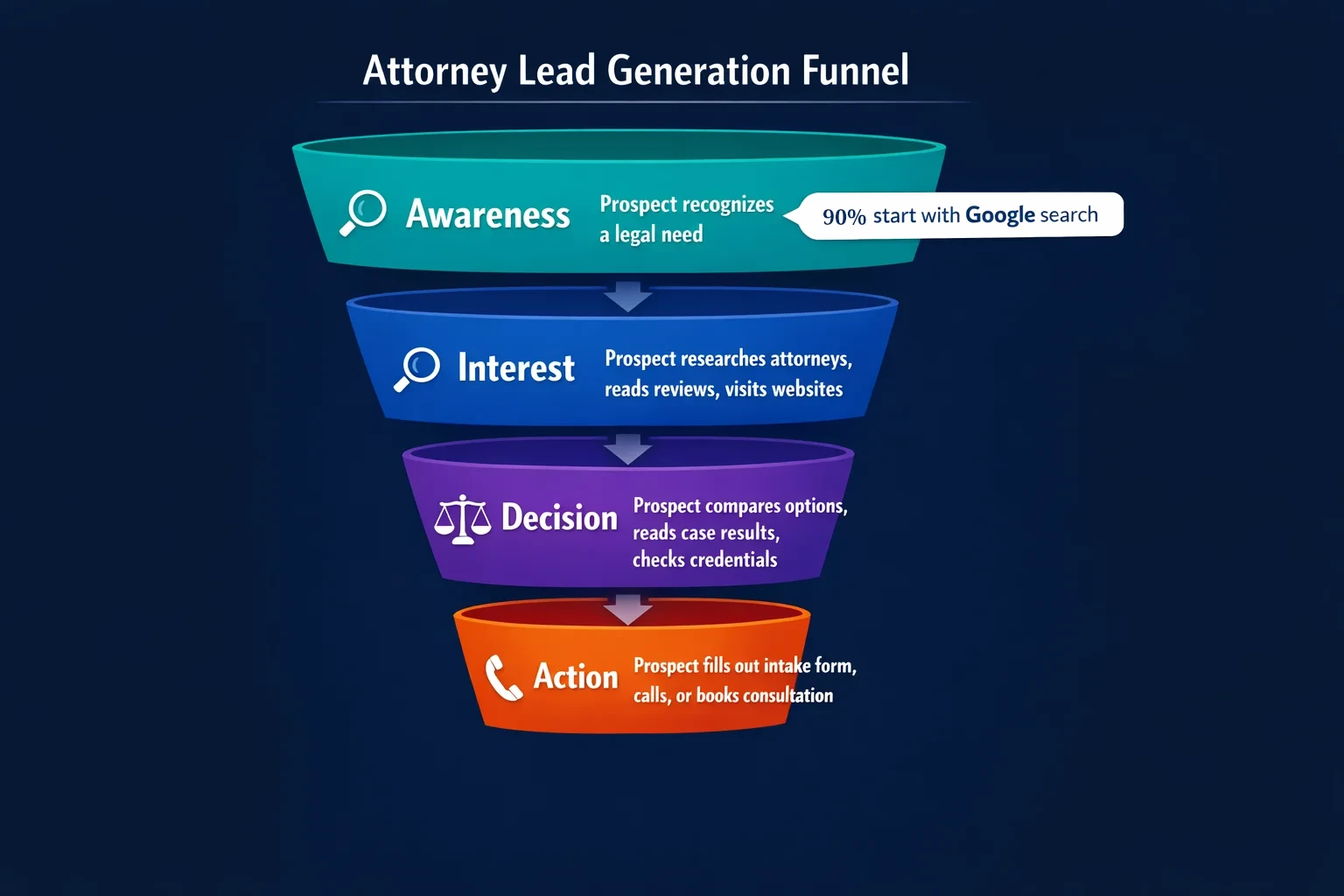
That journey follows a predictable funnel: Awareness → Interest → Decision → Action. Each stage demands a different approach. Someone who just learned they may need an estate plan requires educational content. Someone actively comparing attorneys needs social proof and clear differentiators. Someone who just got arrested needs an immediate, frictionless way to reach you. Treating all three the same way is one of the most common — and costly — mistakes law firms make.
This is why understanding lead temperature matters. Cold leads have casual awareness of a legal issue but aren't yet searching for help. Warm leads are actively researching their options. Hot leads are ready to hire — today. A complete lead generation strategy must address all three, not just the bottom of the funnel.
The urgency to get this right has never been greater. The U.S. legal services market is projected to grow from $375.66 billion in 2024 to nearly $428 billion by 2029. Meanwhile, a 2025 Thomson Reuters report confirmed that legal demand rose 1.6% while worked rates climbed 7.4% — meaning the firms that master pipeline-building will capture a disproportionate share of an already-expanding market.
Strategy #1: Search Engine Optimization Built for Legal Intent
With 96% of people seeking legal help starting with a Google search, and most never scrolling past the first page of results, your visibility in search isn't a marketing nice-to-have — it's the single most important factor determining whether your phone rings or your competitor's does. The keyword "lawyer SEO marketing" alone generates 8,100 monthly searches, reflecting just how many firms are racing to master this channel. The question isn't whether to invest in law firm SEO; it's whether you're doing it right.
Dedicated practice area pages are the non-negotiable foundation. A single generic "Services" page won't rank for the specific queries your prospects are typing. Someone searching "Chicago wrongful termination attorney" or "how to contest a will in Texas" needs to land on a page built specifically for that intent. Each practice area your firm handles deserves its own optimized landing page with targeted keywords, relevant case context, and a clear path to contact.
Local SEO is equally critical. Appearing in Google's map pack — the three local results displayed above organic listings — can dramatically increase qualified calls. This requires a fully optimized business profile, consistent citations across directories, and geo-specific backlinks from local organizations and publications.
On the technical side, implementing attorney schema markup, FAQ structured data, and strong E-E-A-T signals (Experience, Expertise, Authoritativeness, Trustworthiness) tells Google your content deserves to rank for high-stakes legal queries.
Finally, in 2026, optimizing for AI Overviews and search generative experiences is no longer optional. Structure your content with clear headers, direct answers, and cited sources so AI systems pull from your pages — not your competitors'.
Strategy #2: Content Marketing That Answers Real Legal Questions
While SEO captures prospects who are already searching, content marketing earns their trust once they arrive — and often brings them to you in the first place. The attorneys who consistently fill their pipelines aren't just ranking on Google; they're answering the exact questions their ideal clients are typing into search bars at 11pm after a car accident, a difficult conversation with a spouse, or a call from a creditor.
Problem-solving blog posts targeting long-tail queries are your highest-leverage content investment. Searches like "what to do after a car accident that wasn't my fault" or "how to file for emergency custody in [state]" signal genuine legal need — not casual curiosity. A well-written post that answers these questions completely positions your firm as the obvious next call.
Beyond blog posts, comprehensive legal guides and downloadable resources serve a dual purpose: they deliver real value to prospects while capturing email addresses for ongoing nurturing. A guide titled "The Complete Divorce Checklist for [State] Residents" attracts exactly the audience a family law attorney wants in their pipeline.
Video content and YouTube SEO remain dramatically underutilized by most firms. Attorneys who appear on camera explaining legal concepts build trust at a speed that written content simply can't match — prospects feel they already know you before the first consultation.
Critically, content must be segmented by practice area. Personal injury content attracts different prospects than estate planning content. Mixing them dilutes relevance and attracts unqualified leads. Build content hubs around each practice area your firm serves, and let each hub do its own targeted work.
Strategy #3: Pay-Per-Click Advertising Targeting Life Events and Urgency

When someone is arrested at 2am, rear-ended on the highway, or served with divorce papers, their next move is almost always the same: they grab their phone and search for help. These high-urgency, life-event-driven moments are where pay-per-click advertising earns its place in your lead generation mix. Unlike SEO, which builds momentum over months, PPC puts your firm in front of desperate, ready-to-act prospects the moment they search — making it one of the fastest ways to generate qualified consultations.
The catch? Legal PPC is expensive. Competitive terms routinely exceed $94 per click, meaning a single wasted click on an irrelevant search query burns real money. This is why negative keyword lists are non-negotiable. Exclude terms like "free legal advice," "law school," "paralegal jobs," and "legal aid" before your campaign launches — these searches will drain your budget without producing a single viable lead.
Ad copy in legal PPC must lead with empathy, not credentials. Prospects in crisis don't care about your bar memberships in the first three seconds — they need to feel understood. Headlines like "Injured in an Accident? We Fight for Full Compensation" outperform generic "Experienced Personal Injury Attorney" copy consistently. Pair empathetic messaging with a free consultation offer and call extensions so prospects can reach you with a single tap from their mobile screen.
Once clicks arrive, your landing page carries the conversion burden. A/B test relentlessly: headline framing, form length, button color, and social proof placement all measurably affect whether a visitor becomes a lead. Test one variable at a time, let data accumulate, and optimize toward booked consultations — not just form submissions.
Strategy #4: Local Service Ads — The Most Cost-Effective Paid Channel for Attorneys
If PPC is the expensive sports car of legal advertising — fast, powerful, and costly to run — then Local Service Ads are the fuel-efficient vehicle that quietly outperforms it on almost every metric that matters. LSAs operate on a fundamentally different model than traditional pay-per-click: you pay only when a prospect contacts you directly, not every time someone clicks your ad. For attorneys watching their marketing budgets closely, that distinction is enormous.
The mechanics work in your favor from the start. LSAs display at the very top of Google search results — above traditional paid ads, above the map pack, above organic listings. That's the most valuable real estate on the internet for local legal searches, and you're competing for it on a cost-per-lead basis rather than a cost-per-click one. Practitioners consistently report that LSAs deliver lower effective costs than standard PPC campaigns for equivalent lead quality.
The Google Screened badge attached to LSA listings does additional heavy lifting. Prospects see a verified checkmark signaling that Google has confirmed your license and background — instant credibility before they've read a single word of your profile.
Optimizing your LSA ranking comes down to four levers:
- Response time — faster responses to lead inquiries directly improve your ranking position
- Review quantity and quality — more five-star reviews push your listing higher
- Business hours — broader availability signals responsiveness to Google's algorithm
- Service area precision — tightly defined geographic targeting reduces unqualified leads and improves conversion rates
For attorneys not yet running LSAs, this is the channel to prioritize first.
Strategy #5: Legal Directories and Attorney Profile Optimization
Here's a reality most attorneys don't realize until they Google themselves: you almost certainly already have a profile on Avvo, Martindale, Lawyers.com, Nolo, and several other major legal directories — whether you created one or not. These platforms automatically generate listings for every licensed attorney using publicly available state bar data. If you haven't claimed yours, a half-empty, unoptimized profile is sitting there right now, either failing to attract leads or actively undermining your credibility.
Claiming and optimizing these profiles costs nothing but time — and the upside is significant. Major legal directories collectively attract tens of millions of monthly visitors actively searching for attorneys. An optimized profile puts your firm in front of prospects who are already in research mode and moving toward a hiring decision.
Profile optimization follows a clear hierarchy of impact:
- Professional headshot — profiles with photos generate dramatically more clicks than those without
- Detailed practice area descriptions — generic bios lose to specific, benefit-focused descriptions of what you handle and who you help
- Client reviews — ratings and testimonials are often the deciding factor when prospects compare attorneys side by side
- Response rate and speed metrics — many directories display how quickly attorneys respond, directly influencing prospect confidence
- Credential verification — completed bar information, awards, and peer endorsements build authority signals
Beyond free listings, premium enhanced profiles distribute your presence across multiple platforms simultaneously, often including placement in sponsored positions with higher visibility.
That said, treat directories as investments requiring accountability. Track which platforms actually generate consultation requests — not just profile views — and cut spending on underperformers without hesitation.
Strategy #6: Pay-Per-Lead Services — Buying Leads That Are Ready to Convert
Pay-per-lead services operate on a fundamentally different premise than every other channel covered so far: you don't pay for clicks, impressions, or rankings — you pay only when a vetted prospect actually contacts you. For attorneys who want predictable lead flow without the complexity of managing ad campaigns or waiting months for SEO to compound, this model has obvious appeal.
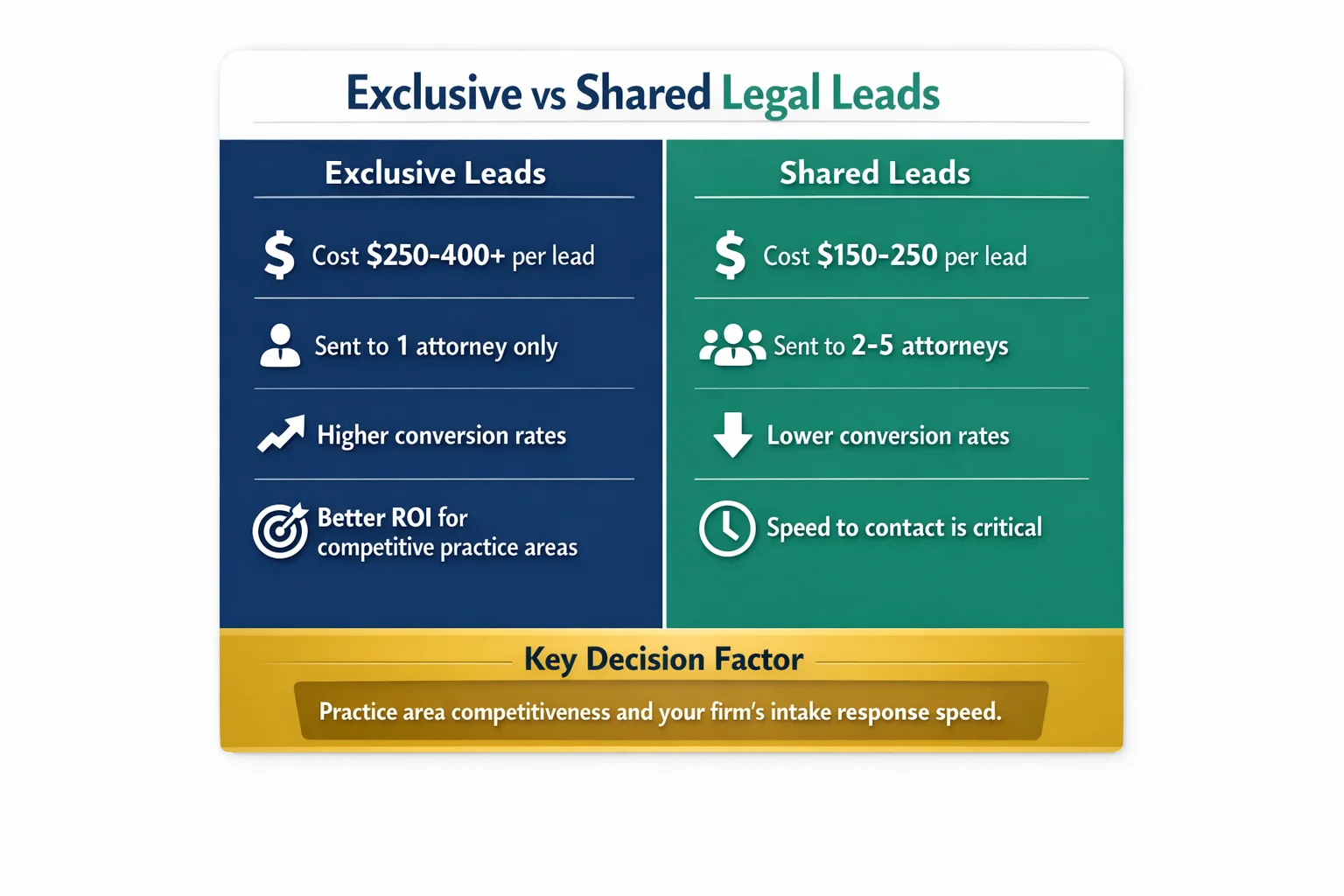
The most important distinction to understand before spending a dollar is exclusive versus shared leads. Exclusive leads are delivered to a single attorney — you're the only firm receiving that prospect's information. Shared leads go to multiple attorneys simultaneously, triggering an immediate race to make first contact. Shared leads cost less upfront, but conversion rates drop sharply when a prospect is fielding calls from three competing firms at once. For most attorneys, exclusive leads deliver meaningfully better ROI despite the higher price tag.
Cost benchmarks vary significantly by practice area and geography. Expect to pay roughly $150–$400 per lead in most markets, with personal injury and mass tort leads commanding premium prices in competitive metros. High-value practice areas justify higher per-lead costs when you factor in case value — a $250 lead that converts to a $20,000 case is exceptional economics.
When evaluating vendors, ask four questions before signing anything:
- How are leads vetted? Reputable services qualify prospects before delivery, filtering out unserious inquiries
- Are exclusivity guarantees contractually binding? Get it in writing
- What's the return policy for unqualified leads? Legitimate vendors offer credit for leads that don't meet agreed criteria
- Is there contract flexibility? Avoid long-term commitments until you've validated lead quality from a specific vendor
Strategy #7: Email Marketing and Automated Lead Nurturing Sequences
Most legal prospects don't hire an attorney the moment they discover your firm. They research, hesitate, compare options, and sometimes sit on a decision for weeks — particularly in practice areas like estate planning, business law, or family law where the emotional and financial stakes feel overwhelming. Email marketing exists precisely to serve these warm leads during that extended consideration window, keeping your firm top-of-mind until they're ready to act.
The foundation of effective legal email marketing is segmentation by practice area and prospect type. A prospect who downloaded your guide on business formation needs entirely different content than someone who visited your personal injury pages after an accident. Sending generic firm updates to both wastes the opportunity. Segment your list from the moment of capture, and every subsequent message becomes more relevant — and more likely to drive a consultation request.
Behavioral triggers are where email marketing becomes genuinely powerful for law firms. When a prospect downloads a legal guide, that action automatically enrolls them in a targeted nurture sequence — a series of emails delivering related content, addressing common objections, and progressively building the case for hiring your firm. Similarly, repeated visits to a specific practice area page can trigger a follow-up email offering a free consultation on exactly that issue.
To prioritize your follow-up efforts, implement a lead scoring framework that assigns point values to prospect behaviors: email opens, link clicks, page visits, form submissions, and consultation requests each signal increasing intent. Prospects crossing a defined score threshold get flagged for immediate personal outreach — turning your email system into an intelligent filter that surfaces your hottest leads automatically.
Strategy #8: Online Reviews and Reputation Management
Before a prospect ever visits your website or calls your office, they've almost certainly read your reviews. Online reviews function as the first impression for the majority of legal clients — they compare star ratings, scan written feedback, and make preliminary judgments about trustworthiness before making any contact. Firms with robust, recent review profiles consistently outperform competitors with thin or outdated feedback, regardless of how polished their websites are.
Building a steady review pipeline requires a systematic process, not occasional luck. After case resolution, send a follow-up email with a direct link to your preferred review platform — removing every possible step between the satisfied client and their written feedback. Train your intake and administrative staff on when and how to make the ask; a warm, personal request from someone the client knows converts far better than an automated message alone.
Reputation monitoring demands equal attention. Respond to every review — thank positive reviewers specifically and address negative feedback professionally without disclosing any case details, which creates confidentiality and ethical exposure. A thoughtful response to a critical review often impresses prospective clients more than the negative review damages you.
The downstream benefits extend well beyond direct trust-building. Review volume and recency directly influence your local SEO rankings, improve your positioning in Local Service Ads, and increase click-through rates on directory profiles — making reviews one of the few assets that simultaneously strengthen multiple channels across your entire lead generation ecosystem.
Strategy #9: AI-Powered Lead Generation and Intelligent Chatbots

The legal prospect who finds your firm at 11 PM on a Tuesday — panicked after an accident, a served divorce petition, or an unexpected arrest — won't wait until morning to get answers. AI-powered chatbots ensure your firm is present and responsive at that exact moment, engaging visitors with intelligent, conversational intake before a single staff member clocks in.
Modern legal chatbots do far more than display a "leave a message" form. They ask structured follow-up questions — case type, jurisdiction, timeline, prior legal representation — that simultaneously qualify the lead and gather the information your intake team needs to have a productive first conversation. By the time a prospect reaches a human, they're pre-screened, categorized by practice area, and ready to move forward.
Beyond reactive website chat, AI-powered lead vetting tools now handle the entire pre-qualification process proactively. These platforms gather prospect information through extended question sequences, filter out unqualified inquiries, and deliver only screened leads directly to attorneys — compressing the time between initial interest and a meaningful consultation.
The most forward-looking development in 2026 is predictive analytics and intent data modeling. AI systems can now identify behavioral signals — specific search patterns, content consumption sequences, and demographic triggers — that indicate an emerging legal need before a prospect has even typed "attorney near me." This shifts lead generation from reactive to anticipatory.
That said, AI should function as a qualifier and router, never a closer. The attorney-client relationship is built on personal trust, and prospects making high-stakes legal decisions need to feel that human connection quickly. Let AI handle the screening; let your attorneys handle everything that matters.
Strategy #10: Website Optimization for Maximum Lead Conversion

Your website isn't just a digital brochure — it's your highest-volume intake coordinator, working around the clock. Yet most law firm websites squander that potential by burying contact options, overwhelming visitors with dense text, and forcing prospects to hunt for next steps. Every single page on your site should make it effortless for a visitor to take action — whether that's calling your office, submitting an intake form, or booking a consultation directly on your calendar.
Landing page design sets the tone immediately. Your hero section needs to communicate your core value proposition within three seconds: who you help, what outcome you deliver, and how to reach you. Trust signals belong above the fold — notable case results, client testimonials, peer recognition, and bar credentials all reduce the hesitation that costs you consultations. Given that the majority of legal searches now happen on mobile devices, a slow or poorly formatted mobile experience isn't just an inconvenience; it's a direct revenue leak.
Intake form optimization deserves particular attention. Shorter forms convert better, but forms that are too sparse fail to qualify the lead. Ask only what's essential upfront — name, contact information, and a brief case description — then gather deeper qualifying details during the follow-up call.
Tools like Claremont Software help firms unify their web presence and lead capture workflows, ensuring that no inquiry slips through the cracks between your website, intake process, and case management system. Firms using optimized lead capture systems have reported conversion rates approaching 18%, demonstrating how dramatically the right infrastructure compounds your results across every other channel you're running.
Strategy #11: Social Media and Thought Leadership Marketing
For most practice areas, social media won't be your primary lead source — and that's perfectly fine. Its real value lies in amplifying every other channel you're running: reinforcing your credibility when a referral Googles you, warming up prospects who found you through search, and keeping your firm top-of-mind with the professional networks most likely to send cases your way.
LinkedIn delivers the highest ROI of any social platform for attorneys. Publishing thought leadership content — case commentary, legislative updates, practical legal guidance — positions you as the authoritative voice in your practice area among the business owners, financial professionals, and fellow attorneys who are your most valuable referral sources. Consistent LinkedIn presence builds the kind of professional authority that converts a cold introduction into a trusted recommendation.
Community involvement content strengthens this further. Sharing your firm's participation in local events, pro bono work, and legal aid initiatives signals genuine investment in your community — and that authenticity generates referral leads that no paid channel can replicate.
Podcast marketing is emerging as a particularly powerful 2026 channel. Prospects researching legal issues consume long-form audio during commutes and downtime, and attorneys who host or guest on relevant podcasts reach those prospects during their decision-making phase — building trust through expertise before any direct contact occurs.
Social media won't fill your pipeline alone, but it makes everything else work harder.
Strategy #12: Referral Marketing and Speed-to-Contact Systems
Referrals remain the gold standard of attorney lead generation — and it's not particularly close. A prospect who arrives because a trusted friend, doctor, or financial advisor recommended you has already cleared the skepticism hurdle that every other channel struggles to overcome. Referred leads convert at dramatically higher rates than any paid source, yet most firms treat referral generation as a passive, hope-for-the-best activity rather than a system worth engineering deliberately.
The fix is building structured referral networks with complementary professionals whose clients regularly encounter legal needs. Personal injury attorneys should cultivate relationships with chiropractors, orthopedic clinics, and emergency care providers. Estate planning attorneys benefit from partnerships with financial advisors and CPAs. Real estate attorneys should be the first call every active real estate agent makes when a transaction gets complicated. These relationships don't happen by accident — they require consistent outreach, mutual value exchange, and staying visible enough that you're the obvious name when a referral opportunity arises.
Once a lead enters your pipeline from any source, speed-to-contact becomes your single most powerful conversion lever. Research consistently shows that firms responding within five minutes convert dramatically more leads than those who follow up hours later — because a prospect who doesn't hear from you immediately will simply call the next attorney on their list.
Building a unified multi-channel intake system is what makes speed possible at scale. Leads arriving from SEO, PPC, directories, referrals, and chat need to flow into a single queue — tracked, prioritized, and routed without manual intervention. No lead should fall through the cracks simply because it arrived through an unfamiliar channel.
How to Choose the Right Lead Generation Mix for Your Firm
Not every strategy covered in this guide belongs in your firm's playbook — and trying to run all twelve simultaneously is a reliable path to mediocre results across the board. The goal isn't maximum activity; it's the right combination for your specific firm.
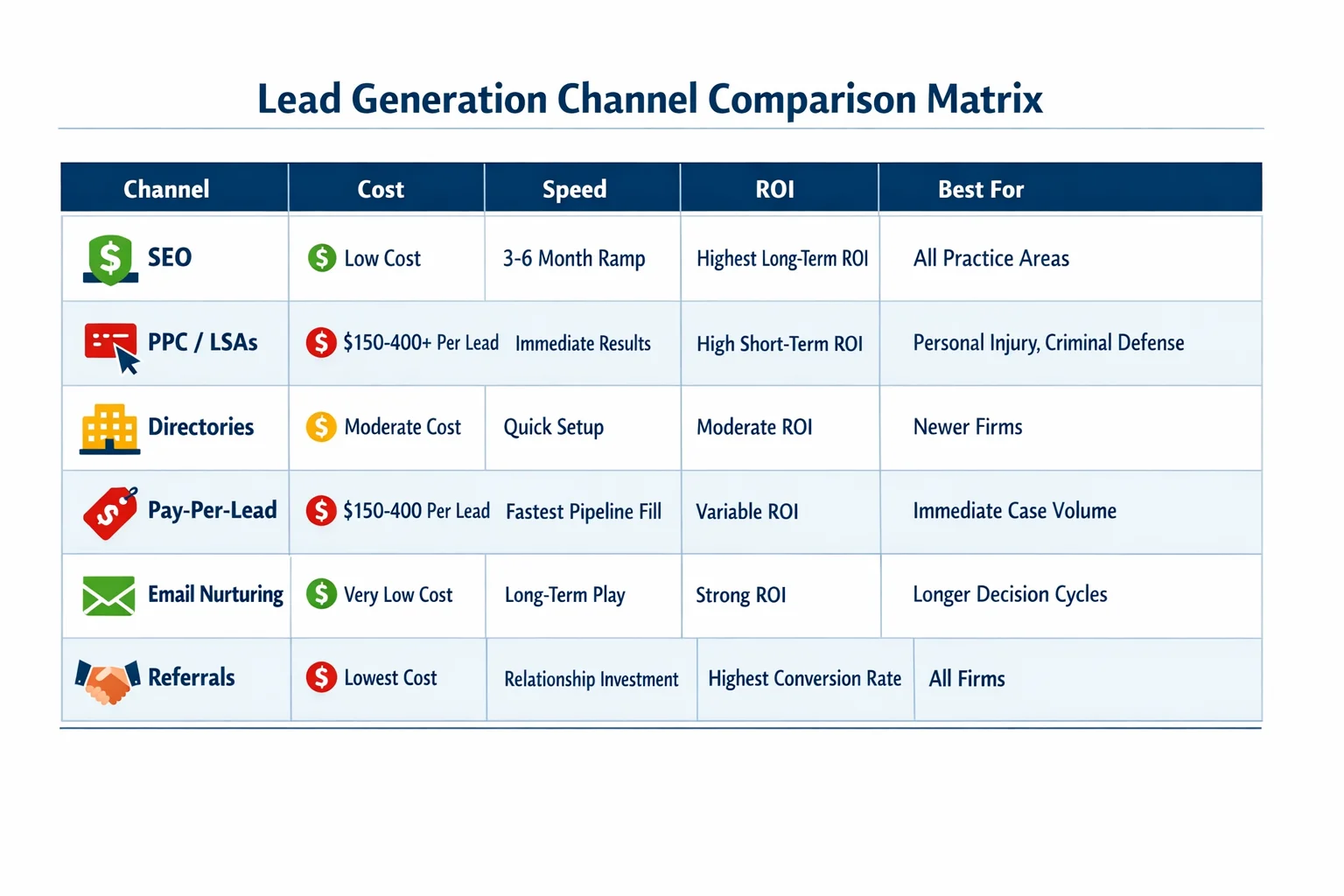
Start by mapping your situation across four variables: firm size, practice area, budget, and geographic market. Solo practitioners typically get the fastest ROI from Local Service Ads and one or two optimized directory profiles — channels that require minimal ongoing management. Mid-size firms can layer in SEO, content marketing, and automated nurturing once the foundational paid channels are producing consistently. Practice area matters just as much: personal injury demands aggressive PPC and LSAs given the urgency-driven search behavior, while estate planning rewards long-form content and email nurturing because decision cycles stretch over months.
Client lifetime value (CLV) is the lens that makes every budget decision rational. A $300 lead that converts to a $15,000 retained case represents a 50x return — meaning even a 10% conversion rate on paid leads generates exceptional economics. Calculate your average case value by practice area before setting channel budgets, and you'll stop treating lead generation as a cost and start treating it as an investment with a measurable return.
Multi-touch attribution is where most firms have a blind spot. A client who found you through a blog post, later saw your LSA, and finally converted after reading your reviews touched three channels before signing — crediting only the last one distorts your entire strategy. Even basic attribution tracking, connecting lead source data in your CRM to signed retainers in your case management software, reveals which channels are genuinely driving revenue versus just generating activity.
Compliance is non-negotiable. TCPA regulations govern how and when you can contact leads via phone and text. State bar advertising rules vary significantly and impose specific requirements around disclaimers, testimonials, and fee representations. Before scaling any outreach sequence or automated follow-up system, verify your approach against your jurisdiction's professional conduct rules — the downside risk isn't just wasted spend, it's disciplinary exposure.
Track everything from first touch to signed retainer using integrated analytics. Platforms like Claremont Software help firms connect their web presence and lead capture workflows directly to intake outcomes, giving you the closed-loop visibility needed to double down on what's working and cut what isn't.
Conclusion
The attorneys who will dominate their markets in 2026 aren't necessarily the most experienced or the most talented — they're the ones who've built systems that consistently put them in front of the right prospects at the right moment.
No single strategy fills a pipeline alone. But the right combination creates compounding results: SEO and content build long-term visibility, paid channels generate immediate flow, directories and reviews build trust at every touchpoint, and AI-powered qualification ensures no opportunity slips through unworked.
Start with your website and intake process as the foundation. Then layer on two or three acquisition channels that match your practice area, budget, and market. Automate your follow-up, respond to every lead within minutes, and track every touchpoint from first click to signed retainer.
The firms losing winnable cases aren't losing them on merit — they're losing them to slower response times, leaky intake processes, and marketing decisions made on instinct rather than data.
Build the system. Measure what matters. The pipeline you create this year becomes the competitive advantage that's nearly impossible to replicate next year.
Frequently Asked Questions
How much does attorney lead generation cost per lead in 2026?
Attorney lead generation costs vary widely depending on the channel and practice area. Pay-per-lead services typically range from $150–$400 per lead in most markets, while pay-per-click advertising on Google can cost $94 or more per click for competitive legal keywords — meaning your actual cost per lead is often much higher once you factor in conversion rates. Local Service Ads tend to be more cost-effective since you pay per lead rather than per click. SEO and content marketing have lower ongoing costs but require a longer ramp-up period. The key is to calculate cost per acquired client, not just cost per lead — a $300 lead that converts to a $15,000 case represents an exceptional return on investment.
What is the difference between exclusive and shared legal leads?
Exclusive leads are sold to only one attorney, meaning you're the sole firm competing for that prospect's business. Shared leads are sold to multiple attorneys simultaneously, so you're immediately racing against competing firms to make contact first. Exclusive leads typically cost more upfront but convert at significantly higher rates because the prospect isn't being bombarded by calls from multiple lawyers at once. Shared leads are cheaper but require an extremely fast response time — often within minutes — to have any realistic chance of converting. For most attorneys, exclusive leads deliver better ROI despite the higher price tag, especially in competitive practice areas like personal injury or family law.
Which lead generation strategy works best for solo attorneys vs. larger firms?
Solo attorneys typically get the best results from a focused combination of local SEO, Google Local Service Ads, and legal directory optimization — all of which are cost-effective and don't require large marketing teams to manage. Claiming and optimizing directory profiles is especially valuable since profiles are often auto-generated from state bar data and just need to be activated. Larger firms can layer in pay-per-click advertising, content marketing programs, email nurturing sequences, and AI-powered lead qualification tools that require more budget and infrastructure. Regardless of firm size, a high-converting website with a clear call-to-action and fast intake response is the non-negotiable foundation every attorney needs before investing in any paid channel.
How long does SEO take to generate leads for a law firm?
Law firm SEO typically takes 3–6 months to begin producing measurable results, and 6–12 months to generate a consistent flow of qualified leads. The timeline depends on several factors: how competitive your local market is, how established your website's domain authority is, and how aggressively you're publishing optimized content and building backlinks. Highly competitive practice areas like personal injury in major metro markets can take even longer. Local SEO — particularly optimizing your Google Business Profile and appearing in the map pack — often produces results faster than organic rankings. While SEO requires patience, it delivers compounding returns over time and remains one of the highest-ROI long-term lead generation channels for attorneys.
Are pay-per-lead services worth it for attorneys?
Pay-per-lead services can absolutely be worth it when evaluated carefully. The model is straightforward: you pay only when a vetted prospect contacts you, which removes the guesswork of traditional advertising. The key is vetting the vendor before committing. Ask whether leads are exclusive or shared, what the lead qualification process looks like, whether there's a return policy for unqualified leads, and how flexible the contract terms are. Track every lead from first contact to signed retainer so you can calculate your true cost per acquired client. For attorneys in high-value practice areas — personal injury, business litigation, estate planning — even a modest conversion rate on quality leads can produce a strong return. Avoid long-term contracts until you've validated lead quality with a trial period.
How do I track ROI on my law firm's lead generation efforts?
Tracking ROI starts with connecting every lead source to a signed retainer using a legal CRM integrated with your case management software. Assign a unique tracking phone number or UTM parameter to each marketing channel — SEO, PPC, directories, referrals — so you know exactly where each lead originated. Record the lead source in your CRM at intake, then track it through consultation, proposal, and signed case stages. Calculate ROI by dividing the total revenue from cases attributed to a channel by the total spend on that channel. Tools like Google Analytics 4 help with website attribution, while a robust CRM ties everything together. Firms that implement this tracking infrastructure can confidently double down on what's working and cut what isn't.
What is the best way to convert website visitors into law firm leads?
The most effective way to convert website visitors into leads is to make it effortless for them to take the next step. Every page — especially practice area pages — should feature a prominent call-to-action: a phone number, a consultation booking widget, or a short intake form. Keep intake forms brief; ask only the essential questions needed to qualify the lead upfront. Trust signals matter enormously — display client testimonials, case results, awards, and credentials prominently. Mobile-first design is non-negotiable since most legal searches happen on smartphones. Adding a live chat or AI-powered chatbot provides 24/7 engagement for visitors who aren't ready to call. Platforms like Claremont Software can help streamline your web presence and lead capture workflows to maximize conversion rates from your existing traffic.
How does AI impact attorney lead generation in 2026?
AI is reshaping attorney lead generation across multiple touchpoints in 2026. AI-powered chatbots provide 24/7 engagement on law firm websites, qualifying visitors by asking about case type, timeline, and jurisdiction before routing them to intake — capturing leads that would otherwise leave without making contact. AI-driven lead vetting tools gather prospect information and ask extensive qualifying questions, delivering pre-screened leads directly to attorneys. On the search side, Google's AI Overviews are changing how prospects discover legal information, making it critical for law firm content to be structured and authoritative enough to be cited in AI-generated answers. Predictive analytics tools can even identify prospects showing legal-need signals before they actively search for an attorney. The firms winning in 2026 use AI to qualify and route leads faster while preserving the personal connection clients expect from their attorney.