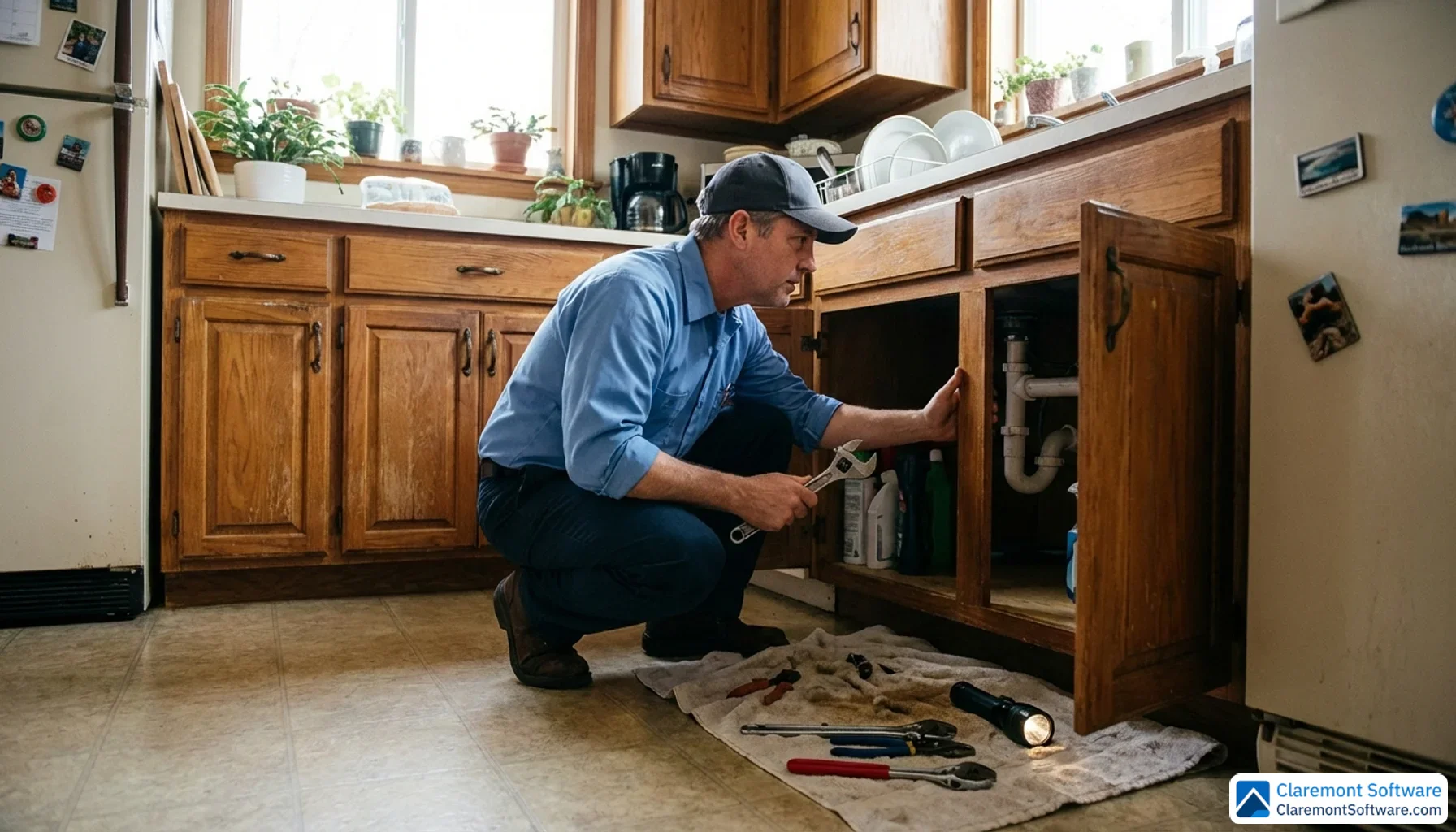
Your plumbing website gets traffic — but your phone isn't ringing, your contact form sits empty, and you're watching competitors book jobs that should be yours.
Sound familiar? You're not alone, and the problem probably isn't what you think it is.
Most plumbers assume a quiet website means they need more traffic. So they pour money into ads, chase rankings, and wait for the calls to come. They don't. Because traffic was never the real problem — conversion was.
A plumbing website has one job: turn visitors into calls, form submissions, and booked jobs. When it fails at that job, it doesn't matter how many people find you. You're essentially running water into a bucket full of holes.
The good news? The issues that kill plumbing website conversions are well-understood, and most of them are fixable without rebuilding your site from scratch.
In this guide, we'll walk through the most common reasons plumber websites fail to generate calls — from broken trust signals and buried phone numbers to slow load times and weak calls to action — and give you clear, actionable fixes for each one.
Your Website Doesn't Build Trust in the First 5 Seconds
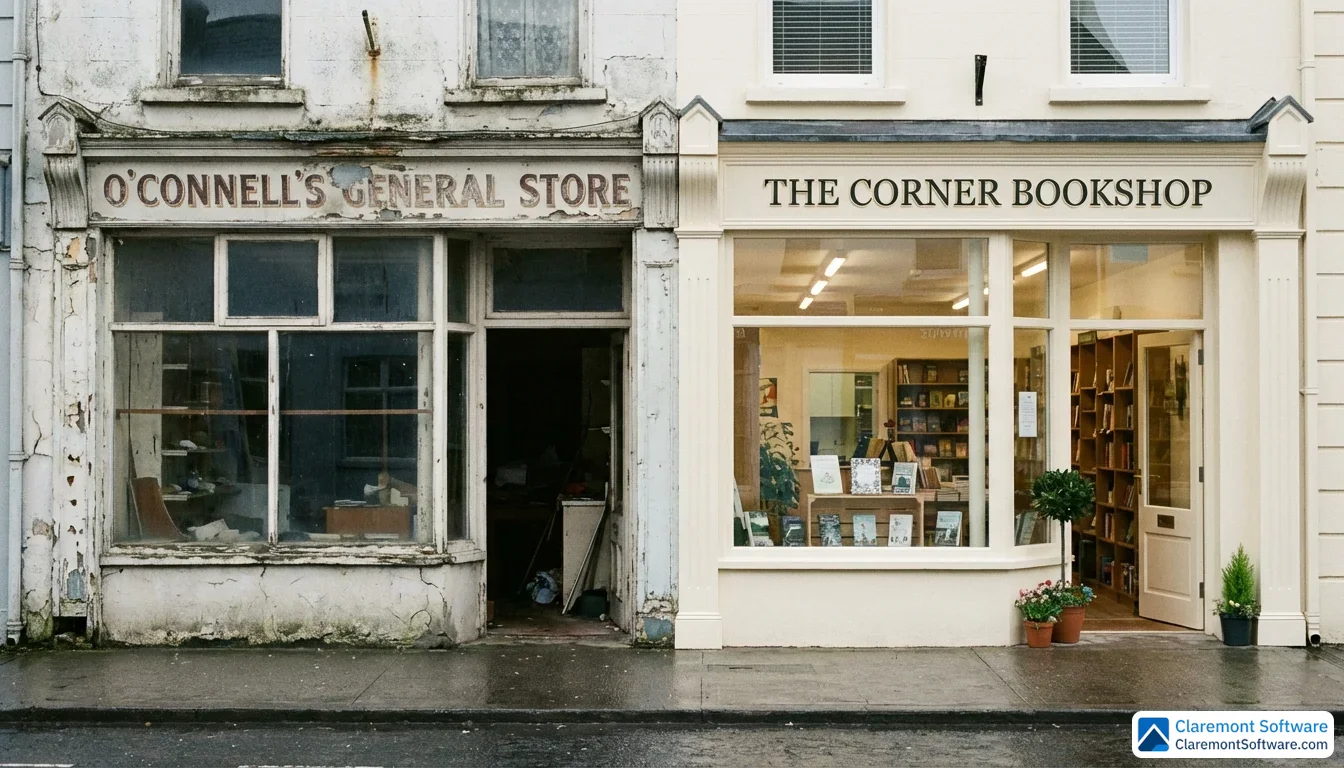
Think about the last time you landed on a website that immediately felt off — something about it made you click away without really knowing why. That instinct is exactly what your potential customers experience when they hit your plumbing website. Homeowners make a snap judgment about your legitimacy within seconds, and if your site doesn't pass that gut-check, they're gone — straight to a competitor who looks more trustworthy.
The single biggest credibility killer on plumbing websites? Stock photos. That generic image of a smiling plumber in a spotless uniform, wrench in hand, has been seen on thousands of websites. Homeowners recognize it immediately, and it signals one thing: this company doesn't want to show you who they actually are. Real photos of your technicians, your branded trucks, your uniformed crew on the job, and completed projects do something stock images never can — they prove you're a real, operating business with real people behind it.
Beyond photography, trust signals need to be visible the moment someone lands on your page — not buried in the footer or tucked away on an "About" page. Your state license number, proof of insurance, industry association memberships like PHCC, and a clear "X years in business" callout should all appear above the fold. These aren't just nice-to-haves; they're the visual shorthand homeowners use to decide whether you're worth calling.
Your overall design carries weight too. A visually inconsistent, outdated, or cluttered website doesn't just look bad — it actively signals incompetence. If your website looks like it hasn't been touched since 2012, homeowners will reasonably wonder whether your plumbing work is equally neglected. A clean, professional, consistently branded design communicates that you run a tight operation — before you've said a single word about your services.
Finally, outdated information compounds every other trust problem. A site that still lists old phone numbers, expired promotions, or services you no longer offer tells visitors you're not paying attention — and that's not someone they want working on their pipes.
Your Phone Number Is Buried or Missing
Picture this: a homeowner's kitchen sink is backing up, water is creeping across the floor, and they've grabbed their phone to find a plumber fast. They land on your website, scan it for two seconds, and can't immediately find your number. So they hit the back button and call whoever shows up next. That job — worth anywhere from $200 to $500 for a simple fix, potentially thousands if it's something bigger — just walked out the door. Not because your work isn't good. Because your phone number was buried in the footer.
This is one of the most common and most preventable conversion failures on plumbing websites.
Your phone number should be the single most prominent element at the top of every page on your site. Not tucked into a contact page. Not sitting quietly in the footer. Front and center, in a large font, in a color that stands out — visible the instant someone arrives, before they scroll a single pixel.
Best practice is to display your number in multiple locations throughout every page: in the header, within the hero section, woven into the body content, and again in the footer. Repetition here isn't overkill — it's strategy. Every time a visitor finishes reading a section and thinks okay, I'm ready to call, your number should be right there waiting.
On mobile — where the majority of plumbing searches happen — the number must be click-to-call enabled. A visitor should never have to copy and paste a phone number into their dialer. One tap, and they're calling you. Anything more friction than that costs you calls.
Take it a step further with a sticky header or floating call button that follows the user as they scroll. No matter how deep into your service descriptions or reviews a visitor gets, your number stays visible and tappable at all times. For someone dealing with a plumbing emergency, that accessibility isn't just convenient — it's the difference between them calling you or giving up and trying someone else.
Slow Load Times Are Killing Your Conversions
Picture this: a homeowner has water gushing from a burst pipe under their kitchen sink. They grab their phone, search for a plumber, and land on your website. They wait. And wait. And wait. By the time your site finally loads — if it loads at all — they've already hit the back button and called someone else. That job, worth anywhere from $200 to $5,000 depending on the damage, is gone. Not because you couldn't do the work. Because your website was too slow.
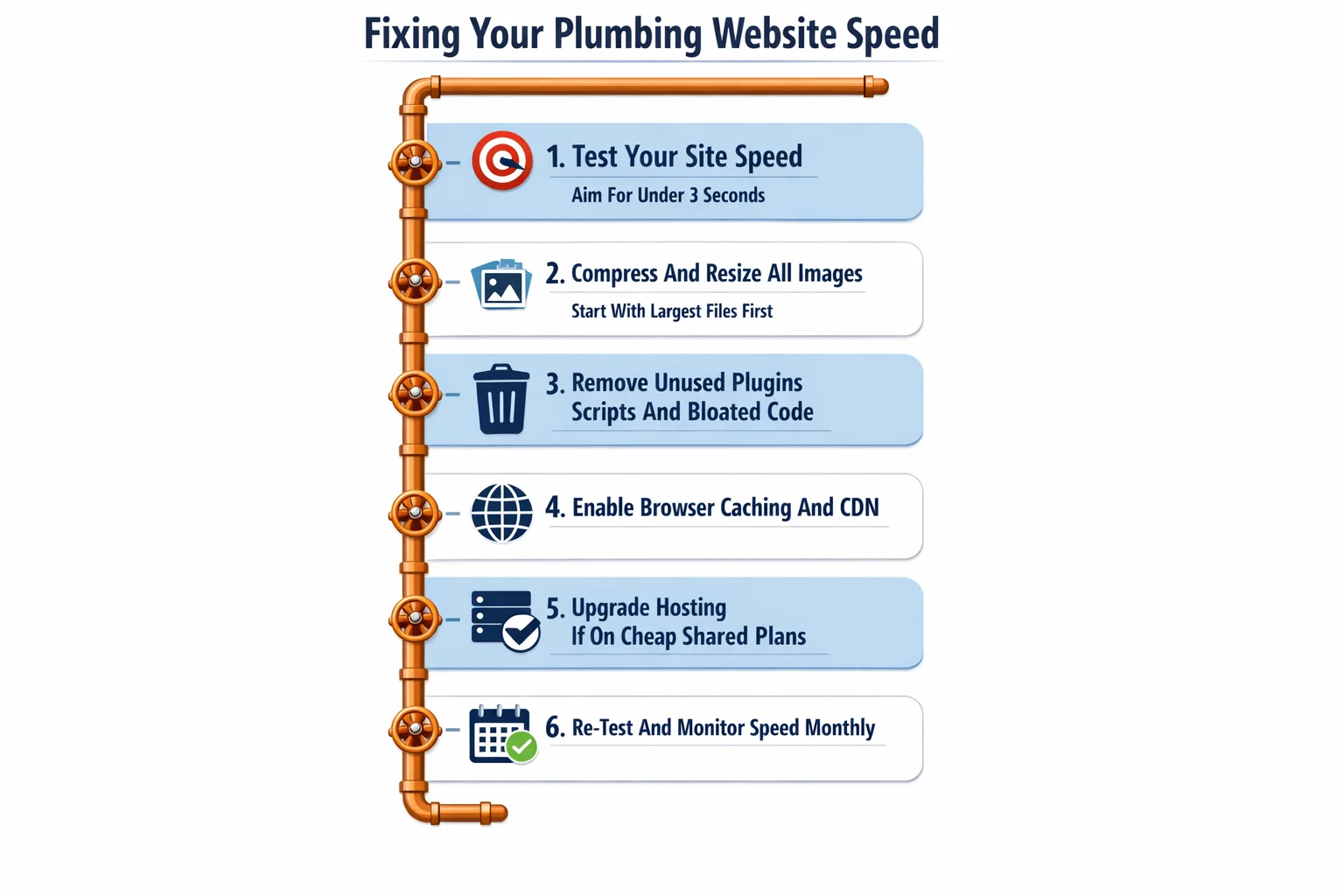
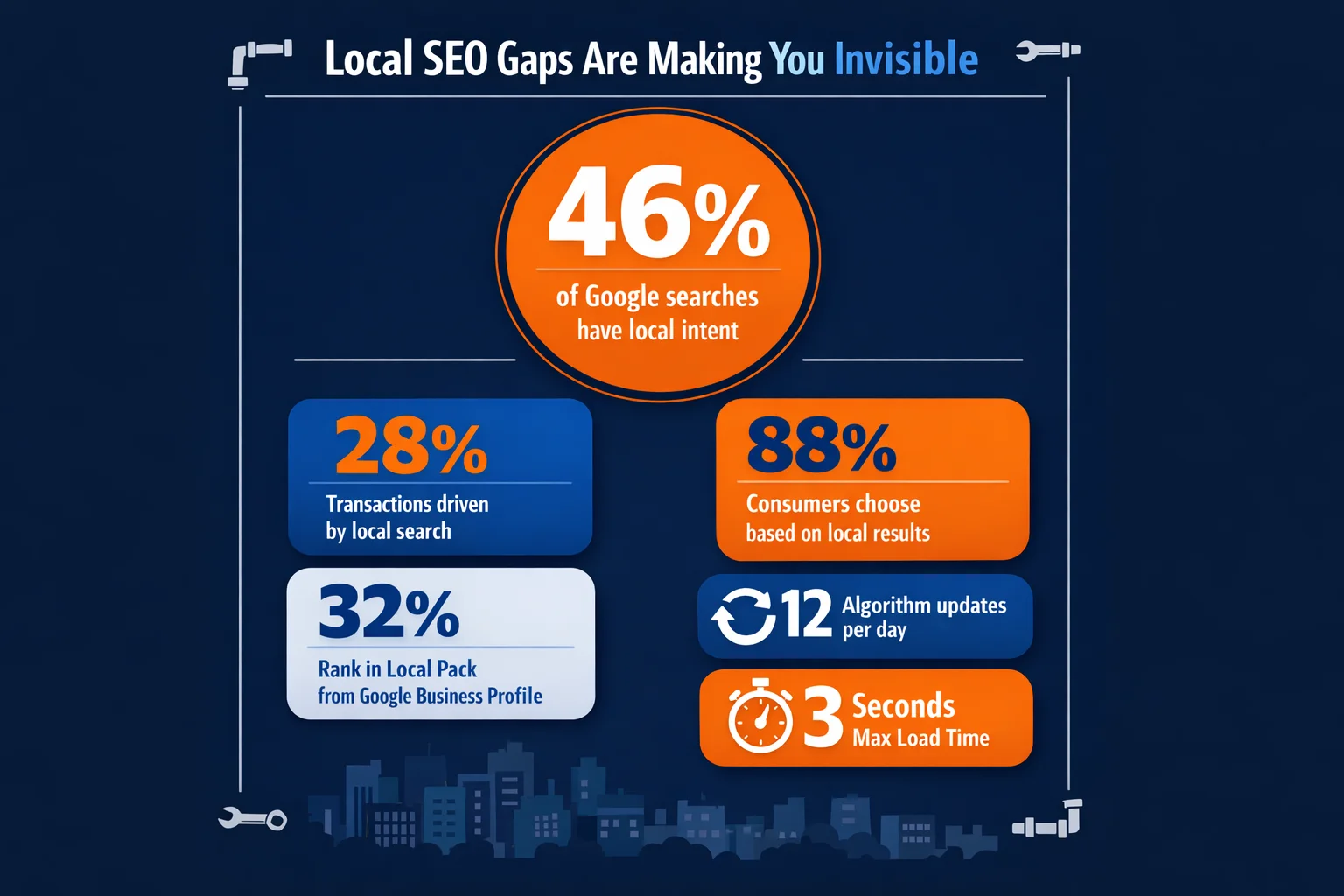
The three-second rule is unforgiving: if your site doesn't load within three seconds, visitors bounce. For someone dealing with a plumbing emergency, every second of that loading spinner feels like an eternity.
The most common culprits behind slow plumbing websites are entirely preventable:
- Oversized, uncompressed images — high-resolution photos of your team and work are great for trust, but they need to be properly compressed before uploading
- Bloated themes or page builders — many drag-and-drop website builders load enormous amounts of unnecessary code behind the scenes
- Cheap shared hosting — budget hosting means your site shares server resources with hundreds of other websites, slowing everyone down
- Excessive third-party scripts — chat widgets, tracking pixels, and social media embeds all add load time
The problem compounds itself: page speed is a confirmed Google ranking factor. A slow site doesn't just lose conversions — it loses search visibility too, meaning less traffic arriving at a site that was already failing to convert the traffic it had.
Start by running your site through a free speed testing tool to pinpoint exactly what's dragging you down. Quick wins include compressing images, enabling browser caching, using a content delivery network (CDN), and upgrading to quality managed hosting. These fixes are often inexpensive and deliver immediate, measurable results.
You're Talking About Yourself Instead of Your Customer's Problems
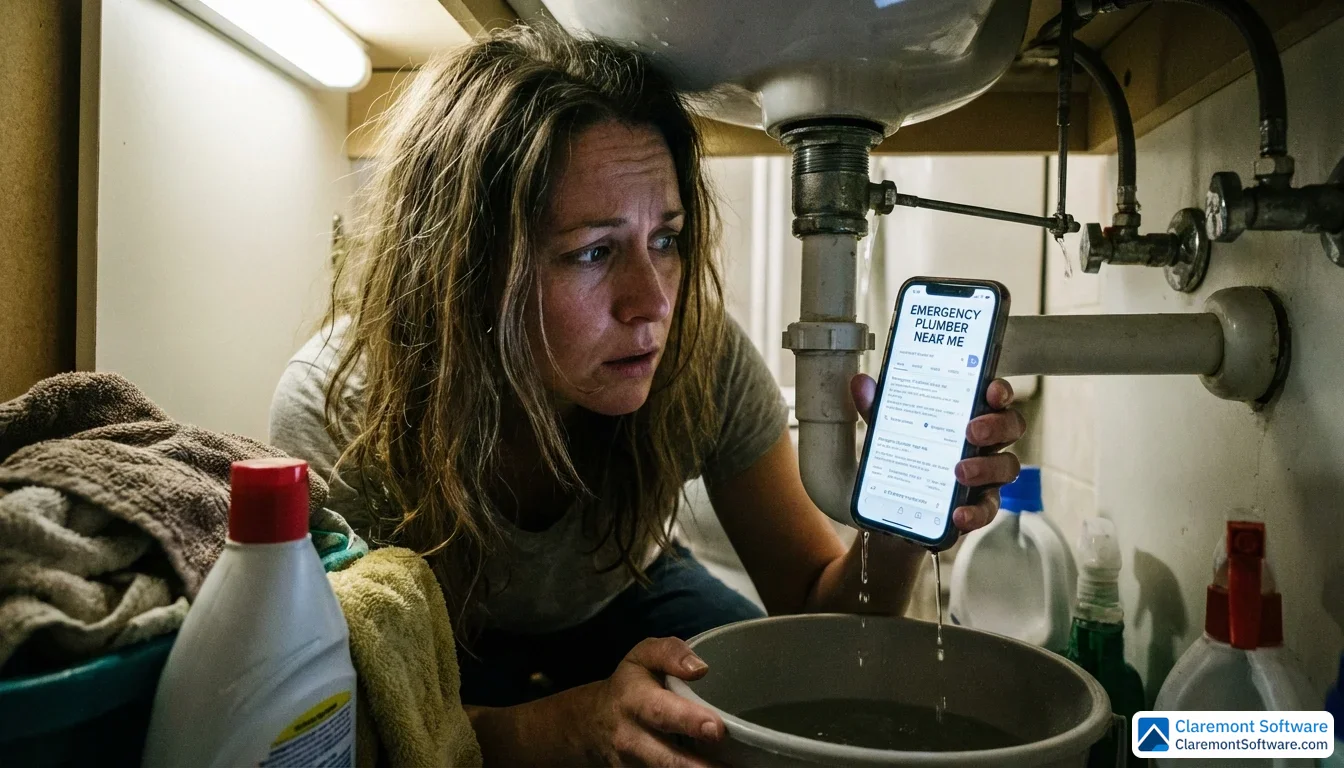
Here's a scenario that plays out on plumbing websites every single day: a homeowner lands on your site, reads "Family-owned and operated since 1987. We pride ourselves on quality workmanship and customer satisfaction," and immediately clicks away. Not because those things aren't true. Because none of it tells them what they actually need to know in that moment — can you fix my problem, and can you do it right now?
Most plumbing websites are written from the inside out. They lead with company history, list certifications, and describe equipment. But the homeowner who just discovered water pooling around their water heater at 9 PM doesn't care how long you've been in business. They care about one thing: will you solve my problem before this gets worse?
The best-converting plumbing websites flip this entirely. They lead with the customer's problem, not the company's story.
Instead of a hero section that reads "Serving the Greater Metro Area Since 1985," imagine landing on a page that says: "Burst Pipe Flooding Your Home? We'll Be There in 60 Minutes — Guaranteed." That headline speaks directly to the panic a homeowner is feeling. It acknowledges the urgency, offers a concrete solution, and makes a specific promise — all in one line.
Customer-centric copy does three things consistently:
- Names the pain point — it reflects the visitor's exact situation back at them so they feel immediately understood
- Acknowledges the urgency — it validates that this is a real problem that needs solving now, not eventually
- States a clear outcome — it tells the homeowner exactly what they'll get by calling you
When your copy fails to do these things, visitors bounce. Not because your plumbing skills are in question, but because they don't feel like your website is talking to them. High bounce rates on plumbing sites are rarely a design problem — they're almost always a messaging problem.
Go through every page of your site and ask: is this sentence about me, or about my customer? Rewrite accordingly. The shift is often small in effort but significant in results.
You're Missing Dedicated Service Pages
Think about how a homeowner actually searches for plumbing help. They don't type "plumbing services" into Google. They type "emergency water heater repair near me" or "drain cleaning cost" or "sewer line replacement how long does it take." They're searching for a specific solution to a specific problem — and if your website doesn't have a page dedicated to that exact service, you're invisible to them at the moment they're ready to call.
This is why a single generic "Our Services" page is one of the most damaging mistakes a plumbing website can make — both for conversions and for search rankings.
When every service you offer is crammed onto one page, two things happen. First, search engines struggle to understand what any individual page is actually about, which limits how well you rank for specific searches. Second, homeowners who land on a wall of services have to work to find what they need — and stressed, time-pressured people don't work. They leave.
The fix is straightforward: every service you offer needs its own dedicated page. Drain cleaning, water heater repair, sewer line replacement, leak detection, fixture installation — each one deserves its own URL, its own content, and its own call to action. These dedicated pages rank for the long-tail keywords that match exactly how homeowners search, giving you multiple entry points into Google's results instead of one.
Each service page should follow a consistent structure that converts:
- The problem — describe the issue the homeowner is experiencing in language they'd actually use
- Your solution — explain what you do, how you do it, and why your approach works
- What to expect — walk them through the process so there are no surprises, which reduces hesitation
- Pricing guidance — even a general range builds trust and filters for serious callers
- A strong call to action — make it effortless to take the next step
One important distinction worth building into your site architecture: emergency service pages and non-emergency service pages should be structured differently. A page for burst pipe repair needs to lead with urgency, display your phone number prominently above the fold, and minimize any friction between landing and calling. A page for water heater installation can take a more measured tone, include comparison information, and guide visitors toward scheduling a consultation. Matching the page's energy to the visitor's emotional state is what separates a site that converts from one that just informs.
Your Calls to Action Are Weak, Missing, or Buried
Even if your website loads fast, builds trust instantly, and has dedicated pages for every service you offer, it can still fail at the final moment — the moment when a visitor is ready to act but can't find a clear reason or pathway to do so. Weak, missing, or buried calls to action are the silent conversion killers that let warm leads slip away at the finish line.
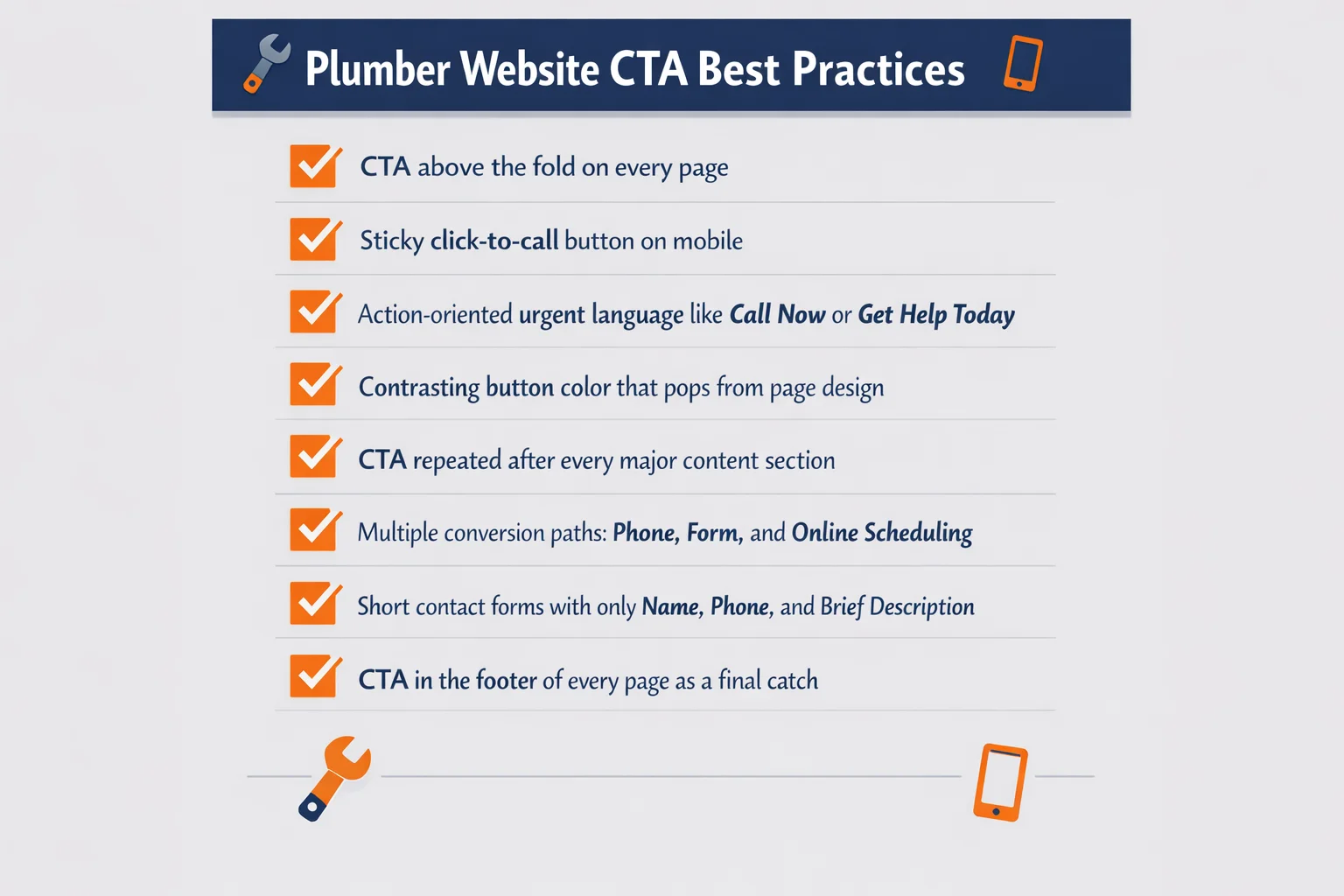
The first rule is simple: every page on your plumbing website needs a clear, repeated call to action — not just your homepage or contact page. A homeowner might land directly on your drain cleaning page from a Google search and never see your homepage at all. If that page doesn't tell them exactly what to do next, they'll figure it out on a competitor's site instead.
The language of your CTAs matters just as much as their placement. Generic phrases like "Contact Us" or "Learn More" create no urgency and inspire no action. Plumbing is an urgency-driven industry — your CTAs should reflect that. Phrases like "Call Now for Same-Day Service," "Get Your Free Estimate Today," or "Schedule Your Repair — We're Available 24/7" speak directly to what a stressed homeowner needs to hear in that moment.
Placement is equally critical. CTAs should appear:
- Above the fold — visible before a visitor scrolls a single pixel
- After key content sections — when you've just explained a problem and solution, that's the moment to prompt action
- At the bottom of every page — capture visitors who read all the way through
Your CTA buttons should also stand out visually. A button that blends into your color scheme gets ignored. Use a contrasting color that draws the eye naturally — if your site is blue and white, an orange or green button will stop the scroll.
Finally, not every visitor wants to call. Offer multiple conversion paths: a phone number for those ready to talk, a contact form for those who prefer to write, and consider adding online scheduling or live chat to capture visitors who are interested but not quite ready to pick up the phone. More pathways mean fewer leads lost.
No Social Proof or Reviews to Back Up Your Claims
Think about the last time you hired someone to work in your home. Chances are, you didn't just take their word for it — you looked for proof. Reviews, photos, references, something that confirmed other people had trusted this person and come out the other side satisfied. Your potential customers are doing exactly the same thing when they land on your plumbing website, and if they don't find that proof quickly, they move on to someone who has it.
The numbers back this up: 88% of consumers make plumbing service choices based on local search results, and reviews are one of the most influential factors in that decision. Yet many plumbing websites either skip reviews entirely or display a handful of generic, manually typed testimonials that read like they were written by the owner's cousin. Homeowners can spot fabricated social proof immediately, and it does more damage than having no reviews at all.
The solution is to pull live reviews directly from Google using an embedded widget or review feed. Dynamic, real-time reviews carry far more credibility than static quotes because visitors can see the dates, the star ratings, and the reviewer profiles — all signals that confirm the feedback is genuine.
Where you display reviews matters just as much as how you display them. Don't bury them on a single testimonials page that most visitors will never find. Instead:
- Feature reviews on your homepage where every visitor sees them immediately
- Add relevant reviews to each service page — a glowing review about your water heater repair work belongs on your water heater repair page, not just in a general pool
- Include reviewer names, star ratings, and service-specific details to maximize authenticity
Complement written reviews with before-and-after project photos. A short description alongside a compelling image — "Corroded pipe replaced in a 1960s home in under three hours" — gives homeowners concrete, visual evidence of your capabilities that no amount of copy can replicate.
Your Website Ignores Mobile Users

Picture this: a homeowner is standing in their kitchen, water spreading across the floor from a pipe that just let go under the sink. They grab their phone — not their laptop, not their tablet — their phone. They search for a plumber. They tap on your website. And then they wait. The text is tiny, the buttons are impossible to hit with a wet thumb, and the phone number is buried somewhere they can't find it.
They're gone in seconds. And so is that job.
This scenario plays out constantly, because the majority of plumbing searches happen on mobile devices — often in exactly these high-stress, hands-full moments when a homeowner needs help immediately. If your website isn't built for that experience, you're losing calls before they ever happen.
Here's the critical distinction: a mobile-responsive design is the baseline, not the finish line. Responsive design simply means your site shrinks to fit a smaller screen. True mobile optimization means the entire experience is built around how people actually use their phones — with their thumbs, under pressure, often with poor patience for anything that doesn't work instantly.
That means prioritizing:
- Thumb-friendly tap targets — buttons and links large enough to tap accurately without zooming in
- Click-to-call functionality — the phone number should dial automatically when tapped, with zero friction
- Simplified navigation — mobile menus should be clean, fast, and intuitive
- Fast load times — mobile connections are often slower than WiFi, making speed even more critical on phones
- Easy-to-complete forms — short fields, large input boxes, and minimal required information
Don't rely solely on browser resize tools to evaluate your mobile experience. Test your site on real devices — multiple phones, different screen sizes, different operating systems. What looks fine in a browser preview can be completely broken on an actual handset.
There's also a ranking dimension to this. Google uses mobile-first indexing, which means it crawls and evaluates your mobile site to determine your search rankings — not your desktop version. Your mobile site isn't a secondary consideration. It is your site, as far as Google is concerned. A poor mobile experience doesn't just cost you calls; it costs you visibility too.
Local SEO Gaps Are Making You Invisible
Here's a scenario that plays out every day: a homeowner searches "plumber near me," your competitor's name appears in the map results, and they get the call — even though you've been serving that same neighborhood for years. The problem often isn't your reputation or your pricing. It's that Google simply doesn't know enough about your business to show it.
Local SEO for plumbers is the engine that puts your website in front of people who are actively searching for a plumber in your area, and the gaps in most plumbing websites are significant. Consider the scale of the opportunity: 46% of all Google searches have local intent, and local search drives 28% of all business transactions for plumbing companies. That's not a niche channel — it's where the majority of your potential customers are looking right now.
The foundation of local SEO is something deceptively simple: NAP consistency. Your business Name, Address, and Phone number must be identical across your website, your Google Business Profile, and every directory listing where your business appears. Not similar — identical. Even minor formatting differences like "Street" versus "St." or "(555) 867-5309" versus "555-867-5309" can create conflicting signals that confuse search engines and quietly suppress your rankings. Audit every listing and standardize the format across the board.
Your Google Business Profile deserves special attention because it carries enormous weight — it accounts for 32% of Local Pack ranking factors, making it the single most powerful local SEO lever available to you. A half-completed profile is a missed opportunity. Fill in every field: services offered, business hours, service areas, photos of your team and trucks, and a compelling business description. Post updates regularly, respond to every review, and use the Q&A section proactively. An active, fully optimized profile signals to Google that your business is legitimate, current, and worth showing to searchers.
Beyond your profile, local citations and directory listings — Yelp, Angi, HomeAdvisor, the Better Business Bureau, and industry-specific directories — build the web of consistent business information that Google uses to verify your authority and relevance in a specific geographic area.
Finally, understand that local SEO is never finished. Google updates its algorithm approximately 12 times every single day, and the sites that maintain rankings are the ones that stay active — publishing fresh service content, earning new reviews, and keeping their business information current. Treat local SEO as an ongoing practice, not a one-time setup task, and it will continue paying dividends in calls and booked jobs long after the initial work is done.
How to Turn Your Plumbing Website Into a Call-Generating Machine
Everything covered in this guide — trust signals, phone visibility, page speed, customer-focused messaging, dedicated service pages, strong CTAs, social proof, mobile optimization, and local SEO — only matters if you actually do something with it. So here's how to move from diagnosis to results.
Start with an honest audit. Go through your website page by page and evaluate it against each issue covered here. Is your phone number prominent and clickable on mobile? Does your homepage load in under three seconds? Are your reviews visible without scrolling? Do you have dedicated pages for each service you offer? Write down every gap you find — you'll likely have more than you expect, and that's fine. Identifying the problems is the first step to fixing them.
Prioritize by impact. Not every fix carries equal weight. Making your phone number prominent, improving page speed, and adding clear calls to action are changes you can implement quickly and that often deliver immediate results. Start there before moving on to longer-term projects like building out service pages or overhauling your content strategy.
Set up proper tracking so you can measure what's working. Install call tracking software and connect your site to analytics so you know exactly how many calls and form submissions your website generates each week. Without this data, you're guessing. With it, you can make informed decisions about where to invest your time and budget.
Treat conversion optimization as an ongoing practice, not a one-time project. Test different headlines, CTA button colors, form lengths, and page layouts over time. Small improvements compound quickly.
The math here is straightforward: simple plumbing jobs run $200 to $500, and major projects can reach $5,000 or more. One additional call per week from a better-performing website pays for most optimization efforts within the first month. Pouring money into ads that send traffic to a site that doesn't convert is the most expensive mistake you can make. A complete plumber marketing system starts with a website that works — fix the foundation first, and every marketing dollar you spend afterward works harder.
Conclusion
Your plumbing website isn't failing because you lack skills, experience, or competitive pricing. It's failing because trust gaps, usability problems, and conversion barriers are quietly turning away homeowners who were ready to call. The good news: every issue covered in this guide is fixable.
You don't need to overhaul everything at once. Start with the highest-impact changes — make your phone number impossible to miss, speed up your load times, add real customer reviews, and rewrite your copy around your customer's problems instead of your company's history. Those changes alone can meaningfully move the needle within weeks.
Layer in dedicated service pages, stronger CTAs, and a fully optimized Google Business Profile, and you're building something that compounds over time — a website that works as hard as you do, generating calls even when you're on a job.
Every missed call represents a job worth $200 to $5,000 or more. Fixing your website isn't a marketing expense — it's one of the highest-return investments your plumbing business can make. See how our plumber web design service builds websites that actually convert. If you're not — it's one of the highest-return investments your plumbing business can make. If you're not sure where to start, Claremont Software specializes in building plumbing websites that actually convert.
Frequently Asked Questions
What is a good conversion rate for a plumbing website?
A good conversion rate for a plumbing website typically falls between 3% and 7%, meaning 3 to 7 out of every 100 visitors take a meaningful action — calling, submitting a form, or booking a job. High-performing plumbing sites with strong trust signals, fast load times, and clear calls to action can push past 10%. If your site is converting below 2%, that's a strong signal that something is broken — whether it's a buried phone number, slow load speed, weak copy, or a lack of social proof. Tracking conversions properly with call tracking software and analytics is the only way to know your real number.
How much should a plumber invest in a website that generates calls?
The right investment depends on your market size and growth goals, but a professionally built plumbing website typically ranges from $2,000 to $8,000 upfront (see our plumber web design plans starting at $297/mo), with ongoing maintenance and SEO running $300 to $1,500 per month. It's worth putting this in perspective: a single simple plumbing job is worth $200 to $500, and major projects like water heater replacements can reach $5,000. If a better website generates even one extra call per week, it pays for itself quickly. A cheap website that doesn't convert is far more expensive in the long run than a well-built one that consistently books jobs.
How do I know if my plumbing website is actually generating calls?
The most reliable way is to implement call tracking software, which assigns a unique phone number to your website so every call can be traced back to it. Pair this with Google Analytics (or a similar tool) to track form submissions and online bookings as conversion events. Your Google Business Profile also provides call data if your number is listed there. Simply asking new customers "How did you find us?" is a low-tech but useful supplement. Without proper tracking in place, you're essentially guessing — and you can't improve what you can't measure.
Should I use a website template or get a custom design for my plumbing business?
Templates can be a cost-effective starting point — there are hundreds of plumbing-specific options available on platforms like ThemeForest — but they come with real limitations. Templates are built for general use, not for conversion optimization specific to plumbing. They can be slow, hard to customize, and may look identical to competitors' sites. A custom-designed website built around your brand, your service area, and proven conversion principles will almost always outperform a template in the long run. If budget is tight, a quality template with professional customization is a reasonable middle ground — just don't sacrifice speed, mobile usability, or clear calls to action in the process.
How often should I update my plumbing website content?
You should aim to update your plumbing website content at least once a month, and more frequently if you're actively pursuing SEO growth. Google rewards websites that stay active and relevant with more frequent indexing and stronger ranking signals. Practical updates include publishing new blog posts or seasonal tips, refreshing service pages with current pricing guidance, adding new customer reviews, and updating photos of recent jobs. At minimum, audit your site quarterly to ensure all information — hours, service areas, phone numbers, and licensing details — is accurate. Outdated information doesn't just hurt SEO; it actively destroys trust with potential customers.
Do I need a separate landing page for my plumbing PPC ads?
Yes — sending paid ad traffic to your homepage is one of the most common and costly mistakes plumbers make with PPC campaigns. A dedicated landing page matches the exact message of your ad, removes distractions like full navigation menus, and focuses the visitor on a single action: calling or submitting a form. For example, an ad for "emergency drain cleaning" should lead to a page specifically about emergency drain cleaning — not a generic homepage. Dedicated landing pages consistently outperform homepages for paid traffic because they maintain message continuity and reduce friction. The result is a lower cost per lead and a higher return on your ad spend.
How important is pricing transparency on a plumbing website?
Pricing transparency is a significant trust builder, even if you can't publish exact prices. Homeowners are wary of surprise charges, so acknowledging this concern on your website works in your favor. You don't need to list a price for every job — plumbing costs vary too much for that to be practical — but including ballpark ranges for common services (e.g., drain cleaning, water heater replacement), explaining your diagnostic or service call fee, and clearly stating that you provide upfront quotes before any work begins all help reduce hesitation. Competitors who hide all pricing information create anxiety; you can stand out simply by being more upfront than they are.
Can live chat or chatbots help my plumbing website generate more leads?
Yes, live chat and chatbots can meaningfully increase leads by capturing visitors who aren't ready to call but are willing to type a quick question. This is especially valuable for non-emergency inquiries where a homeowner wants a quote or has a question before committing. A well-configured chatbot can qualify leads, collect contact information, and even book appointments 24/7 — including outside business hours when calls go unanswered. For plumbing businesses, the key is making sure the chat option complements your phone number rather than replacing it. Emergency visitors will always want to call; chat captures the ones who might otherwise leave without converting.