Boost your law firm's online visibility and client conversion with proven attorney website optimization tips. Focus on law firm website SEO, mobile optimization, strategic content writing, Core Web Vitals, schema markup, and clear CTAs to attract and retain clients effectively. Website optimization for lawyers isn't optional — it's the difference between generating leads and losing them to competitors. To see what optimized sites look like in practice, explore the best lawyer websites from solo and small firms winning clients online.
Why Attorney Website Optimization Tips Matter for Your Law Firm's Success

Attorney website optimization tips are strategies that help law firms improve online visibility, attract qualified leads, and convert visitors into clients. If your firm isn't on the first page of Google, you are losing clients to competitors who rank higher.
Quick Answer: Top Attorney Website Optimization Tips
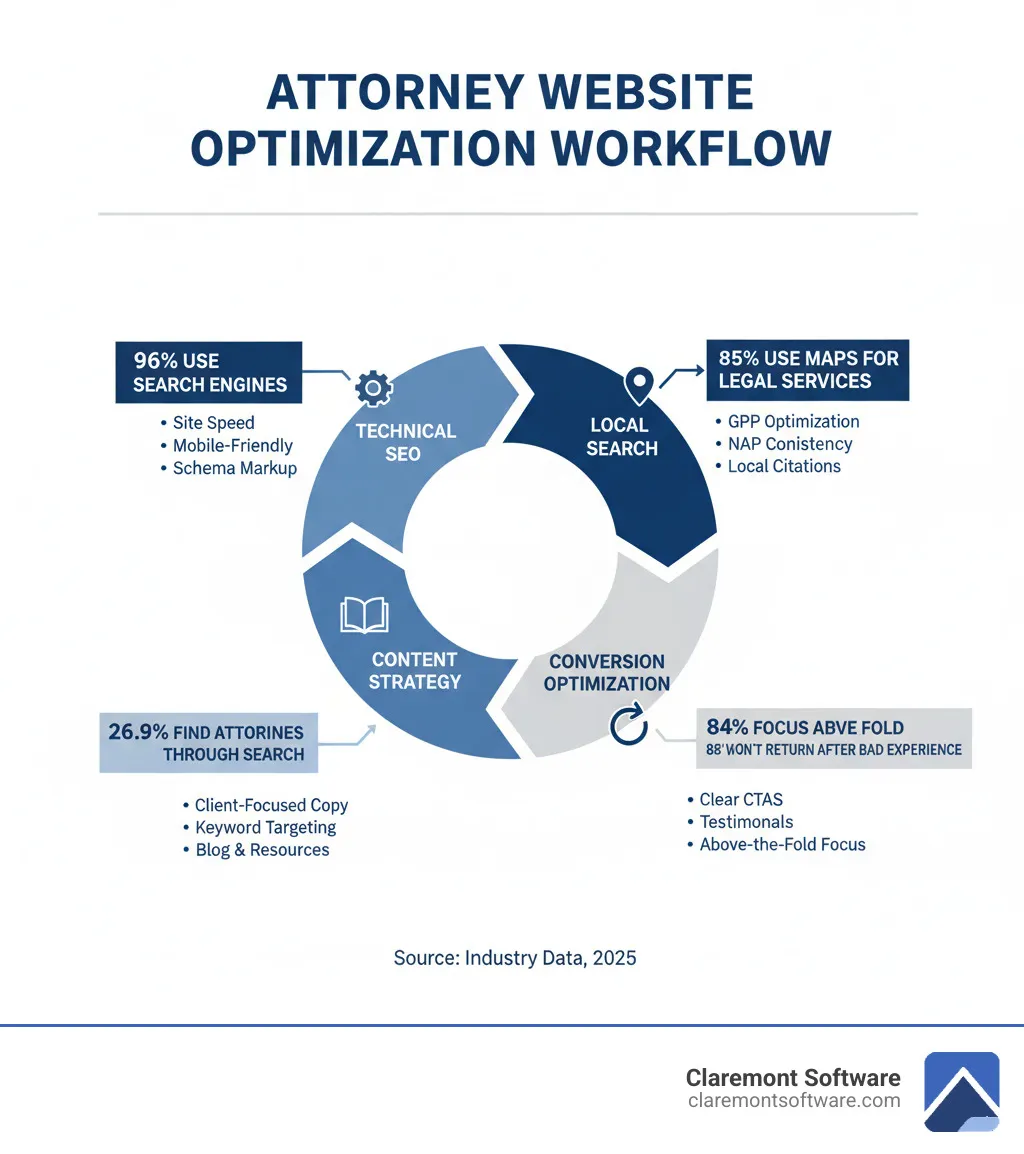
- Optimize above-the-fold content — 84% of visitors never scroll down
- Prioritize mobile-friendly design — Most legal searches happen on mobile
- Focus on local SEO — Claim your Google Business Profile and maintain NAP consistency
- Create client-focused copy — Address pain points, not just services
- Build social proof — Display testimonials, case results, and reviews
- Improve site speed — Slow sites lose 88% of visitors permanently
- Use strategic keywords — Target geo-specific, long-tail search terms
- Implement clear CTAs — Make it easy for visitors to contact you
- Add schema markup — Help search engines understand your content
- Track your metrics — Monitor organic traffic, rankings, and conversions
With 96% of people using search engines for legal advice, your website is your most valuable lead generation tool. However, many attorneys have websites that are either invisible on search engines or fail to convert visitors. Effective website optimization for lawyers requires a dual focus on visibility (technical and local SEO) and conversion (user experience and content strategy).
Investing in law firm website SEO isn't a luxury — it's a necessity. Firms that treat their website as an afterthought are effectively handing clients to competitors who've invested in a strong digital presence. This guide breaks down what works, providing actionable attorney website optimization tips to help you compete more effectively online, regardless of your firm's size or budget.
Mastering First Impressions and User Experience
Your website has about three seconds to convince a visitor you can help them. A poor user experience is costly: 88% of people will not return to a site after a bad first experience. With Google's mobile-first indexing now standard, your site must be flawless on every device, as potential clients are often searching on their phones during a crisis.
Think of your website as your digital reception area. It must be clear, welcoming, and easy to steer.

Optimize Above the Fold for Immediate Impact
"Above the fold" is what visitors see without scrolling. Since 84% of people focus on this area, it's your most valuable real estate. It must include:
- A Clear Headline: Instantly state what you do and who you serve (e.g., "Personal Injury Lawyers Serving Lake County, IL").
- Your Unique Value Proposition: Answer "Why you?" Do you offer evening consultations, speak multiple languages, or have a specific success rate?
- An Obvious Call to Action (CTA): A clickable phone number or a prominent "Schedule Free Consultation" button.
Prioritize Client-Focused Copy Over Flashy Design
Great design can't save bad copy. Avoid legal jargon and speak directly to your client's pain points. Instead of listing services, show empathy: "Been injured in a car accident and dealing with difficult insurance companies?" This approach, seen on sites like attorney Stewart Guss's, focuses on benefits over features, building trust much faster than a list of credentials. This is one of the most powerful attorney website optimization tips you can implement.
Law Firm Mobile Optimization: A Non-Negotiable
Law firm mobile optimization isn't optional — it's the foundation of your entire digital strategy. Google uses mobile-first indexing, meaning it primarily evaluates the mobile version of your site for rankings. If your mobile experience is subpar, your desktop rankings suffer too.
Most legal searches happen on mobile devices, often during high-stress moments — after an accident, during a custody dispute, or when facing criminal charges. Your site needs to perform flawlessly when it matters most.
- Responsive Design: Your site should automatically adapt to any screen size, with readable text and tappable buttons (minimum 44×44 pixels for touch targets).
- Click-to-Call: Ensure phone numbers are clickable on mobile devices. A prominent tap-to-call button can dramatically increase consultation requests.
- Simplified Navigation: Use a clean hamburger menu with clear practice area links. Mobile visitors shouldn't need to pinch, zoom, or hunt for information.
- Font Sizing: Body text should be at least 16px to prevent browser zoom on mobile Safari and Chrome.
- Form Optimization: If your contact form requires scrolling through 10 fields on a phone, you'll lose leads. Keep mobile forms to 3–5 fields maximum.
Test your entire user journey on multiple devices. A frustrating mobile experience means lost clients — 88% of users won't return after a bad experience. Learn more about Mobile First Design.
Law Firm Website Speed and Core Web Vitals
Law firm website speed directly impacts both your search rankings and your conversion rate. Google's Core Web Vitals are measurable performance metrics that factor into rankings, and they matter more than ever for law firm websites.
The three Core Web Vitals every law firm should track:
- Largest Contentful Paint (LCP): How quickly the largest visible element loads. Aim for under 2.5 seconds. Hero images and large banners are common culprits for slow LCP on law firm sites.
- Interaction to Next Paint (INP): How responsive your site feels when users click or tap. Contact forms, navigation menus, and chat widgets should respond instantly — under 200 milliseconds.
- Cumulative Layout Shift (CLS): How stable your page layout is as it loads. Nothing frustrates visitors more than clicking a "Call Now" button only to have it jump as an ad loads above it. Keep CLS under 0.1.
Common speed killers on law firm websites include unoptimized hero images, too many third-party scripts (chat widgets, analytics, retargeting pixels), render-blocking CSS, and uncompressed video backgrounds. Use PageSpeed Insights to diagnose specific issues and prioritize fixes that will have the greatest impact on performance.
Avoid Intrusive Pop-ups and Use Better Alternatives
Aggressive, full-screen pop-ups frustrate users and increase your bounce rate. Instead of interrupting visitors, use smarter lead capture methods:
- Exit-Intent Pop-ups: Appear only when a user is about to leave.
- Slide-in CTAs: Emerge from the corner after a user has engaged with the page.
- In-line Forms: Integrate naturally within your content for a seamless experience.
The goal is to make engagement an easy choice, not a forced interruption.
Law Firm Website Content and Authority Building
Quality law firm website content is what keeps potential clients on your site and builds their confidence. For law firms, this means demonstrating E-E-A-T (Experience, Expertise, Authoritativeness, and Trustworthiness), a framework Google uses to evaluate content quality. You're already an expert; your website needs to prove it.
Effective law firm website content writing goes beyond simply describing your services. It means creating comprehensive, helpful resources that address your clients' real questions and concerns at every stage of their legal journey. When combined with quality backlinks and strong social proof, this strategy establishes your site as a go-to resource. Our SEO Services are designed to help law firms build this authority.
Strategic Keyword Usage: Attorney Website Optimization Tips
Keywords are the phrases potential clients use on Google. Effective keyword strategy is about understanding search intent — the 'why' behind a search.
- Informational Intent: Someone searching "what is a DUI" needs educational content.
- Commercial Intent: Someone searching "DUI lawyer Gurnee IL" is ready to hire.
Focus on long-tail keywords (e.g., "estate planning for small business owners Libertyville IL") and geo-targeted keywords (e.g., "family law attorney Lake County"). These attract highly qualified visitors. We use tools like Google Keyword Planner, Semrush, and Ahrefs to find these terms and integrate them naturally into your content.
Law Firm Website SEO: On-Page Essentials
Strong law firm website SEO starts with on-page fundamentals — the elements you directly control on every page of your site. Many attorneys overlook these basics, which is why even small improvements can yield significant ranking gains.
- Title Tags: Every page needs a unique, compelling title tag (~60 characters) that includes your primary keyword and location. "Personal Injury Lawyer Gurnee, IL | Free Consultation" outperforms generic titles like "Home | Smith Law Firm."
- Meta Descriptions: Write action-oriented meta descriptions (~155 characters) that include your keyword and a clear value proposition. This is your ad copy in search results — make it count.
- Header Hierarchy: Use one H1 per page (your main topic), followed by H2s for major sections and H3s for subtopics. This structure helps search engines understand your content and improves accessibility.
- Internal Linking: Link between related practice area pages, blog posts, and your contact page. If your personal injury page mentions car accidents, link to your dedicated car accident page. Internal links distribute authority and keep visitors engaged longer.
- Image Optimization: Use descriptive alt text that includes relevant keywords (e.g., "personal injury lawyer reviewing case documents" rather than "IMG_4532"). Compress images to under 100KB where possible and use modern formats like WebP.
- URL Structure: Keep URLs clean and descriptive:
/personal-injury-lawyer-gurnee/beats/page?id=47&cat=3.
Consistent on-page law firm website SEO across your entire site sends clear signals to Google about what you do, where you practice, and who you serve.
Law Firm Website Content Writing That Converts
Not every visitor is ready to hire you immediately. Effective law firm website content writing addresses every stage of the client journey, from awareness to decision.
- Top of Funnel (Awareness): Answer basic questions with blog posts (e.g., "What to Do After a Car Accident?"). This builds trust and establishes expertise.
- Middle of Funnel (Consideration): Provide detailed practice area pages and FAQs to help potential clients evaluate their options. Address common objections and explain what to expect from the legal process.
- Bottom of Funnel (Decision): Use attorney bios, client testimonials, and case results to show why your firm is the right choice. Make it easy for them to contact you.
The best law firm website content doesn't read like a legal brief. It speaks in plain language, addresses the reader directly ("you" and "your"), and anticipates the questions someone in a difficult situation would actually ask. Content that combines legal authority with genuine empathy consistently outperforms dry, credential-heavy copy.
Improve Social Proof to Build Credibility
What others say about your firm is more persuasive than what you say about yourself. Since 43% of people use referrals, online social proof is your digital word-of-mouth.
- Testimonials & Case Results: Showcase stories and results from satisfied clients (while adhering to state bar rules).
- Awards & Recognitions: Display honors from Super Lawyers, bar associations, or media outlets.
- Attorney Bios: Go beyond a résumé. Share professional photos and details that create a personal connection.
- Online Reviews: Encourage reviews on your Google Business Profile and respond professionally to all feedback.
Managing your online reputation is a critical attorney website optimization tip. While referrals are great, they are often not enough on their own.
Getting Found: Technical and Local SEO for Law Firms
Even the best website is useless if clients can't find it. Technical and local SEO ensure your firm is visible when potential clients search on Google. Your goal is to make it easy for search engines to understand, trust, and recommend your site.
This is critical, as 85% of people use online maps to find legal service locations. If you're not in the map results or on the first page, you're invisible to most potential clients.
Technical SEO Essentials: Attorney Website Optimization Tips
Technical SEO is the foundation of your website's visibility. It ensures search engines can crawl and index your site effectively. Here are the essentials:
- Site Speed: Your site should load in under 3 seconds. Slow sites lose visitors. Use PageSpeed Insights to check your performance.
- SSL Certificate (HTTPS): The padlock icon in the browser bar signals a secure site, which is essential for building trust and for rankings.
- XML Sitemap: This file acts as a roadmap for search engines, helping them find all your important pages. Ensure it's submitted to Google Search Console. Learn more about how sitemaps work.
- Title Tags & Meta Descriptions: These are your first impression in search results. The title tag (~60 characters) and meta description (~160 characters) must be compelling and include your primary keyword.
- Canonical Tags: Prevent duplicate content issues by specifying the preferred version of each page, especially if you have similar practice area pages across multiple locations.
Following Google's Webmaster Guidelines is non-negotiable. Avoid common pitfalls by reviewing these 5 Common SEO Mistakes Local Businesses Make and How to Fix Them.
Law Firm Schema Markup for Enhanced Search Visibility
Law firm schema markup is structured data you add to your website's code that helps search engines understand your content in a machine-readable way. When implemented correctly, schema can earn your site rich results — enhanced search listings with star ratings, business hours, FAQs, and more — that dramatically improve click-through rates.
Key schema types every law firm should implement:
- LocalBusiness / LegalService: Tell Google your firm name, address, phone, hours, and practice areas. This directly supports your local SEO and Google Business Profile.
- Attorney (Person): Mark up individual attorney profiles with credentials, education, bar admissions, and practice areas. This strengthens E-E-A-T signals.
- FAQPage: If your practice area pages include FAQs (they should), FAQPage schema can display those Q&As directly in search results, taking up more real estate on the page.
- Review / AggregateRating: Display star ratings in search results from client reviews (ensure compliance with your state bar's advertising rules).
- BreadcrumbList: Help search engines understand your site hierarchy and display breadcrumb navigation in results.
- Article / BlogPosting: For blog content, article schema helps Google understand authorship, publication dates, and content topics.
You can validate your law firm schema markup using Google's Rich Results Test tool. While schema alone won't skyrocket your rankings, it makes your search listings more compelling and improves how search engines interpret your site — a meaningful competitive advantage when most law firms still don't use it.
Law Firm Website Security and Trust Signals
Law firm website security isn't just about protecting data — it's a ranking factor and a trust signal that directly impacts whether potential clients feel safe contacting you. Attorneys handle sensitive information, and your website must reflect that level of care.
- SSL/TLS Certificate (HTTPS): This is the absolute baseline. Google has confirmed HTTPS as a ranking signal, and browsers now flag HTTP sites as "Not Secure." If potential clients see that warning before they even reach your homepage, many won't proceed.
- Privacy Policy: A clear, accessible privacy policy is legally required in many jurisdictions and signals professionalism. Explain how you handle form submissions, consultations, and client data.
- Trust Badges: Display bar association memberships, Super Lawyers badges, Martindale-Hubbell ratings, and client review platform logos. These visual cues provide instant credibility.
- Secure Contact Forms: Use encrypted form submissions and display a brief note like "Your information is protected and confidential." Visitors are more likely to share sensitive case details when they feel secure.
- Regular Security Audits: Keep your CMS, plugins, and dependencies up to date. A hacked law firm website is a reputation disaster — and Google will flag compromised sites in search results.
Security and trust go hand-in-hand for law firms. Every trust signal you add removes a barrier between a potential client and that initial consultation request.
Dominate Your Area with Local SEO
Local SEO helps you appear when someone in your community needs a lawyer. For firms in Gurnee, Libertyville, or Lake County, this is how you connect with clients ready to hire.
- Google Business Profile (GBP): This is your most powerful local SEO tool. Claim your Google My Business listing and fill out every section with photos, correct categories, and active Q&As. Respond to all reviews.
- NAP Consistency: Your Name, Address, and Phone number must be identical across all online directories.
- Citations: Get listed on legal directories like Justia, as well as general business directories.
- Location-Specific Pages: Create dedicated pages for each community you serve (e.g., "Personal Injury Lawyer Gurnee") with localized content.
- Local Link Building: Earn links from other local businesses, charities, or news sites to signal community involvement.
This targeted approach to local SEO is how smaller firms can effectively compete for local clients.
Law Firm Conversion Optimization: Turning Visitors into Clients
Website traffic is only valuable if it converts into new clients. Law firm conversion optimization is the practice of systematically improving your site so a higher percentage of visitors take action — calling your office, filling out a form, or scheduling a consultation. The true success of attorney website optimization tips is measured by this conversion rate, not just traffic numbers.
Your website should be a 24/7 salesperson, guiding potential clients to take action. Even small improvements in conversion rate can mean significant revenue growth. Increasing your conversion rate from 2% to 4% effectively doubles your leads without spending a single additional dollar on marketing.
Implement Clear and Effective Calls to Action (CTAs)
A Call to Action tells visitors what to do next. Without clear CTAs, even interested visitors may leave. Effective CTAs are direct and action-oriented.
- Use strong verbs: "Contact Us for a Free Consultation" or "Call Now."
- Placement is key: Include a primary CTA above the fold and repeat it throughout your pages.
- Design for attention: Use contrasting colors and make buttons large enough for easy tapping on mobile devices.
- Test and refine: Use A/B testing to see which button text, color, or placement drives the most conversions.
Rethink Website Forms for Higher Engagement
Standard "Name, Email, Message" forms are impersonal and have low engagement. Innovative firms are using interactive tools that provide immediate value in exchange for contact information.
- Interactive Calculators: A case value calculator for personal injury firms gives users instant information and provides you with a qualified lead.
- Quizzes and Assessments: A "Do I have a case?" quiz educates visitors while capturing their details.
- Multi-Step Forms: Breaking a long form into smaller, manageable chunks with a progress bar significantly increases completion rates.
This principle of reciprocity — giving value first — improves both the quantity and quality of your leads. The best law firm conversion optimization strategies prioritize making it easy and comfortable for potential clients to reach out.
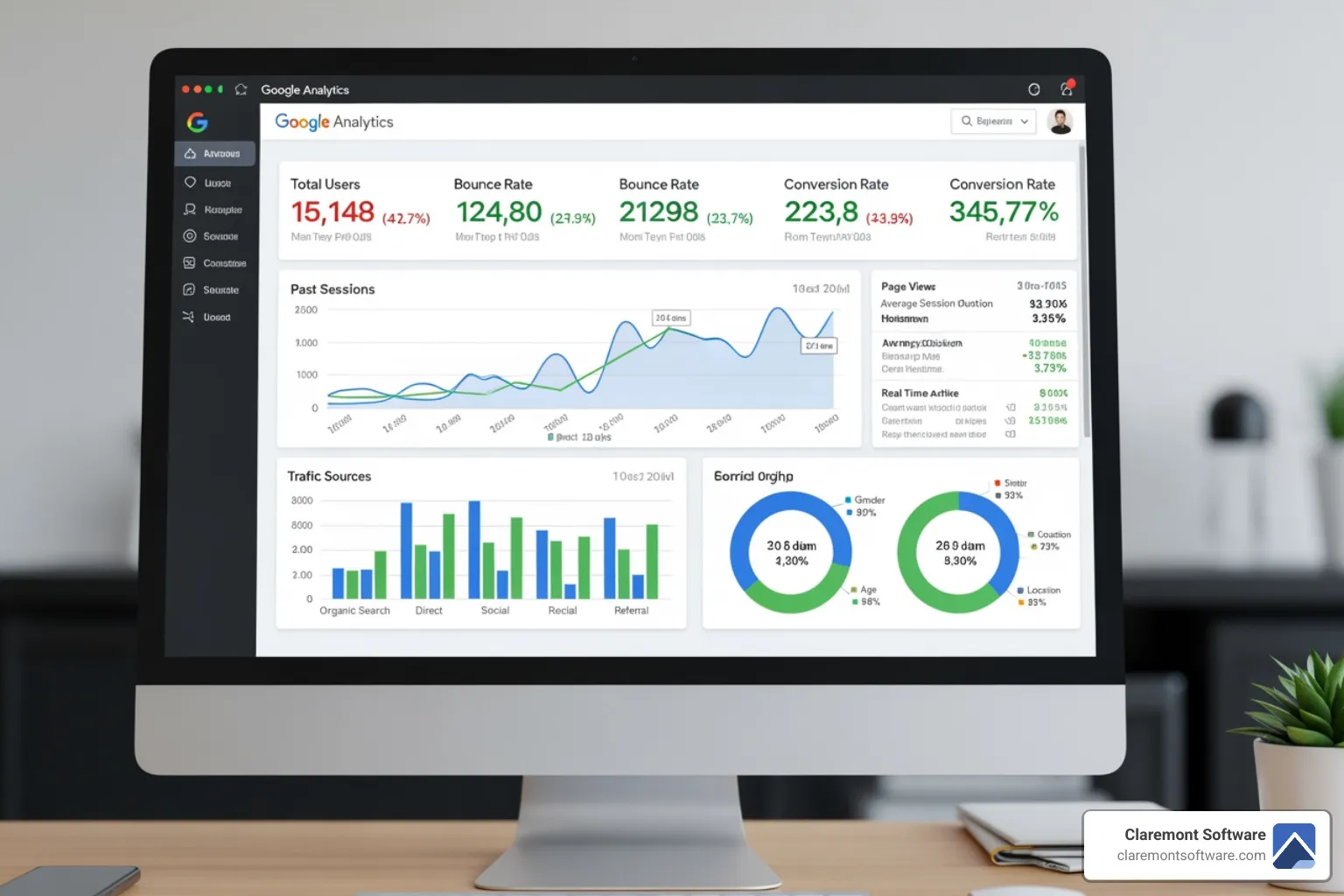
Track Your KPIs to Measure SEO Success
You can't improve what you don't measure. Tracking Key Performance Indicators (KPIs) shows whether your website is delivering a return on investment.
- Organic Traffic: How many people find you via search engines.
- Keyword Rankings: Where you appear for your target search terms.
- Click-Through Rate (CTR): The percentage of people who click your listing in search results.
- Conversion Rate: The percentage of visitors who contact you. This is a critical metric.
- Bounce Rate: The percentage of visitors who leave after viewing only one page.
Use Google Analytics to track these metrics. Setting up conversion goals allows you to see exactly which pages and keywords are generating consultations, turning your optimization efforts into a measurable investment.
Law Firm Website Best Practices: Your Complete Checklist
Implementing law firm website best practices can feel overwhelming, but a systematic approach ensures nothing falls through the cracks. Use this checklist to audit your current site and prioritize improvements that will have the greatest impact.
Design & User Experience
- Clear value proposition visible above the fold
- Click-to-call button prominent on mobile
- Professional photography (avoid generic stock photos)
- Consistent branding across all pages
- Accessible navigation with practice areas easy to find
Content & SEO
- Unique, keyword-optimized title tags and meta descriptions for every page
- Dedicated page for each practice area with 800+ words of helpful content
- Regular blog posts addressing common client questions
- Attorney bios with professional photos, credentials, and personal details
- Internal links connecting related pages across your site
Technical Performance
- Page load time under 2.5 seconds (test with PageSpeed Insights)
- Mobile-responsive design that passes Google's mobile-friendly test
- HTTPS enabled with a valid SSL certificate
- XML sitemap submitted to Google Search Console
- Schema markup (LocalBusiness, Attorney, FAQPage) properly implemented
Conversion & Lead Generation
- Contact form on every page (or accessible within one click)
- Multiple contact options: phone, form, email, and live chat
- Client testimonials and case results prominently displayed
- Trust badges: bar memberships, awards, review platform ratings
- Google Analytics configured with conversion tracking
These law firm website best practices represent the standard that top-performing attorney websites maintain. You don't need to tackle everything at once — start with the items that address your site's biggest weaknesses and work through the list systematically.
Frequently Asked Questions about Attorney Website Optimization
What is the difference between traditional SEO and the Search Generative Experience (SGE)?
Traditional SEO focuses on ranking your web pages in Google's list of blue links. SGE, or Search Generative Experience, is Google's AI-powered feature that creates a snapshot answer, or "AI Overview," at the very top of the search results. It synthesizes information from multiple sources, including your website, reviews, and Google Business Profile. SGE does not make traditional SEO obsolete; it makes high-quality, authoritative content more important than ever, as the AI favors well-optimized sources for its information.
How long does it take for law firm SEO to work?
SEO is a marathon, not a sprint. While some quick wins are possible, most law firms begin to see meaningful, compounding results within 6 to 12 months. The exact timeline depends on factors like the competitiveness of your practice area and location, your website's current authority, and the consistency of your efforts. The work you do today builds on itself, creating a long-term asset that continues to generate leads for years.
How much should a law firm budget for SEO?
SEO costs vary widely based on your approach (in-house, freelancer, or agency) and the scope of the project. Monthly agency retainers can range from $500 to $5,000+. The most important thing is to view SEO as an investment, not an expense. Unlike paid ads that stop when you stop paying, SEO builds a sustainable lead generation engine for your firm. Over time, it lowers your client acquisition cost and delivers a significant return on investment by consistently attracting qualified clients.
Why is mobile optimization so important for law firm websites?
Google uses mobile-first indexing, meaning the mobile version of your site is what primarily determines your search rankings. Beyond rankings, the majority of legal searches happen on mobile devices — often during urgent situations. If your site is slow, hard to navigate, or difficult to read on a phone, potential clients will leave and contact a competitor instead. Law firm mobile optimization directly impacts both your visibility in search results and your ability to convert visitors into consultations.
What is schema markup and does my law firm need it?
Law firm schema markup is structured data code added to your website that helps search engines understand your content more precisely. For law firms, it can display rich results in Google — like star ratings, business hours, FAQ answers, and attorney credentials — directly in search listings. While not a direct ranking factor, schema makes your search results more visually compelling and informative, leading to higher click-through rates. Most law firm websites don't use schema yet, which means implementing it gives you a notable competitive edge.
Conclusion
Effective attorney website optimization tips are about building a digital asset that works as hard as you do. A well-optimized website connects you with clients in Gurnee, Libertyville, and throughout Lake County, IL, at the exact moment they need legal help. It's your 24/7 representative, building trust and generating leads while you focus on practicing law.
We've covered the essentials: mastering user experience, law firm mobile optimization, creating authoritative content with strategic law firm website content writing, ensuring technical and local SEO are sound with proper law firm schema markup and law firm website security, and converting visitors into clients through proven law firm conversion optimization techniques. This is a long-term investment that builds authority and creates a consistent stream of qualified leads, with results that compound over time.
The firms that win online aren't necessarily the biggest — they're the ones that take website optimization for lawyers seriously and execute consistently. For web design inspiration from firms that have nailed all three pillars, see our curated gallery of standout law firm websites. Every improvement you make — from faster page speeds to better content to cleaner schema — moves you closer to dominating your local market.
If you're ready to implement these strategies but lack the time or expertise, we can help. At Claremont Software, we specialize in creating professional, mobile-friendly websites that deliver measurable ROI. We build websites designed to be profitable investments that prevent lost revenue to higher-ranking competitors.
Ready to transform your website into a powerful lead generation engine? Explore our Web Development Services to build a website that drives measurable ROI. Let's create a site that brings in the clients your firm deserves.