Discover how custom web applications, tailored to your business, enhance efficiency, customer experience, and scalability. Learn key benefits, processes, and technologies to build solutions that fit your unique workflows and drive long-term success.
Why Your Business Needs More Than a Standard Website

Custom web application development is the process of creating interactive software that runs in a web browser, designed specifically to solve your unique business challenges. Unlike static websites that simply display information, custom web applications allow users to input data, perform tasks, automate workflows, and process information in real-time.
Quick Answer: What Makes Custom Web Application Development Different?
- Interactive functionality - Users can create, read, update, and delete data (CRUD operations).
- Browser-based access - No downloads required; works across all devices.
- Custom to your business - Built around your specific workflows and processes.
- Scalable and secure - Grows with your business and protects your data.
- Full ownership - You control all features, updates, and integrations.
In today's digital economy, generic, off-the-shelf solutions often fall short. They force you to adapt your processes to fit their rigid frameworks, costing you time and competitive advantage. Custom web applications flip that script entirely—the technology adapts to your business, not the other way around.
The global custom software market is projected to grow at 22.5% annually through 2030 because businesses that invest in custom solutions see measurable returns. These include increased efficiency, higher conversion rates, and significant cost savings by eliminating unnecessary features and licensing fees.
From custom ticket sales systems to automated internal processes, these solutions are competitive differentiators that directly impact your bottom line. This guide will walk you through everything you need to know about custom web application development, from initial concept to long-term success.
Understanding Custom Web Applications: What, Why, and How
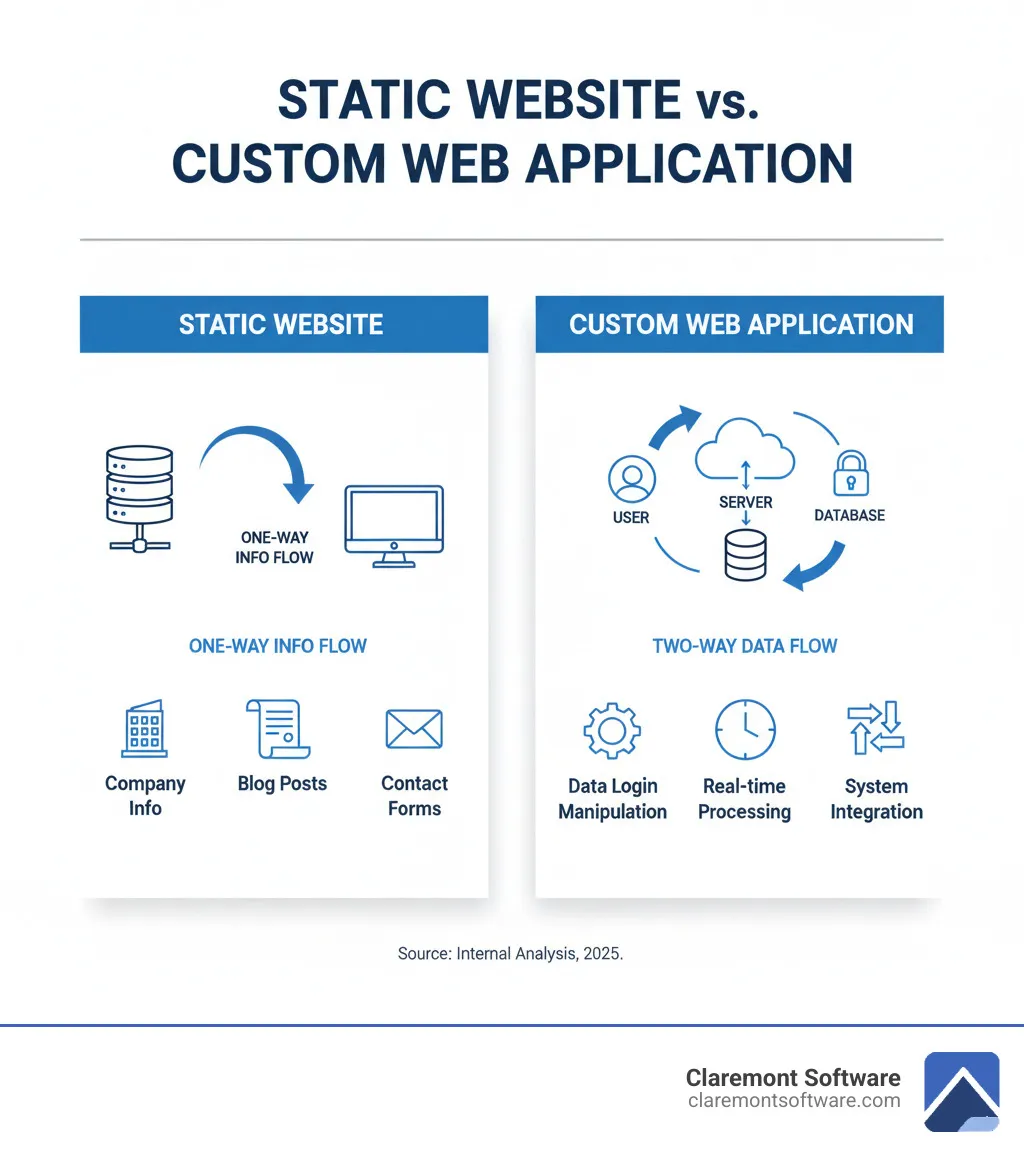
At its core, a web application is interactive software that runs in your browser. Unlike a regular website that just shows you information, a web app lets you do things—enter data, make changes, and see results in real-time. It's software that lives on the internet, accessible from any device.
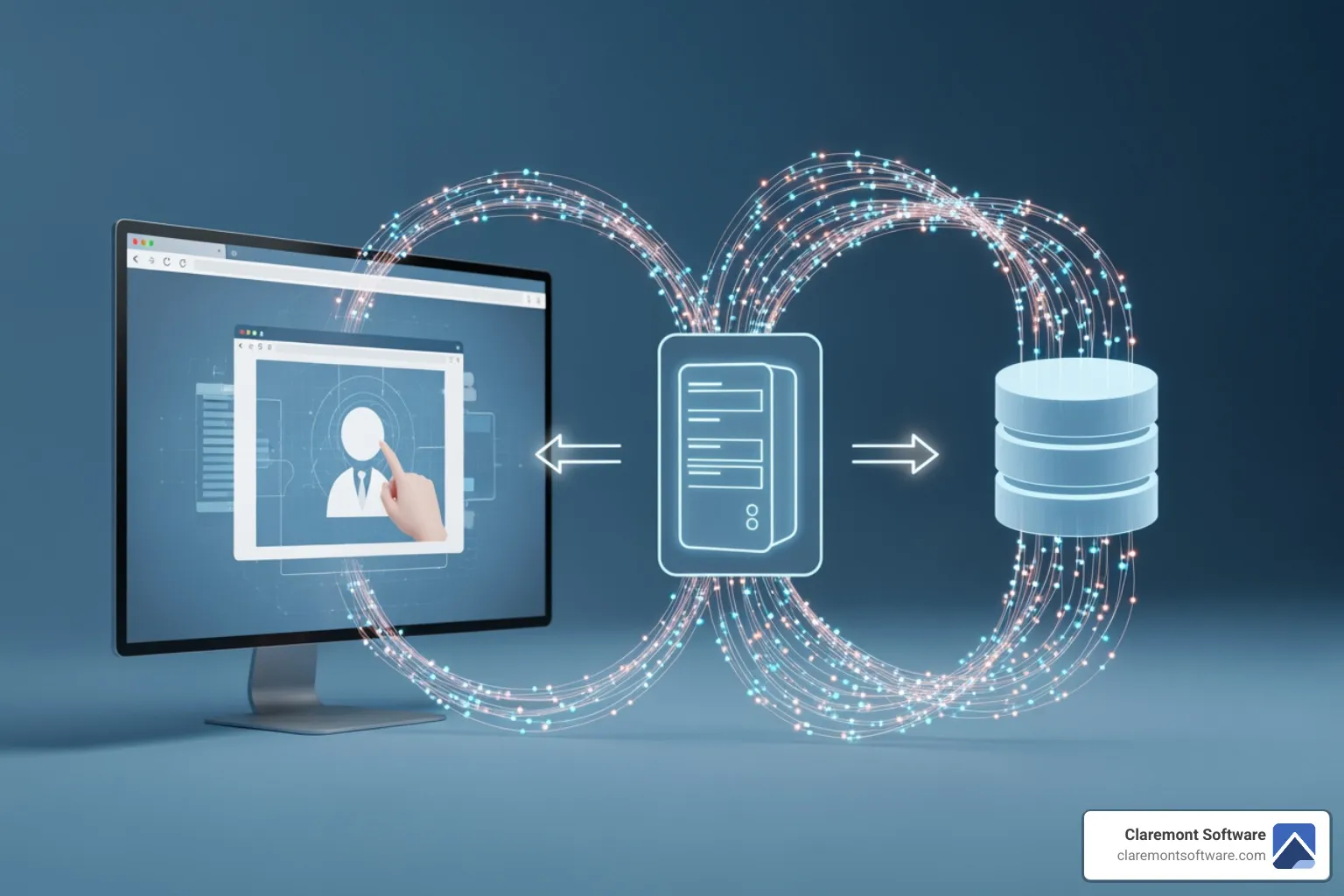
The power lies in the two-way flow of data. A traditional website is a digital brochure; a web application is a conversation. You input information, it processes that data, stores it in a database, and gives you back what you need. For example, a restaurant's website shows a menu, but a custom web application lets customers build an order, schedule pickup, and process payment—all without an app download.
This browser-based accessibility is a game-changer for businesses, allowing teams to access the same tool and real-time data from anywhere, without complex software installations.
If you're wondering how this kind of functionality could transform your online presence, our Web Development services might be exactly what you need.
Custom-Built vs. Off-the-Shelf Software
Every business faces the choice: buy ready-made software or build something custom? Off-the-shelf solutions seem affordable upfront, but they are designed for everyone, which means they're perfect for no one. You'll inevitably pay for features you don't use, miss features you desperately need, and bend your business processes to fit the software's limitations.
Let's break down the real differences:
| Feature | Custom Web Applications | Off-the-Shelf Software |
|---|---|---|
| Cost | Higher upfront investment. Leads to long-term savings by eliminating licensing fees and improving efficiency. | Lower upfront cost, often subscription-based. Ongoing fees can accumulate, and workarounds may lead to hidden costs. |
| Features | Built precisely for your unique business needs. No extraneous features, no compromises. | Generic functionality for a broad audience. May lack critical features or include unnecessary ones. |
| Scalability | Designed to grow with your business. You control when and how it scales. | Scalability is tied to the vendor's pricing tiers and can become expensive or limited. |
| Integration | Built to connect seamlessly with your existing systems, ensuring data flows exactly as you need it to. | Integration capabilities are predefined and may be complex, costly, or impossible with your unique systems. |
| Control | Full control and ownership over features, updates, and intellectual property. | The vendor dictates the roadmap, features, and updates. You are dependent on their support and decisions. |
Yes, custom web application development requires a larger upfront investment. But you're buying software that fits your business perfectly. You own it completely—the code, the features, and its future. When you control the software, you control your destiny.
The Business Case for Customization
Businesses across Lake County, from Gurnee to Libertyville, are investing in custom web application development because the right technology transforms operations.
- Increased efficiency: Automate repetitive tasks like data entry, report generation, and customer notifications. We've seen custom solutions cut processing time from hours to minutes, freeing your team to focus on growth.
- Better customer experiences: Create the exact features your customers need, like a specialized product configurator or a self-service portal. This thoughtful customization leads to higher engagement and better conversion rates.
- Competitive advantage: Offer something genuinely unique that your competitors can't buy off the shelf. A custom application can become a moat around your business.
- Scalability: A custom app is designed from day one to handle your growth. It adapts as your business evolves, without expensive migrations or rebuilds.
- Data-driven insights: Capture the exact information you need and integrate it with existing systems for a complete picture of your operations. This allows you to make decisions based on the right data.
Making these strategic technology decisions requires expertise. Our Consulting & Strategy services help you determine how custom solutions can deliver the best return for your business goals.
Common Types of Custom Web Applications
What can you build? The answer is almost anything your business needs. Here are some of the most common solutions we create:
- E-commerce platforms: Go beyond templates to handle complex pricing, integrate with multiple warehouses, or support unique sales workflows and checkout experiences.
- Customer portals: Give clients self-service tools to track orders, manage subscriptions, download documents, and submit support requests in one place. This reduces your support calls and empowers your customers.
- Internal business tools (CRM/ERP): Instead of adapting your process to a generic tool, build one around how your business actually works—from sales pipelines to inventory management.
- Content management systems (CMS): A custom CMS gives your marketing team the exact tools they need to manage your website's content, without the clutter of off-the-shelf options.
- Booking and scheduling systems: Manage reservations, appointments, or rentals with an application that enforces your specific rules and integrates with your payment processor.
- Data management and reporting tools: Turn information chaos into actionable insights by capturing data from multiple sources and presenting it in dashboards that make sense to your team.
- Industry-specific solutions: Address unique challenges in sectors like healthcare (HIPAA-compliant systems), finance (secure compliance tools), or logistics (real-time tracking).
The Blueprint: Your Custom Web App Development Journey
Starting a custom web application development project is like building a house: you need a blueprint. We follow a proven, step-by-step process called a Software Development Lifecycle (SDLC). Specifically, we use an Agile methodology, working in iterative cycles. This means we build features in manageable chunks and get your feedback regularly, ensuring the final product matches your evolving needs.
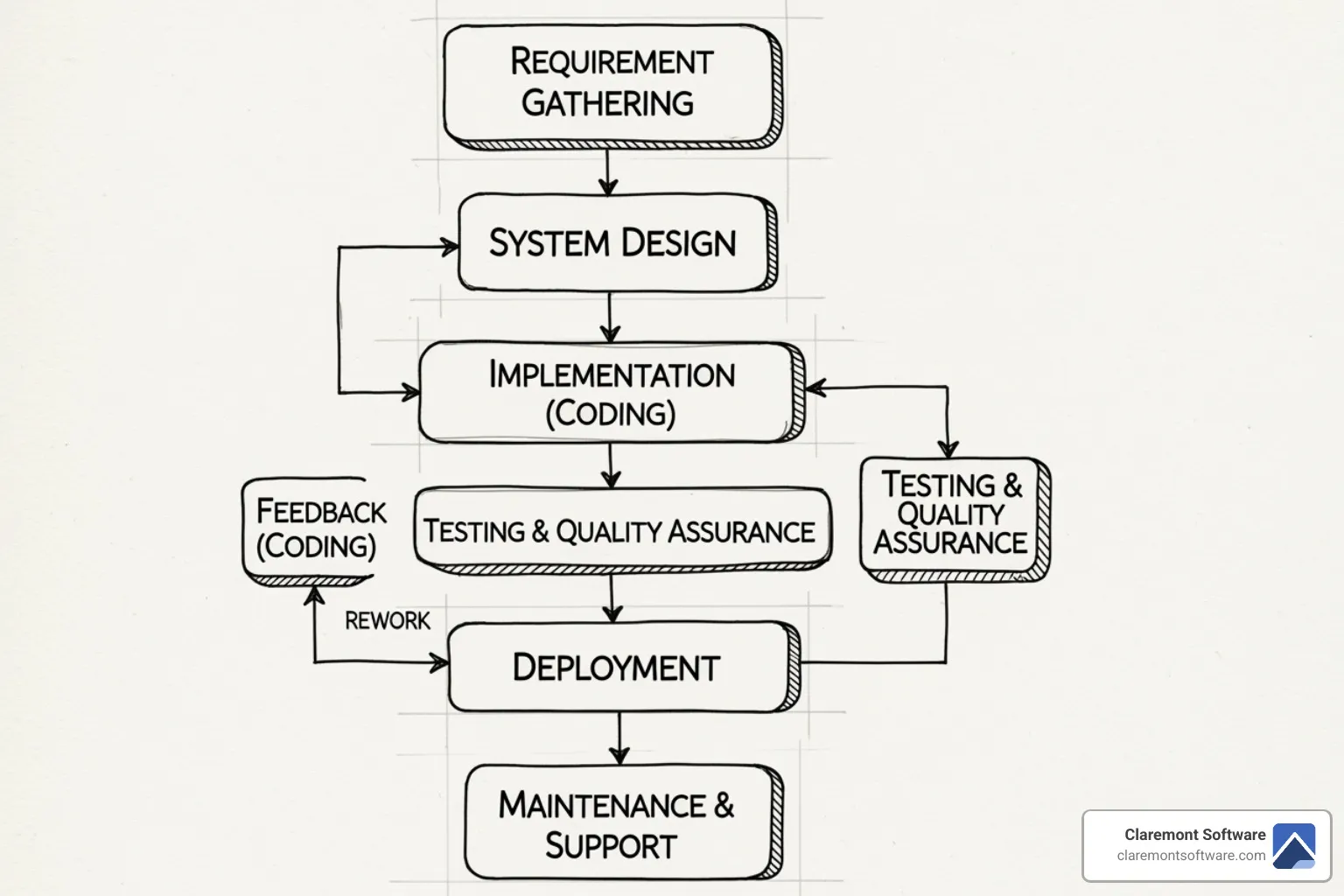
The Core of custom web application development: The Process
Our approach to custom web application development follows six key stages, taking your project from idea to a working, revenue-generating application.
- Planning & Findy: This is where we dive deep into your business goals, user needs, and technical requirements. We map out user stories and create a clear project plan with realistic timelines and budget estimates. Rushing this stage is a recipe for failure.
- UI/UX Design: We ensure your application is not just functional but also intuitive and enjoyable to use. We create wireframes, mockups, and interactive prototypes so you can experience the user journey before any code is written. This user-centric approach saves time and money by catching issues early.
- Development: Our developers build the front-end (what users see) and the back-end (the server, database, and logic). Using agile sprints, we develop features iteratively, so you can see progress regularly and provide feedback that shapes the next cycle.
- Testing & QA: Your application undergoes rigorous testing to ensure it's stable, secure, and performs well under load. This includes unit testing, integration testing, and security vulnerability checks. You participate in user acceptance testing (UAT) to verify it meets your business needs.
- Deployment: This is launch day. We move your application from our development environment to a live server where users can access it. We set up the necessary infrastructure and ensure a smooth, secure transition.
- Maintenance & Support: Our partnership doesn't end at launch. We provide ongoing monitoring, bug fixes, security updates, and improvements to ensure your application remains a valuable asset. Learn more about our Maintenance & Support services.
The Crucial Role of UI/UX Design
A beautiful interface is useless if users can't figure out how to use it. That's why we focus on both User Experience (UX) and User Interface (UI).
- User Experience (UX) is about the overall effectiveness of the application. Can users accomplish their goals easily? Does the workflow make sense? We ensure the design aligns with how your team or customers actually work.
- User Interface (UI) is the visual and interactive elements—buttons, colors, and layout. Good UI reinforces your brand and builds trust.
Through wireframing, prototyping, and usability testing, we create an application that is intuitive and engaging. A well-designed UI/UX directly impacts productivity, customer satisfaction, and your bottom line.
Key Considerations: Simple vs. Complex Applications
Understanding what makes an application simple versus complex helps set realistic expectations for scope, timeline, and budget.
- Functionality: A simple app might handle basic data entry. A complex one could involve intricate workflows, real-time data processing, and advanced analytics.
- Third-party API Integrations: Does your app need to connect with other systems like payment gateways (Stripe), CRMs, or shipping carriers? Each integration adds complexity.
- Scalability: An app for 10 internal users has different requirements than a portal for thousands of customers. We design for future growth from the start.
- Browser and Device Compatibility: Ensuring a flawless experience across different browsers (Chrome, Safari) and devices (desktops, tablets, phones) requires additional development and testing.
- Data Complexity: The structure and volume of data your application handles significantly impact development. A simple database might store contacts, while a complex one could manage an entire supply chain.
The Tech Stack: Building Blocks of Your Application
A tech stack is the combination of programming languages, frameworks, and tools used to build your application. It's the foundation and framework of your digital solution. Every web application has two main parts: the front-end (client-side), which is what users see and interact with in their browser, and the back-end (server-side), the behind-the-scenes engine that handles logic, data, and security.
Choosing the right tech stack is a critical decision that affects your application's speed, scalability, and long-term maintenance. There's no one-size-fits-all answer; the best stack depends on your specific project goals.
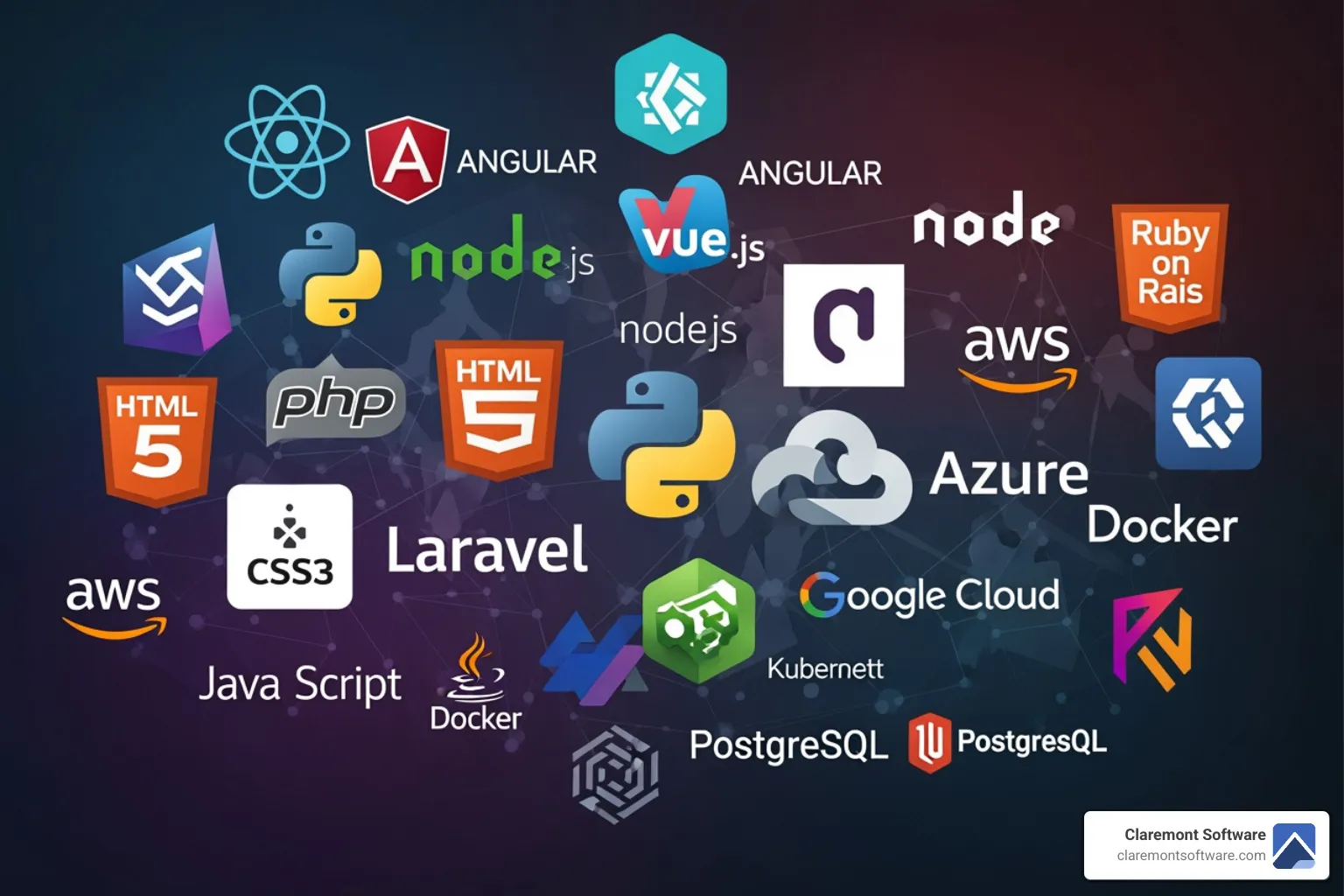
Key Technologies in custom web application development
We use a variety of modern technologies to build powerful and reliable web applications.
Front-end frameworks speed up development and ensure a responsive user interface.
- React: Developed by Facebook, its component-based structure is perfect for complex, single-page applications that require fast, smooth interactions.
- Angular: A comprehensive framework from Google, ideal for large-scale, enterprise-level applications that demand a structured and maintainable codebase.
- Vue.js: Known for its simplicity and flexibility, Vue is great for both integrating into existing projects and building new applications from scratch.
Back-end frameworks handle server logic, database interactions, and user authentication.
- Django: A high-level Python framework with a "batteries-included" philosophy, excellent for building complex, database-driven websites quickly.
- Laravel: A popular PHP framework that simplifies common tasks, allowing for the rapid development of robust and maintainable web applications.
Databases store your application's data. We choose between relational databases (like MySQL or PostgreSQL) for structured data with clear relationships, and NoSQL databases (like MongoDB) for unstructured data and massive scalability.
Our Backend Development services focus on implementing the most suitable stack to power your application efficiently and securely.
Hosting and Deployment Solutions
Once built, your application needs a place to live. Web applications are hosted on remote servers, making them accessible from anywhere.
Cloud hosting is the modern standard, offering scalability, reliability, and security. We primarily work with leading providers:
- Amazon Web Services (AWS): The market leader, offering a vast range of services that provide virtually unlimited and flexible server capacity to handle any traffic level.
- Google Cloud: A comprehensive platform known for its strong infrastructure and flexible pricing models.
While some businesses opt for on-premise hosting for total data control, it comes with higher costs and maintenance burdens. Our deployment strategies often involve CI/CD (Continuous Integration/Continuous Deployment) pipelines, which automate testing and updates for faster, more reliable releases.
Our DevOps & Deployment services ensure your application launches smoothly and performs optimally.
Ensuring Long-Term Success with Custom Web Application Development
Launching your custom web application isn't the finish line; it's the starting point. Like any valuable asset, it requires ongoing care to thrive. A robust post-launch strategy, including continuous improvement and proactive management, is what separates a successful application from one that becomes an outdated liability.
We believe in building long-term partnerships. Our commitment extends far beyond deployment. Our Maintenance & Support services are designed to keep your application running smoothly, securely, and efficiently for years to come.
Security and Scalability
Security and scalability are the twin pillars that support a successful application. Without them, even the most innovative app can become a liability.
Security is built in from the ground up. Web applications are constant targets, so we implement robust measures to protect your data and users. We defend against common threats like SQL Injection and Cross-Site Scripting (XSS) by following industry best practices:
- Data encryption to make intercepted data unreadable.
- Strong user authentication and authorization to ensure users are who they say they are and can only access appropriate data.
- Regular security audits and patching to defend against evolving threats.
For businesses in regulated industries, we can build applications to meet strict standards like HIPAA compliance for healthcare or financial regulations for risk management.
Scalability ensures your application can grow with your business. A scalable architecture handles increasing users, data, and features without grinding to a halt or requiring expensive rebuilds. We design with modular components and conduct load testing to simulate high traffic, ensuring your app performs reliably under pressure. Leveraging cloud hosting like AWS or Google Cloud provides inherent scalability, allowing resources to adjust as your demand changes.
Version Control, Bug Tracking, and Maintenance
Every piece of software has bugs; what matters is how they are managed. A systematic approach to maintenance is key to long-term stability.
- Version Control: We use systems like Git to track every code change. This allows multiple developers to work collaboratively and enables us to quickly identify and roll back changes if an issue arises.
- Bug Tracking: We follow a systematic process for defect management. When a bug is found, it's categorized by severity, assigned to a developer, fixed, and then verified by testers. This ensures a stable and reliable application.
- Scheduled Maintenance: Proactive maintenance is like preventive medicine for your app. It includes regular software updates, security patches, and performance optimizations to prevent unexpected downtime and keep your application fast and secure.
Continuing to work with the original development company for maintenance is highly efficient, as we are already intimately familiar with your codebase.
Frequently Asked Questions about Custom Web Applications
How does a custom web application differ from a standard website?
The core difference is interactivity. A standard website primarily delivers content one-way, like a digital brochure. A custom web application is interactive software that runs in a browser. It allows users to perform tasks, manipulate data, and engage in complex workflows (creating, reading, updating, and deleting information). Think of it as a dynamic tool, not just a static page.
How much does a custom web application cost?
This is like asking, "how much does a house cost?" The price of custom web application development varies widely based on the complexity of features, the technology stack, and the development timeline. A simple application might start in the tens of thousands of dollars, while complex enterprise solutions can cost significantly more.
While the upfront investment is higher than off-the-shelf software, custom apps often lead to significant long-term savings by eliminating licensing fees and boosting efficiency. We recommend an initial findy or "Architectural Framework" phase, typically ranging from $4K to $12K, to create a detailed project plan and provide an accurate budget estimate before full development begins.
In which industries are custom web applications most beneficial?
Nearly every industry can benefit, but some see dramatic advantages, especially those with unique workflows or strict compliance needs.
- Healthcare: Custom apps are essential for managing patient data, scheduling, and ensuring HIPAA compliance.
- Finance: Specialized tools are needed for risk management, fraud detection, and regulatory compliance where security is paramount.
- E-commerce and Retail: Custom platforms provide a competitive edge with personalized shopping experiences, complex inventory management, and unique pricing rules.
- Logistics and Automotive: Custom systems are ideal for fleet management, real-time tracking, and supply chain optimization.
- Education: Custom e-learning platforms and student portals can be custom to specific curricula and administrative processes.
Any business with unique workflows that are constrained by off-the-shelf software is a perfect candidate for a custom solution. It's about making technology serve your business, not the other way around.
Conclusion
Throughout this guide, we've explored how custom web application development is more than just acquiring software—it's about crafting the right software, built specifically for your business goals.
Are you wrestling with off-the-shelf solutions that don't quite fit? Are manual processes draining your team's energy? These aren't just inconveniences; they're opportunities waiting to be opened up.
A custom web application is a strategic investment that pays dividends. By automating workflows, you free your team to focus on growth. By offering a custom customer experience, you increase conversions. By building a scalable solution, you create a sustainable asset that grows with you, free from vendor limitations.
At Claremont Software, we serve businesses in Gurnee, Libertyville, and throughout Lake County, IL, with this exact philosophy. Your digital tools are investments that must deliver measurable returns. Our approach focuses on converting visitors into customers and preventing lost revenue, ensuring your custom solution pays for itself and drives future growth.
You now have the knowledge to make informed decisions about your business's digital future. Building a custom application is about creating a unique competitive advantage, empowering your team, and setting your business up for long-term success.
We're here to help you take that next step. Whether you're exploring possibilities or ready to build, let's discuss your vision.
Contact us to discuss your project today for a free consultation. Let's create something remarkable together.